
From Signal to Decision in 60 Minutes: How We Built an Operating System for Corporate Crises
Most companies do not lose a crisis in the first statement. They lose it in the hour before anyone decides anything. RepuCrisis OS turns a detected signal into a step-by-step response protocol, with a person making every final call.
Most companies do not lose a crisis in the first statement. They lose it in the hour before anyone decides anything.
A post appears in a local Telegram channel. A blogger records a video about a product failure. A competitor seeds an anonymous "investigation". Someone in the company sees it. Then the questions begin: is this serious, who should know, do we answer, who answers, and when. While those questions travel up the hierarchy, the story travels faster.
Over more than 25 years in corporate communications, I have watched this hour decide the outcome far more often than the quality of any press release. Together with Professor Dmytro Oltarzhevskyi and colleagues at the Vasyl Stefanyk Carpathian National University, we turned that observation into a method, and then into a working tool: RepuCrisis OS, a decision-support system for crisis headquarters and reputation analytics.
The goal is simple to state. A detected signal should become a clear, step-by-step response protocol within one hour, and a person, not an algorithm, should make every final decision.
You can try the system yourself: open the interactive RepuCrisis OS prototype on Industry Pulse.
The Problem Is Speed of Decision, Not Speed of Monitoring
Monitoring tools are good at finding mentions. They are much worse at telling a management team what to do with them.
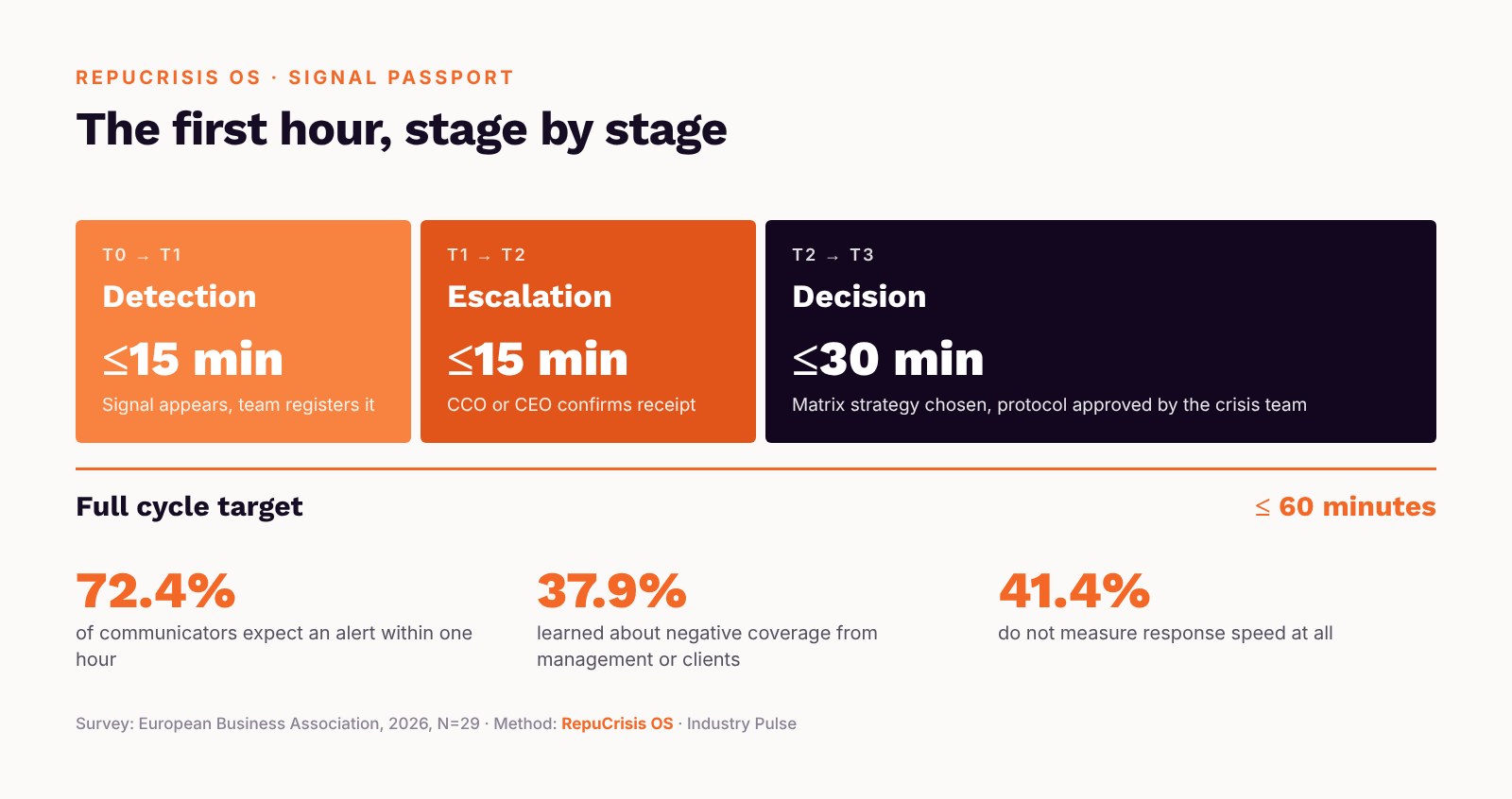
A 2026 survey of communicators conducted with the European Business Association (N=29) shows the gap clearly. Seven in ten respondents (72.4%) expect to be alerted to a significant signal within an hour. Yet 37.9% admit they learned about negative coverage from their own management or from clients, not from their monitoring. And 41.4% do not measure their response speed at all.
In other words, many teams have data but no protocol. RepuCrisis OS is built to close exactly that gap.
Three Matrices Instead of Intuition
At the core of the method are three decision matrices. Each answers one question that crisis teams usually answer by instinct.
Matrix 1: Where does the signal come from, and what does it touch? It separates problems caused by the company's own actions from those caused by external factors, and measures their impact on core operations. The answer sets the direction of effort: change what the company does, change how it is perceived, or both.
Matrix 2: How should we communicate? It selects the communication strategy, from proactive disclosure to targeted reactive communication with the community, or a deliberate, justified silence when speaking would only amplify a weak signal.
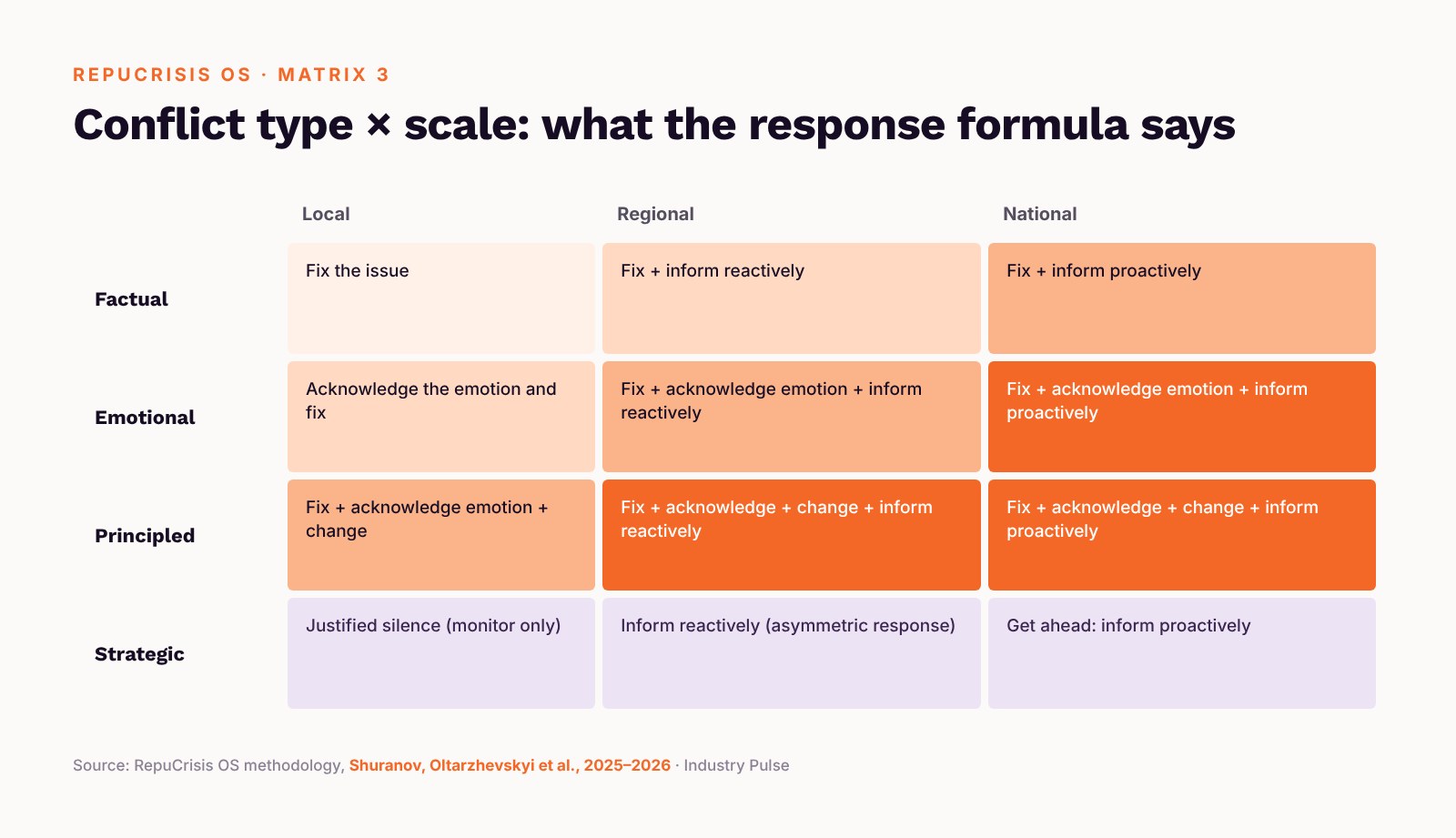
Matrix 3: What kind of conflict is this, and how big? A 3×4 grid crosses four conflict types (factual, emotional, principled and strategic) with three scales (local, regional and national). A factual dispute with a few residents and an emotional wave across national media need entirely different people, channels and tone.
On top of the matrices sits the dynamics of the crisis. Following Seymour and Moore, we distinguish the "cobra", a sudden crisis that demands immediate concentration of resources, from the "python", a slow, cumulative pressure that tightens over weeks and is easy to underestimate.
Every Signal Gets a Passport
The second element is discipline around time. Every significant signal receives a passport with timestamps for each stage:
- Detection: from the moment the signal appears to the moment the team registers it, with a target of 15 minutes or less.
- Escalation: from registration to the CCO or CEO, also 15 minutes or less.
- Decision: from escalation to an approved headquarters decision, 30 minutes or less.
The full cycle should fit into 60 minutes. Because every stage is recorded, the team can see exactly where time was lost. In one of our test cases, an internal discussion about working conditions took 68 minutes, and the passport showed the delay sat at the decision stage, not in monitoring. That is the kind of insight that changes how a company organizes itself before the next crisis.
The passport also records the outcome. Did the correct message actually reach the audience? Was silence the right choice? This turns each incident into a learning record, not just a memory.
Measuring What Communication Actually Achieved
The third element is evaluation. RepuCrisis OS combines two recognized frameworks: the AMEC Integrated Evaluation Framework and the RepTrak reputation model.
The assessment works on three levels. The first is outputs: how many publications, what reach, what share carried the key message, what tone. The second is outtakes: how stakeholders actually perceive the company, measured through trust, admiration and good feeling. The third is outcomes: what changed for the business.
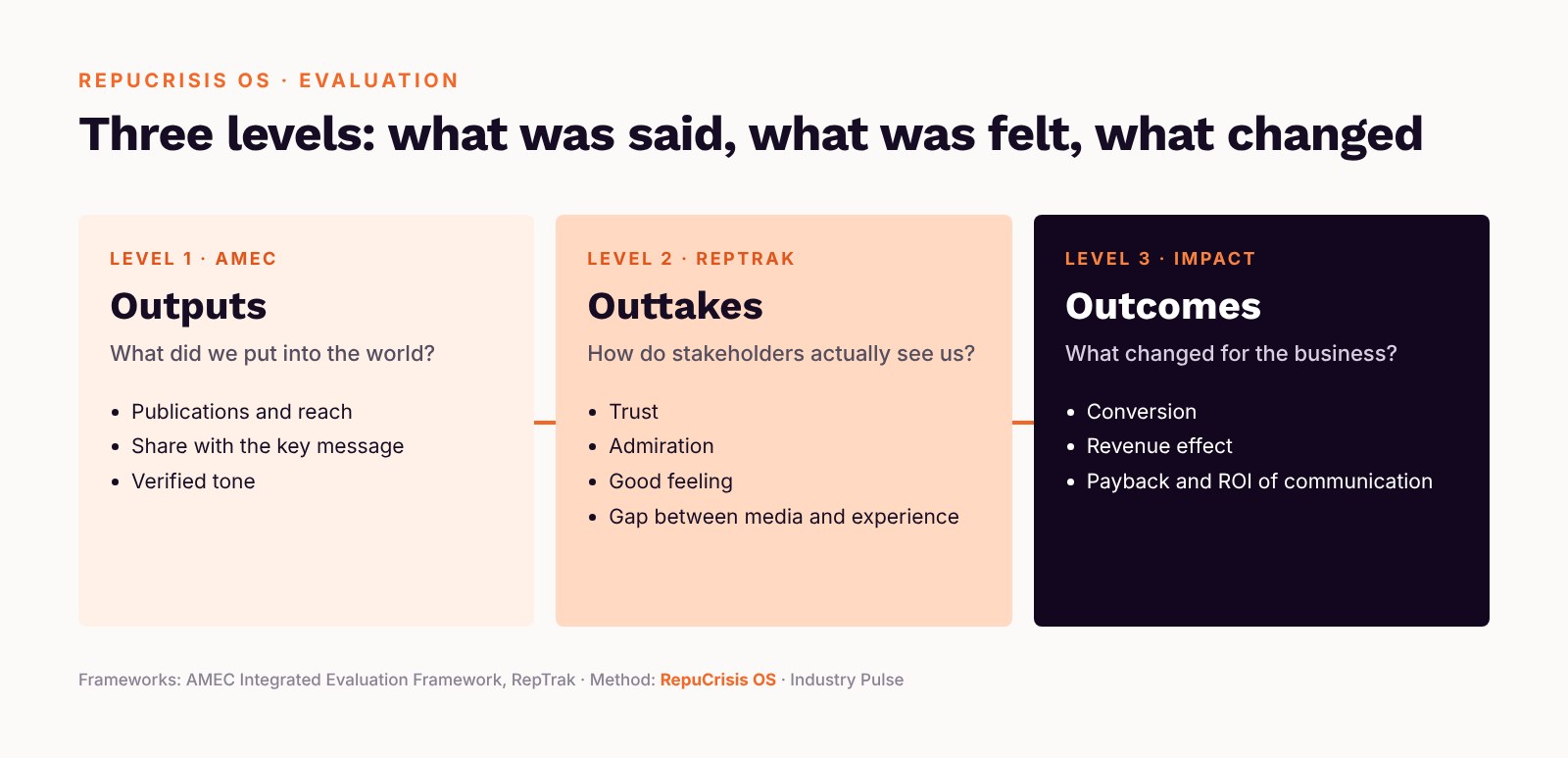
Comparing the levels often reveals what single metrics hide. A company can have favorable media coverage while the people who deal with it every day feel quite differently. That perception gap is often where the next crisis is born.
AI Assists, People Decide
We use AI where it is strong: sorting signals, classifying them, and proposing a scenario based on the matrices. Every assessment is then verified by a person. This human-in-the-loop principle is consistent with the Barcelona Principles 4.0 for communication measurement, and in crisis work it is not optional. A model can recognize a pattern; only management can take responsibility for a decision.
Where the System Stands Today
RepuCrisis OS is a university spin-off developed under the Triple Helix model of cooperation between university, business and government. The current version is a working prototype at technology readiness level 6, demonstrated in a relevant environment, with a simulator that walks teams through realistic cases: a local conflict near a facility, a viral blogger post, accusations of product safety issues, and a competitor's information attack.
We see three groups that need this first: companies of 100 or more employees in fintech, telecom, retail, energy and agribusiness; mid-sized businesses that do not have their own crisis department; and local communities and municipal enterprises that need to respond to disinformation quickly.
The Full Story: Try RepuCrisis OS Yourself
The complete concept is published on Industry Pulse as an interactive prototype: all three matrices, four real-life crisis simulations, the signal passport with its timeline, the RepTrak and AMEC assessment and the business model behind the system.
Open the full RepuCrisis OS concept (interface in Ukrainian).
The Main Lesson
Crises rarely give a company a second hour. The organizations that come through them well are not the ones with the most eloquent statements. They are the ones that know, before anything happens, who sees the signal, who decides, by when, and on what basis.
A method cannot prevent every crisis. But it can make sure the first hour is spent deciding, not searching for someone who can.

Senior Editor, Corporate Communications & PR
Mikhail Shuranov is one of Ukraine's most experienced communications and corporate affairs executives, with more than 25 years of leadership experience across telecommunications, consumer brands, investment groups, and strategic communications.