
Three Trends Shaping the Development of PR in Ukraine Today
Mykhailo Shuranov, PR Director of NEQSOL Holding in Ukraine, examines how uncertainty, compliance, and artificial intelligence are reshaping communications practice in Ukraine today.
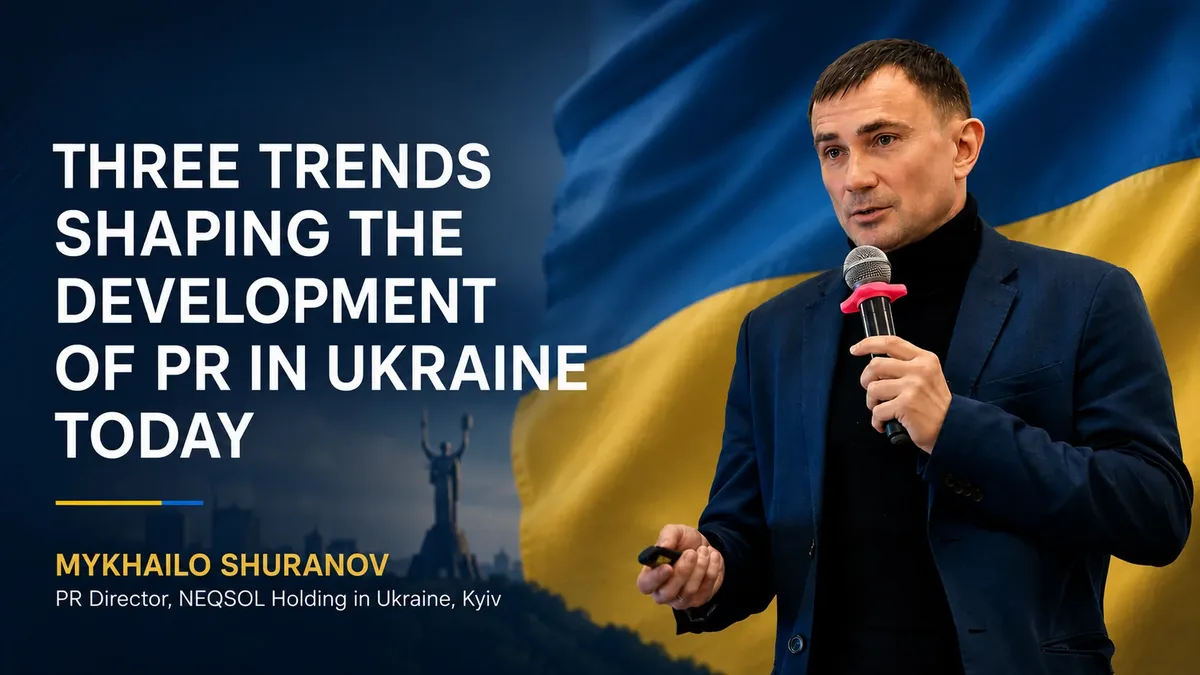
By Mykhailo Shuranov, PR Director of NEQSOL Holding in Ukraine, Kyiv.
This article was originally published in the Ukrainian professional magazine Marketing & Advertising ("Маркетинг і реклама"), Issue No. 5–6 (320–321), May–June 2026. This English-language version is published by Industry Pulse with the author's permission.
When answering questions about communications planning, reputational risks, and the role of new technologies, I identified three key trends that, in my view, have the greatest influence on the PR profession in Ukraine today.
First, communications are moving away from a predictable planning model toward a model of managing uncertainty. While only a few years ago, a ratio of 80% planned work to 20% situational work was considered normal, today the balance is approaching 50–50. The war, regulatory changes, and the rapid transformation of the business environment are forcing companies to develop not one plan, but several possible scenarios.
Second, compliance and transparency are becoming the foundation of reputation. Most serious reputational crises today are caused not by communications mistakes, but by problems within organizations' actual operations. This is why international investors and major companies are paying increasing attention to corporate governance, compliance, and transparency in decision-making.
Third, artificial intelligence is becoming not only a tool, but also a new communications audience. Today, AI helps collect information, analyze risks, and model scenarios. However, companies already need to think not only about what people will read about them, but also about how artificial intelligence systems will perceive them. Alongside SEO, a new field is emerging: GEO, or Generative Engine Optimization, which involves managing a brand's digital reputation within the generative search environment.
It is through the lens of these three trends that I would examine the current practice of PR in Ukraine.
1. Uncertainty as the Main Factor in Communications
The primary factor today is uncertainty. Moreover, it is connected not only with the war and security risks, but also with changes in the regulatory environment, which often occur rapidly and are not always predictable for businesses.
At the same time, Ukrainian companies are increasingly focusing on business resilience. While communications may previously have claimed the role of a driver of certain changes, today the PR function is primarily expected to support key business priorities: maintaining trust, ensuring stable relationships with stakeholders, and protecting reputation under conditions of constant challenges.
In effect, communications are becoming one of the tools used to ensure business resilience, while the task of communications teams is no longer limited to promotion. It also includes supporting an organization's ability to operate effectively amid continuous change.
2. Transparency, Compliance, and Reputational Crises
When speaking specifically about reputational crises, the key factor remains a lack of business transparency and a failure to align operations with the principles of compliance and corporate governance.
In today's world, information spreads extremely quickly, and any discrepancy between a company's public statements and its actual actions will sooner or later become public. For this reason, most serious reputational crises today arise not from mistakes made by communications teams, but from management failures.
This is precisely why major international investors pay such significant attention to compliance. At NEQSOL Holding, for example, adherence to international compliance and corporate governance standards is one of the main priorities both at the group level and in every country where the holding operates.
For international investors, compliance is not merely a regulatory requirement. It is an important instrument for managing risks, protecting investments, and ensuring long-term reputational resilience.
In my opinion, reputation today increasingly depends not on how effectively a company communicates, but on how consistently it follows its own principles of doing business.
3. From Annual Plans to Alternative Scenarios
While a ratio of 80% planned work to 20% situational work could previously have been considered normal, today the balance has moved closer to 50–50.
When communications are viewed through the PESO model, owned channels provide the highest degree of predictability. Through these channels, an organization has full control over both the content of its messages and the timing of their distribution.
A relatively high degree of planning is also possible in shared channels, where a company interacts with its communities and audiences. Although the reactions of community members cannot always be predicted, the organization still has considerable influence over the communications process.
In paid communications, a company can secure planned placements and guarantee the delivery of its message to specific audiences. However, even commercial cooperation cannot guarantee the expected response. Practice shows that an audience's perception of a message may differ significantly from forecasts and often requires additional communications efforts or adjustments to the message itself.
Results are most difficult to predict in earned media because they depend on a large number of external factors: the editorial policies of media outlets, the current news agenda, the positions of other stakeholders, and the broader social context.
In general, we are always better at planning our own actions than at predicting how stakeholders will respond to them. This is why modern planning increasingly resembles the preparation of alternative scenarios rather than the development of a single detailed plan for the year ahead.
4. The Relationship Between Marketing and PR
In my opinion, the interaction between marketing and PR resembles the unity and struggle of opposites.
On the one hand, PR has traditionally been viewed as part of the promotional mix, one of the classic elements of marketing. This is why many marketers tend to see the role of communications primarily as supporting sales and brand development.
On the other hand, modern public relations has long since become a strategic management function. It encompasses not only consumers, but also investors, employees, government authorities, communities, and other stakeholder groups.
At the same time, PR professionals must not lose touch with business reality. No matter how strategic the communications function may be, it must help the organization achieve its business objectives every day.
5. Risk Management in an Increasingly Digital Environment
Fundamentally, the methods remain unchanged. They include risk analysis, risk prioritization, and the assessment of both the probability of occurrence and the potential impact on the organization's operations.
Proactive engagement with stakeholders, systematic analysis of the external and internal environment, and the continuous monitoring of change remain the foundation of effective planning.
However, the implementation of these approaches is becoming increasingly digital. Artificial intelligence is already being actively used to collect information, monitor the information environment, analyze risks, develop possible scenarios, and assess their potential consequences.
In other words, the tools are changing, but the underlying logic of risk management remains the same.
6. Artificial Intelligence as a Tool and a New Audience
Artificial intelligence currently performs several roles within communications teams. It helps collect and organize information, conduct preliminary analysis, formulate alternative perspectives on a problem, and prepare initial conclusions.
In effect, AI has already become an additional analyst within communications teams. At the same time, the final assessment of a situation and the decision-making process remain in human hands.
I have not yet seen fully autonomous implementation of communications activities without a decisive human role, although this will probably become a reality within the next few years.
At the same time, we must recognize another important change: artificial intelligence is gradually becoming a distinct audience in its own right. This is why companies need to work on their presence in the generative search environment in much the same way as they previously worked on SEO.
GEO involves creating a high-quality digital footprint for a company, ensuring the availability of reliable sources of information, maintaining a consistent reputational policy, and producing authoritative content that artificial intelligence systems can use when generating answers for users.
7. Measuring PR Effectiveness at Three Levels
I remain a supporter of the approach originally established in the Macnamara model and later developed by the AMEC professional community.
For my own purposes, I distinguish between three levels of performance indicators.
The first is the operational level. These indicators are measured daily or even in real time and make it possible to monitor the current situation.
The second is the tactical level. These indicators are assessed monthly or quarterly and help determine how effectively the communications strategy is being implemented.
The third is the strategic level. This concerns changes in reputation, levels of trust, and the quality of relationships with stakeholders. Such indicators should be evaluated annually because they demonstrate the real contribution of communications to the resilience and long-term effectiveness of a business.
During periods of uncertainty, operational indicators become more important. However, this should not distract attention from the main objective: strategic reputational results.
They remain the ultimate goal of any system for evaluating PR effectiveness.
---
Originally published in Marketing & Advertising ("Маркетинг і реклама"), Issue No. 5–6 (320–321), May–June 2026. Translated and adapted for Industry Pulse with the author's permission.

Senior Editor, Corporate Communications & PR
Mikhail Shuranov is one of Ukraine's most experienced communications and corporate affairs executives, with more than 25 years of leadership experience across telecommunications, consumer brands, investment groups, and strategic communications.