
Why Your AI Transformation Can Fail — and It's Not the Technology
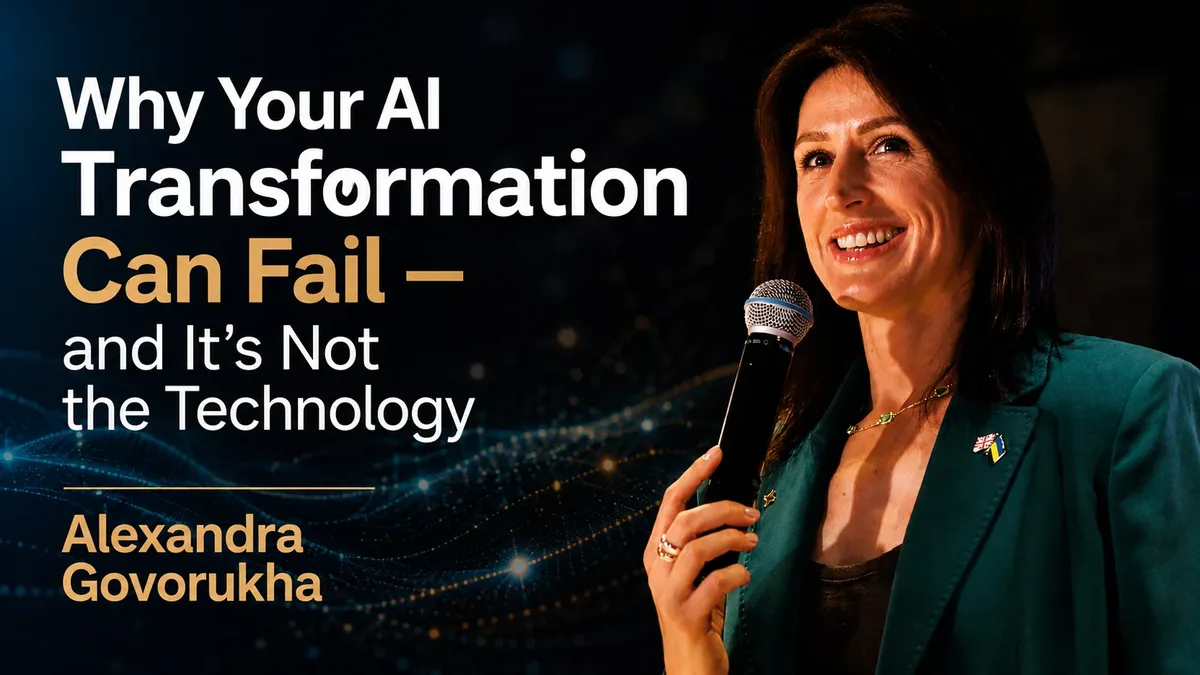
Between 70% and 95% of digital transformation efforts fail — and the cause is rarely technical. Alexandra Govorukha, Ambassador of IT Association of Ukraine in the UK and UAE, Communications Executive, argues that AI transformation succeeds or collapses on communications, not deployment.
This article was first published by Arabian Post.
Between 70% and 95% of digital transformation efforts fail. That's not a technology problem. Boston Consulting Group research reveals roughly 70% of challenges in AI projects stem from people and process issues, not technical ones.
Yet most organisations continue to treat transformation as a deployment challenge, not a communications one.
My Executive Master's in Digital Transformation and Innovation Leadership from IE Business School gave me a front-row seat to how transformations are architected. Studying Strategic Communications at LSE showed me why so many of them still fail. The two disciplines together changed how I advise approaching this problem.
Here's what I see happening on the ground: leadership makes a decision, a transformation team is assembled, a roadmap is built, and technology is procured. Then the announcement goes out — a town hall, a slide deck, an all-hands email. And employees, who were never part of the story, are expected to become part of the solution.
It doesn't work. 54% of employees feel unprepared to handle changes brought by new technologies, and their lack of readiness is a leading cause of resistance and failure.
The real issue is that organisations confuse informing with communicating.
How Does Strategic Communications Help CEOs to Drive Change?
Some leaders think that communication is just a message sent from an organisation to its audience. In reality, it is rather a negotiation of meaning, during which audiences can define, resist, or co-create that meaning.
In the context of AI transformation, your employees are not passive recipients of change. They are an audience with high power and high interest — the group that, according to the power/interest mapping framework, would be placed at the centre of your engagement strategy. These are the people who control daily workflows, institutional knowledge, and — ultimately — adoption. If they don't understand the WHY, no amount of training budget or change management process will compensate.
The Narrative Failure at the Heart of Most Transformations
Organisations that fail at transformation typically commit one of two communications errors:
Telling instead of listening — broadcasting the rationale for transformation without fostering genuine dialogue. The dialogic approach is built on mutual respect, genuine listening, and openness to change. It is demanding precisely because it requires organisations to be vulnerable. To hear what employees are actually afraid of. To acknowledge that the transformation may not yet have all the answers.
Leading with logic and skipping emotion. Behavioural change doesn't happen through information alone. People shift when they are moved. It's when they can imagine a different future for themselves within the story you are telling, not just for the company. A narrative that explains what AI will do to the business, without showing what it means for the individual, will consistently fail to land.
So, What Works: Audience-Centric Transformation Communications
Microsoft's AI transformation offers a useful contrast. Rather than announcing change, Microsoft used structured change management to first build awareness of the problem being solved, then close the communication gaps between leaders, consulting teams, and end users before asking anyone to adopt. They used the ADKAR model to create awareness, gather feedback on communication gaps, and get all layers of the organisation on the same page — ultimately succeeding in shifting the narrative around their product and increasing adoption of complex cloud-based technology.
ADKAR is a change management model developed by Prosci. It stands for five sequential stages an individual must move through for change to succeed:
- Awareness — of the need for change. Why is this happening at all?
- Desire — to support and participate in the change. Awareness alone doesn't create buy-in; people need a personal reason to engage.
- Knowledge — of how to change. Training, processes, tools.
- Ability — to implement the required skills and behaviours in practice. The gap between knowing and doing.
- Reinforcement — to sustain the change. Without it, people revert.
The model's core insight is that organisations typically invest almost entirely in Knowledge (training) and Ability (tools), while skipping Awareness and Desire entirely. That's precisely the communications failure: you can't train people into wanting something they don't understand or trust.
The approach maps directly onto what strategic communications frameworks prescribe: start with context, not solution. Define your most important internal audiences. Understand what they stand to lose and gain. Then build a narrative that transports them — emotionally and rationally — into the future state you are asking them to help build.
A Practical Checklist for CEOs and Chief Transformation Officers
- What is the master plot of your transformation story? (Survival? Growth? Relevance? All three read differently to different audiences.)
- How does your narrative balance rational case (efficiency, competitiveness) with emotional resonance (career security, purpose, pride)?
- Are employees participants in shaping the narrative, or recipients of a finished story?
- Have you mapped internal stakeholders by power and interest — and invested your deepest dialogue where it matters most?
- What does success look like beyond adoption metrics? How will you track attitude and behavioural change over time?
What Is the Business Case Here?
Change management investments yield 5.3x success rates over technology-only approaches, per McKinsey's meta-analysis of 1,200 initiatives. The cost of communications is a multiplier on everything else your transformation budget is trying to achieve.
The organisations that will lead in the AI era are the ones that can take their people with them — honestly, inclusively, and strategically.
That starts with treating internal communication as a discipline, not an afterthought.
About the Author
Alexandra Govorukha is Ambassador of IT Association of Ukraine in the UK and UAE, Communications Executive. She has more than 15 years of international experience in public relations, corporate affairs, reputation management, and B2B communications in the technology industry. Her work focuses on strategic communications, international business relations, technology-sector positioning, and the global promotion of Ukrainian innovation.
She holds an Executive Master's in Digital Transformation and Innovation Leadership from IE Business School and has studied Strategic Communications at the London School of Economics.
---
Originally published by Arabian Post.

Contributing Author — Ambassador of IT Association of Ukraine in the UK and UAE, Communications Executive
Communications & Reputation leader with 15+ years of international experience building and scaling PR and communications functions for technology companies across GCC, UK, Europe, and global markets.