Google, Move Over: How ChatGPT Ads Are Kickstarting the Billion-Dollar Battle for Decision-Making
By Vitalii Yermak · 2026-08-07
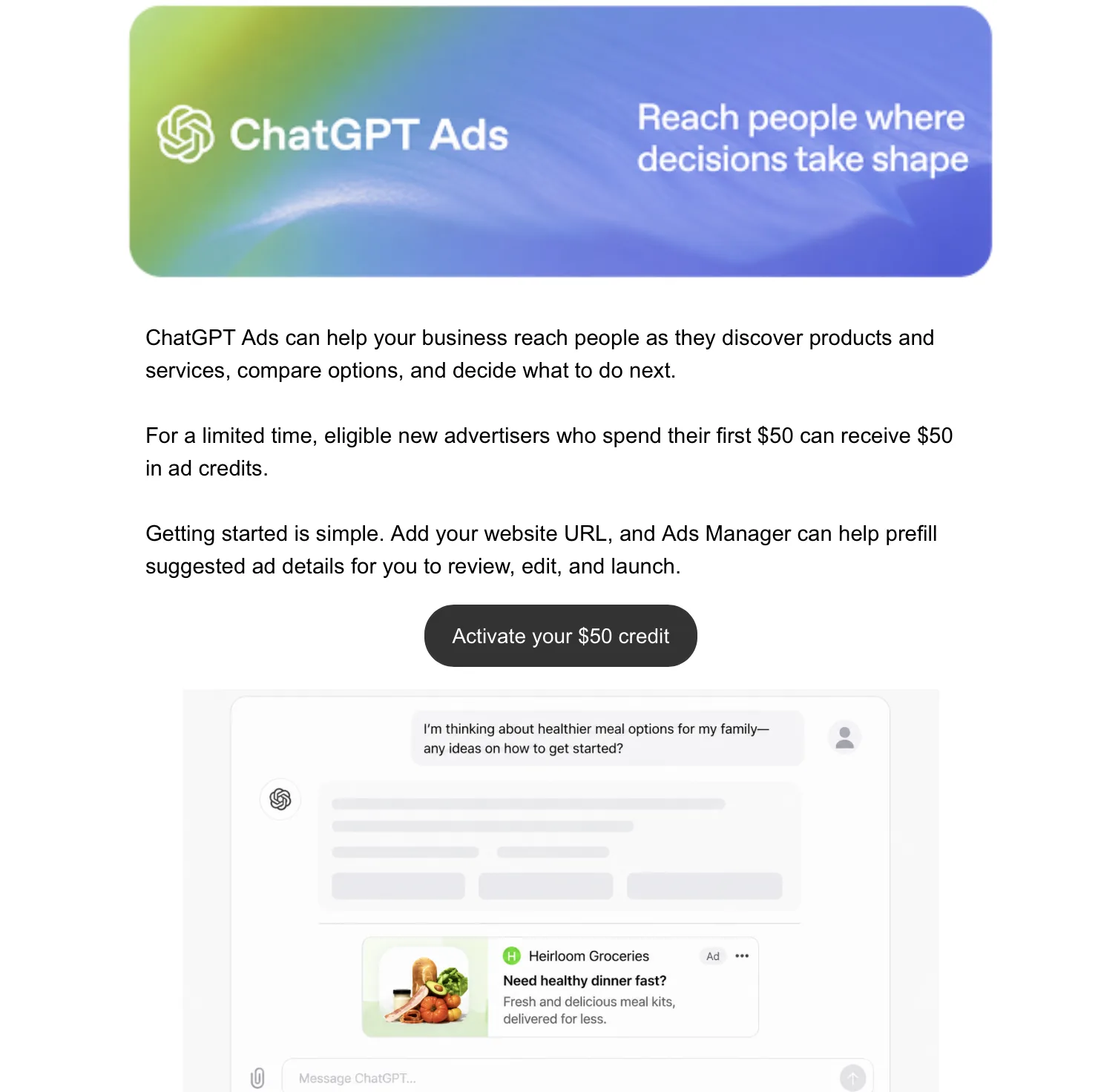
OpenAI has quietly fired a shot at the core of Big Tech's business model. Vitalii Yermak analyses how ChatGPT Ads monetise the consideration phase — and how CMOs should reallocate budgets.
By Vitalii Yermak — Senior Editor & Strategic Communications Expert
Executive Summary
While the industry was debating whether LLMs would replace copywriters, OpenAI quietly fired a shot at the core of Big Tech's business model. An email arrived in my inbox inviting me to test ChatGPT Ads — complete with promotional ad credits. This official rollout closes the chapter on Google Search's absolute monopoly over intent-driven advertising.
This isn't just another ad unit; it is a fundamental disruption of the buyer journey. While Google scrambles to integrate AI Overviews without cannibalizing its traditional link-based ad revenues, OpenAI is monetizing the exact point where modern consumers actually make decisions.
We are witnessing the opening moves of a major reallocation in digital advertising budgets.
Deconstructing the Mechanics: A Native Contextual Knockout
Until now, digital advertising operated on two primary models: demand capture (Google Search, targeting explicit keywords) and demand generation (Meta, targeting behavioral profiles).
ChatGPT Ads introduces a third, highly effective category: native intervention during the consideration phase.
Based on early platform previews and advertiser access, the mechanics differ fundamentally from traditional web ads:
Seamless Intent Matching. Ads do not pop up as annoying side banners, nor do they interrupt the flow of conversation. They appear immediately below an AI-generated answer when a user seeks recommendations or comparisons — for example, a user asks "What are the best healthy meal kit options for a family?" and an ad card for a meal kit service displays right underneath. Structural Separation. OpenAI insists that ad placements do not bias or alter the organic underlying LLM response. However, because the ad card sits directly beneath the AI's synthesis, users perceive it as a natural, highly relevant next step in their decision-making process. * Automated Campaign Creation. Advertisers do not need to build complex ad variations from scratch. Simply inputting a business URL allows the AI-powered Ads Manager to analyze the site and automatically generate suggested headlines, ad copy, and visuals for approval.
The Tectonic Shift in the Marketing Funnel
To understand where ad budgets will flow, marketing leaders must recognize that the traditional funnel is undergoing a major structural transformation.
PHASE 1 — RESEARCH & CONSIDERATION (Google losing share) Platforms: ChatGPT, Perplexity, Claude. User mindset: "Help me analyze, compare, and decide." New format: ChatGPT Ads — influencing choices before the purchase.
PHASE 2 — PURCHASE & TRANSACTION (Google retains dominance) Platforms: Google Search, Amazon, direct URLs. User mindset: "I know what I want; give me the link to buy." Established format: Google SEM / Shopping Ads — capturing the click.
1. The End of Total Google SEM Dominance
Google is not disappearing. For pure transactional queries — such as "buy iPhone 16 Pro" or "emergency plumber near me" — Google remains the undisputed king. Users simply want an immediate link, phone number, or checkout page.
However, Google is losing ground during the exploratory phase. Users no longer want to click through ten SEO-bloated articles to compare products. They want a synthesized answer from an AI assistant. By placing ads directly inside these answer cycles, OpenAI is monetizing the most valuable stage of consumer preference formation.
2. From Static Landing Pages to Conversational AI Agents
The traditional conversion path has always been linear: ad click → landing page → form fill. In an AI-native ecosystem, clicking a ChatGPT ad can route users directly into a brand's custom AI agent. Instead of navigating an external website, users can ask follow-up questions, configure options, and complete inquiries within a real-time dialogue.
Strategic Recommendations: How Business Leaders Should Allocate Budgets
For CMOs, communications directors, and media strategists, this moment requires a balanced tactical roadmap.
1. Protect Your Performance Baseline
Do not impulsively slash existing Google or Meta search budgets. Google Search remains the most reliable engine for capturing high-intent, bottom-of-funnel conversions that sustain immediate revenue.
2. Establish an Early Adopter Experimentation Fund (5–10% of Paid Budget)
The early phase of any ad auction represents an asymmetric opportunity. Similar to Facebook Ads in 2010 or TikTok in 2019, initial competition is low, customer acquisition costs (CAC) are suppressed, and platform algorithms favor early adopters. Testing ChatGPT Ads early allows brands to capture cheap impression share before the market saturates.
3. Synchronize Paid Media with "Artificial Opinion"
As explored in my work on Artificial Opinion, paid placement inside AI interfaces cannot succeed in isolation. If a paid ad unit sits below an organic LLM answer that criticizes your product or brand, the ad spend is wasted. Forward-thinking marketing teams must coordinate Generative Engine Optimization (GEO) with ChatGPT paid ads to ensure organic AI responses and paid placements tell a unified, trustworthy story.
The Publisher Backlash: Monetizing in the Shadows of a Content Crisis
The rollout of ChatGPT Ads comes at a moment of unprecedented tension between AI platforms and content creators. Major media outlets and platforms — including Reddit, USA Today, Politico, and Reuters — are actively threatening to block search crawlers and AI bots. As Google's AI Overviews digest publisher content directly within answer blocks, organic referral traffic for major outlets has plummeted by 18% to 31% year-over-year. Publishers are taking a stand, explicitly refusing to serve as free training data for engines that bypass their websites entirely.
This creates a high-stakes paradox for the advertising industry. While traditional publishers fight to protect their intellectual property and decaying traffic models, OpenAI is building a commercial ad engine on top of that very same synthesized information. For brands, this means advertising inside AI interfaces isn't just a new marketing channel — it is a hedge against the disappearing open web. As users click traditional links less and less, sponsored placements within LLM responses may soon become one of the few remaining ways to guarantee visibility in front of an audience that no longer visits source websites.
Final Thoughts
The launch of ChatGPT Ads is neither an immediate death sentence for legacy search giants nor a quick fix for advertisers. It is the natural commercial evolution of generative AI.
As AI assistants evolve from passive search tools into active decision partners, the brands that learn to communicate — both organically and through targeted ad placements — within these conversational spaces will capture the market. The rest will be left competing for the remnants of traditional search traffic.