The Era of Synthetic Aesthetics: Will Humanity Be Able to Protect Visual Culture, Which Is Being Destroyed by AI?
By Yaroslav Kryzhanivsky · 2026-10-05
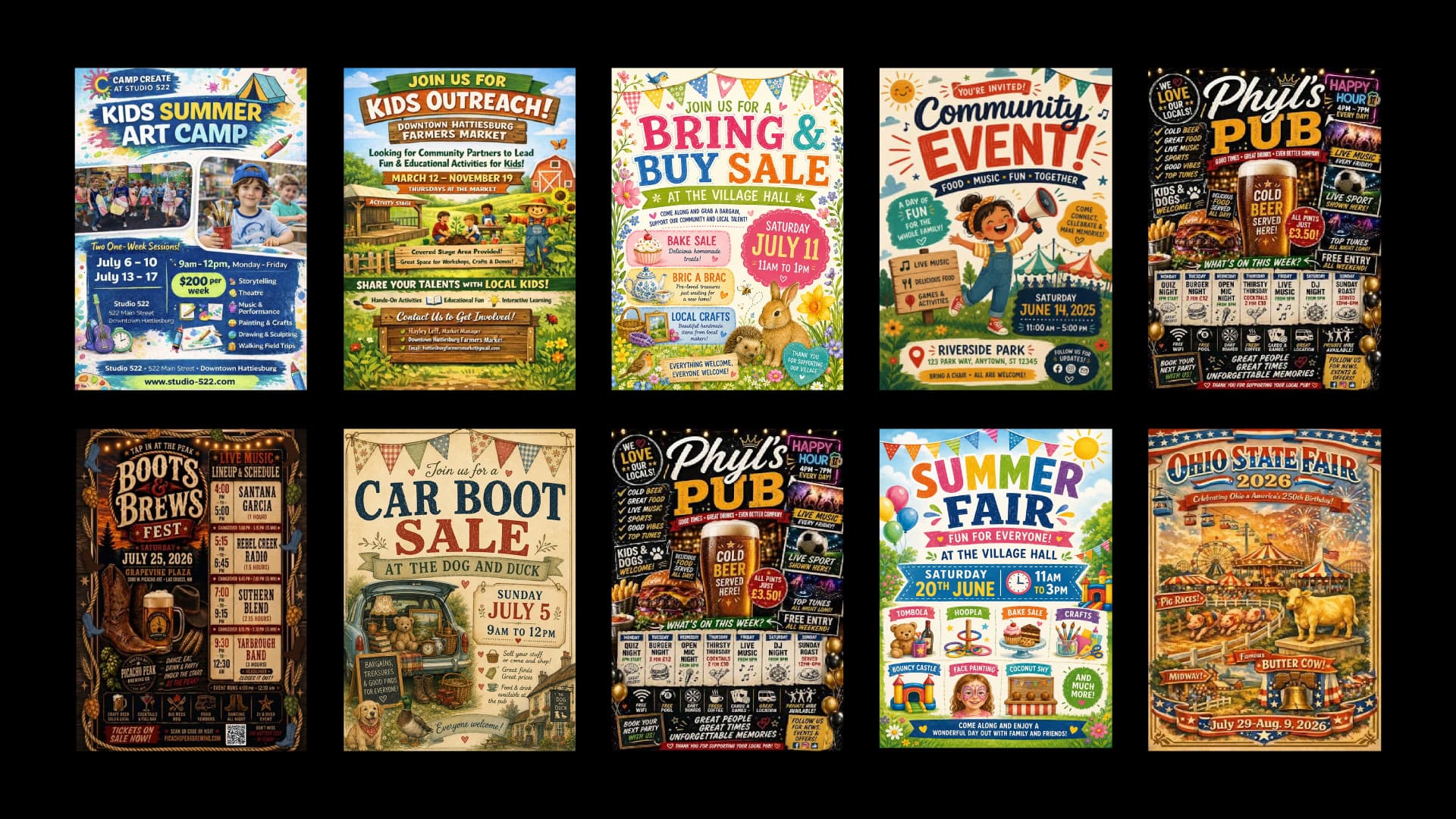
AI-generated design is flooding public space with polished sameness. Yaroslav Kryzhanivsky asks what designers must protect—and how the profession can adapt.
We live in an era of the greatest paradoxes in the history of design. On the one hand, it is an incredibly dynamic time: the tools available to us today would have seemed like magic from sci-fi movies just ten years ago. On the other hand, this dynamic has a reverse, dark side. We find ourselves up to our ears in endless, ubiquitous, and viscous AI slop—content generated by machines for machines, leaving humans on the sidelines.
As a graphic designer, I constantly observe what is happening in the industry, and I can say with confidence: today we are experiencing perhaps the worst period for the design of street communication, playbills and posters, and sometimes even book covers. And the problem is much deeper than just "ugly pictures."
The Epidemic of Sameness
Opening social media feeds, I see the pain of my colleagues every day. Our cities are flooded with generated posters. Playbills for local events, coffee shop menus, posters for literary evenings, stand-ups, and seminars—all of this today looks as if it came off the same assembly line. It’s the default aesthetic from ChatGPT, Midjourney, or Gemini: perfectly polished, symmetrical, with characteristic neon or pastel lighting, an identical icon style, and absolutely soulless, empty graphics.
This uniform layout, where the composition is always predictable, and the typography mostly falls apart (because algorithms still perceive letters as a decorative pattern, not a carrier of meaning), creates visual noise. Previously, bad design was at least diverse in its clumsiness. Today it is perfectly standardized.
The Approaching "Dead Internet"
This visual collapse is not happening in a vacuum. Tracks entirely generated by AI are leading on streaming platforms. Articles, non-fiction books on Amazon, websites, and mobile apps are mass-produced by algorithms. But the saddest and most ridiculous thing about this absurdity is that this synthetic content is then liked, commented on, and promoted by the exact same bots.
The "dead internet" theory, which just a few years ago seemed like marginal conspiracy, looks like a statement of fact in 2026. We are creating a vicious circle where a machine entertains a machine, and a human acts merely as an operator pressing the Enter button.
A Surgeon's Tool or a Dilettante's Toy
I am not a conservative who opposes everything new. As a designer and art director, I interact with AI tools every day. For me, it is a great co-pilot. Algorithms help speed up routine technical tasks, expand artboards, generate simple graphics based on references for draft moodboards, or quickly structure gigabytes of introductory information from a client. But the key here is—for me, it is a tool. I control it, drawing on my background.
But what is generative AI for the average person? For a client or small business owner who previously would have turned to a design agency or freelancer? It is an illusion of omnipotence. It is the ability to "create" independently, based solely on one's own, often very limited, everyday experience of visual observation. A person without basic knowledge of composition, without an understanding of color theory, without skills in working with typography, and simply without elementary taste suddenly gets their hands on a tool that produces a "beautiful" (at first glance) picture in five seconds.
For the average person, AI is just a dry execution of a task. They need to plug a hole—make a poster for tomorrow. And globally, the client does not care exactly how it looks visually, because they actually cannot evaluate the result.
To distinguish good design from mediocre, one needs specialized education, years of practice, or, at the very least, a high level of visual awareness. When you work with beginner students, you immediately see: taste is not an innate gift; it is a muscle pumped up by years of classical art education, studying the history of art, and analyzing the works of the masters. An average person evaluates a visual work based exclusively on their background. And if this background consists of memes, cheap advertising, and mass market—the default settings of their taste will correspond. Without an interest in visual culture, a person is simply unable to see the plastic and unnatural nature of AI generation. To them, it seems "expensive and rich."
Visual Ecology
And here we come to the most important point. Creating visual images using artificial intelligence, based solely on the prompts of random users, is perhaps a quick solution to a specific client's problem. But it is the creation of a colossal problem from the point of view of ethics, aesthetics, and general cultural development.
Design is not just pictures on the internet. It is the environment of our existence. When I walk the city streets, collecting materials for archives of local typography or exploring urban space, I see how our shared visual baggage is formed. Everything that surrounds us on the street—signs, posters, navigation—shapes our taste subconsciously. Visual space works like radiation: it is invisible, but it has a cumulative effect.
When we see bad, synthetic, soulless things every day, it adds to our baggage of knowledge. It normalizes bad taste. The perception of beauty gradually shifts from the right point of view toward degradation. If we feed society visual fast food, we will raise a generation incapable of digesting complex aesthetics, metaphor, or subtle typographic work.
Scenarios of Our Tomorrow
If we look at the situation soberly, the mass adoption of generative AI is a high-speed train with failed brakes. It flies at breakneck speed, demolishing all the old rules of the game. To try to stop it, to wave your arms, write angry manifestos, or prove to every client that "a machine has no soul" is to stand right on the tracks. You will simply be hit and smeared. The only rational way out right now is to lie between the ties, let this massive metal machine rush over you, and then get up and do your job in the new reality.
What does this new reality mean? In the coming years, we will see total market polarization and the death of the "middle class" in design. Those specialists who previously monotonously laid out simple banners, assembled standard presentations, or churned out generic logos for the mass market will be left without a job. Their segment will be completely swallowed up by AI slop, because for small businesses, speed and zero cost will always defeat aesthetics.
Instead, two radically different poles will form: an endless ocean of synthetic visual fast food on the one hand, and exclusive, emphatically "human" craft on the other. Real design with its barely noticeable imperfections, non-standard grid, deep metaphor, and conscious typography will become a marker of luxury. Just as manual labor is valued today in the world of fast fashion, human thought will be valued in the world of fast generation.
How to Survive Between the Ties
To avoid turning into a vestige and getting under the wheels of this train, we will have to radically change our approach to the profession. Here are my main recommendations for colleagues:
Evolve from "hands" to "brains". Stop positioning yourself as a person who simply knows how to work in graphic editors. Sell expertise, art direction, strategy, and business problem-solving. An algorithm can generate a thousand bright pictures a minute, but it does not know which one will work for a specific brand in a specific cultural context. Your value now lies in the ability to choose, cut off the excess, and curate the process.
Go into the physical dimension and craft. AI lives on screens and thinks in pixels. It is absolutely powerless where tactility begins. Complex printing techniques, blind embossing, silkscreen printing, the choice of textured paper, spatial design, packaging with atypical architecture—this is a territory where algorithms will not have access for a very long time. Do what can be touched.
Sell empathy and human connection. Clients who are ready to pay high checks are buying more than just the final PDF file. They are buying the process, the joint search, the confidence, and the feeling that they are being heard. AI doesn't know how to drink coffee with a client, it can't read the doubts in a client's eyes, and it lacks the life experience to share their pains.
Instead of a Conclusion
In 2026, the task of a designer, art director, or agency has changed radically. We are no longer monopolists in image creation—machines do it faster and cheaper. Our new mission is to be curators of meaning, defenders of aesthetics, and orderlies of the "visual forest."
We must create not just a "beautiful picture," but humanity, empathy, relevance, and a deep understanding of the cultural context—things that AI, being merely a statistical model, is inherently devoid of. Only in this way will we be able to preserve the visual ecology of our world and prevent it from finally drowning in plastic AI slop.
About the Author
Yaroslav Kryzhanivsky is an Art Director, Brand Designer, lecturer and curator whose work spans major agencies, corporate rebrands and high-growth ventures. He is the Section Editor for Design & Brand at Industry Pulse.