
Manufacturing · Industry Pulse Editorial Team · · 7 min read
The Disassembly Monopoly: Why America’s Newest Factories Are Built to Destroy
The highest margins in industrial production no longer come from building products, but from monopolizing their destruction. Welcome to the era of the reverse assembly line.
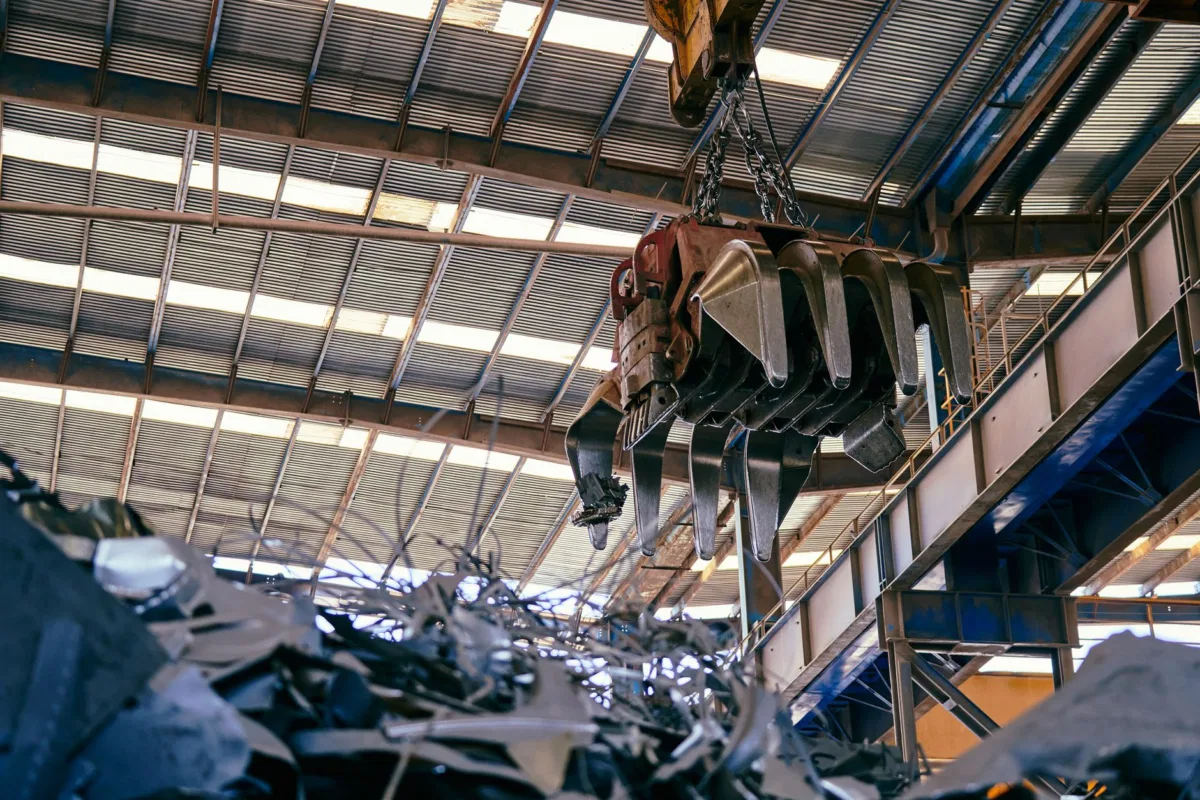
Drive down Interstate 75 through Ohio, and you will eventually pass a sprawling, windowless industrial complex that looks indistinguishable from the automotive assembly plants that have defined the region for a century. The loading docks are packed with heavy freight. The power substations hum with the immense voltage required to run heavy robotics. Yet, if you watch the logistics gates closely, you will notice a structural inversion of the traditional industrial model.
Finished vehicles go in. Nothing but raw, elemental ingots comes out.
This facility does not build cars. It destroys them, systematically and profitably, at a scale previously thought impossible. Welcome to the era of the reverse assembly line, where the most lucrative frontier in American manufacturing is no longer the creation of complex goods, but their proprietary annihilation.
For decades, the end-of-life phase of consumer and industrial products was treated as an externality. Manufacturers built goods, sold them, and left the messy business of disposal to municipal waste systems, scrap yards, and third-party recyclers. The goal was to push volume out the door. What happened to the steel, lithium, neodymium, and copper a decade later was someone else’s problem.
That calculus has violently reversed. The supply chain traumas of the early 2020s, coupled with the escalating geopolitical weaponization of critical minerals, forced a brutal realization in the boardrooms of the Fortune 500. The global spot market for raw materials is fundamentally unreliable. The only secure mine left on earth is the graveyard of your own past production.
Consequently, the world’s largest original equipment manufacturers (OEMs) are quietly executing a massive vertical integration of the scrap industry. They are designing products specifically to be destroyed, utilizing proprietary disassembly robotics to reclaim their own elements, and effectively locking competitors out of the secondary materials market. Circular manufacturing has shed its environmentalist origins. It is now a ruthless strategy for resource monopolization.
The Architecture of Collapse
To understand the economics of the reverse assembly line, one must first look at how products are being redesigned at the point of inception. The traditional manufacturing ethos prioritized durability and structural integrity. Components were welded, glued, and riveted together to withstand years of abuse. This made them exceptionally difficult to take apart. A third-party recycler attempting to extract a cobalt-rich battery cell from a 2020-era electric vehicle often had to resort to brute force—shredding, smelting, and chemically leaching the wreckage in a process that destroyed a significant portion of the valuable material.
Today, industrial design is governed by a new mandate: Design for Destruction.
Engineers are embedding "active disassembly" mechanisms into the core architecture of high-value goods. Adhesives are formulated to instantly lose their grip when exposed to a specific electromagnetic frequency. Fasteners are made from shape-memory alloys that snap open when heated to exactly 185 degrees Celsius. Battery packs are structured like modular vaults, designed to be unlocked by a robotic arm holding the correct digital and physical key.
When a 2026 model electric vehicle reaches the end of its life and is returned to the OEM’s reverse factory, it is not shredded. It is placed on a conveyor belt and subjected to a highly choreographed sequence of thermal, chemical, and kinetic triggers. The vehicle essentially unzips itself.
Within forty-five minutes, a two-ton machine is reduced to neatly sorted bins of battery-grade lithium, aerospace-grade aluminum, and rare-earth magnets, all retaining their structural purity. Because the OEM designed the exact sequence of collapse, their proprietary robots can execute the disassembly with zero material degradation. A third-party scrap yard, lacking the software keys and the thermal blueprints, would simply melt the car down into low-grade slag.
The Elemental Hoard
This asymmetry in extraction efficiency is creating a closed-loop monopoly. By making products that only the original manufacturer can profitably disassemble, OEMs are turning their customer base into a distributed strategic reserve of raw materials.
Consider the economics of neodymium, the rare-earth element crucial for the permanent magnets used in EV motors and wind turbines. China controls the vast majority of the global processing capacity. For an American automaker, buying fresh neodymium on the open market carries immense geopolitical risk and price volatility.
However, if that automaker has sold three million vehicles over the past decade, they possess a massive, localized reserve of neodymium driving around the American suburbs. By heavily incentivizing trade-ins and mandating end-of-life return clauses in leasing contracts, the automaker can reclaim those magnets. The reverse assembly line extracts the neodymium at a fraction of the cost of mining and refining virgin ore. More importantly, it keeps that neodymium out of the hands of rival automakers.
The product itself is no longer the endgame. The product is merely a temporary vessel used to generate revenue while storing the company’s raw materials until they are needed for the next production cycle. We are witnessing the financialization of physical elements, where a corporation’s balance sheet includes the exact tonnage of lithium currently being leased out to consumers in the form of automotive batteries.
The Death of the Aftermarket
The rise of the disassembly monopoly has devastating implications for the independent recycling and repair industries. For generations, an entire ecosystem of scrap yards, refurbishers, and aftermarket parts dealers survived by scavenging the refuse of the industrial economy.
That ecosystem is being systematically starved of oxygen. As OEMs tightly control the end-of-life logistics of their products, the volume of high-value scrap making its way to independent yards is plummeting. Furthermore, the active disassembly mechanisms embedded in modern goods are heavily patented and software-locked. Attempting to force open a modern smart-device or EV battery without the OEM’s proprietary disassembly protocol often triggers a deliberate corruption of the high-value components, rendering them worthless to scavengers.
The major manufacturers argue that this extreme control is necessary for safety and environmental compliance. Lithium-ion batteries and complex electronics pose severe fire and chemical risks if handled improperly. By keeping the destruction in-house, the OEMs claim they are ensuring maximum recycling efficiency and minimal environmental contamination.
While this is technically true, it functions as an impenetrable moat. The barriers to entry for manufacturing are now doubled. A new competitor must not only figure out how to build a complex product; they must also secure a virgin supply chain in a world where the incumbent giants are endlessly recycling their own private hoards of materials. The incumbents do not need to buy lithium on the open market; they just harvest it from their older models. The startup, lacking a legacy fleet to harvest, is left paying massive premiums for raw ore.
The Capital Expenditure Trap
Yet, the transition to reverse manufacturing carries its own severe risks. The capital expenditure required to build a facility capable of automated, high-throughput disassembly is staggering. These plants require optics, sensors, and machine-learning systems far more advanced than those used in forward assembly. Putting a screw into a pristine, standardized hole is a relatively simple robotic task. Removing a screw from a chassis that has been warped by a decade of rust, collisions, and thermal stress requires a level of robotic improvisation that borders on artificial general intelligence.
Furthermore, the economic viability of the disassembly monopoly relies entirely on the assumption that the reclaimed elements will remain valuable. If a manufacturer builds a multi-billion-dollar reverse logistics network to reclaim lithium and cobalt, they are structurally betting that battery chemistry will not fundamentally change. If a breakthrough in solid-state sodium batteries renders lithium obsolete, the manufacturer is suddenly holding a massive stockpile of worthless scrap and a highly specialized destruction facility with no profitable output.
The companies aggressively pursuing this strategy are betting that elemental physics places a hard ceiling on material substitution. Copper will always be the most cost-effective conductor. Neodymium will always make the strongest magnets. Titanium will always offer the best strength-to-weight ratio. If these elemental truths hold, hoarding the periodic table is the ultimate competitive advantage.
The Vault Factory
The industrial landscape of the late 2020s is being redrawn by the realization that creation is cheap, but extraction is priceless. The forward assembly line, optimized by a century of Taylorism and automation, has become a commoditized process. Anyone with sufficient capital can hire contract manufacturers to put parts together.
The true leverage now lies in tearing them apart. The massive facilities rising in the American Midwest and the Sun Belt are not factories in the traditional sense. They are elemental vaults, designed to capture, process, and hoard the building blocks of the modern economy. By mastering the science of proprietary destruction, the industrial giants of this decade are ensuring that they will never again be held hostage by a fragile global supply chain. They have learned to mine themselves.
Staff analysis by the Industry Pulse newsroom, edited by Viktor Peshekhonov, under our editorial policy.
More Analysis
Law · Industry Pulse Editorial Team
The Neural Subpoena: Why Corporate Litigation Is Targeting Employee Brainwaves
Hospitality · Industry Pulse Editorial Team
The Acuity Premium: Why Luxury Hospitality Is Evolving Into Outpatient Infrastructure
Sports Industry · Industry Pulse Editorial Team
The Varsity Arbitrage: Why Wall Street is Buying Up the Youth Sports Economy
Healthcare · Industry Pulse Editorial Team
The Micro-Foundry Premium: Why America’s Hospitals Are Printing Their Own Pharmaceuticals
Finance · Industry Pulse Editorial Team
The Obsolescence Swap: Why Wall Street is Trading the Half-Life of Silicon
Real Estate · Industry Pulse Editorial Team
The Hydrological Premium: Why Wall Street Is Pricing Land by the Gallon