
NVIDIA Unveils GR00T 2 Robot Foundation Model for Cross-Body Skill Transfer
NVIDIA introduced GR00T 2 at the Conference on Robot Learning, a world-action model capable of transferring human skills to machines with minimal training. According to reporting from Interesting Engineering, the system utilizes a cross-adaptation approach called X-Adapt to enable robots with various physical configurations to learn complex manipulation tasks from just five demonstrations.
Context from Industry Pulse
The introduction of GR00T 2 occurs as the engineering sector explores more efficient ways to deploy autonomous systems. The ability to fine-tune a robot in 30 minutes using a single graphics card lowers the barrier for industrial adaptation. This development complements other regional engineering advancements, such as the expansion of aerospace and defense hubs in Texas and the deployment of new nuclear reactor designs. By utilizing reasoning models to direct robot actions through an API, NVIDIA is positioning its software to handle the complex, multi-step assemblies required in modern manufacturing and laboratory settings, where error recovery and visual steering are critical for maintaining high success rates during autonomous operations.
"Providing five demonstrations for each task raised the average to 95 percent following a 30-minute fine-tuning session on a single NVIDIA RTX 5090 graphics card."
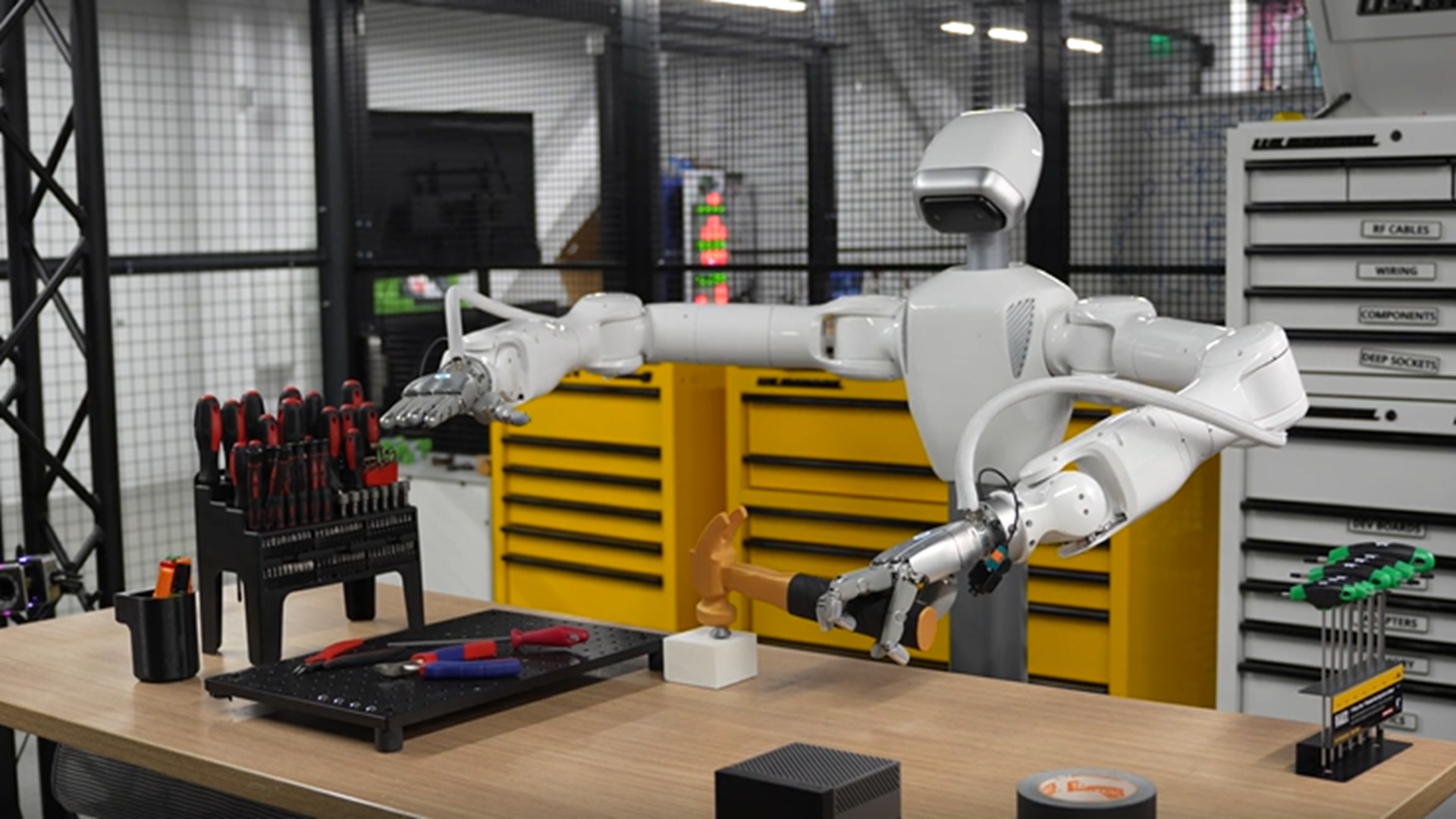
The GR00T 2 model serves as a foundation for robotic learning by predicting future video frames and physical movements simultaneously. This dual prediction capability allows machines to understand the mechanics of physical interactions and determine the specific actions required for task completion. According to Interesting Engineering, the architecture is compatible with diverse hardware, including humanoid robots, dexterous five-fingered hands, and standard parallel-gripper arms.
Initial testing demonstrated that robots using this model could achieve a 40 percent success rate on tasks they had never previously encountered. However, Interesting Engineering reports that providing five specific demonstrations per task increased the success rate to 95 percent. This improvement was achieved through a 30-minute fine-tuning process on a single workstation-grade graphics card, utilizing less than three minutes of robotic data for each new skill acquired.
The training data for GR00T 2 is extensive, incorporating over 400,000 hours of first-person human video and more than 33,000 combined hours of gripper and teleoperation data. As noted by Interesting Engineering, NVIDIA has made 100,000 hours of the Human-1M dataset available to the public. The model also integrates with reasoning systems that can decompose complex objectives into manageable steps while recovering from external interruptions or operational errors.
NVIDIA also showcased a smaller, optimized version known as GR00T 2 Turbo. This variant is designed for high-speed execution on onboard processors like the Jetson Thor. During demonstrations on a Unitree G1 humanoid, the Turbo model successfully performed popcorn-serving and table-clearing tasks with high reliability. Interesting Engineering highlights that this technology aims to move robotics beyond rigid, pre-programmed actions toward more flexible manipulation in both industrial environments and domestic settings.
The Industry Pulse Bottom Line
NVIDIA is transforming robotic training from month-long programming cycles into half-hour fine-tuning sessions. By enabling skill transfer across different robot bodies, GR00T 2 significantly reduces the data and time required to deploy adaptable automation.