
Colorado State Engineers Develop Tensegrity Robots Inspired by Elephant Trunks
Researchers at Colorado State University have engineered flexible, modular robots that mimic the dexterity of elephant trunks. As reported by Interesting Engineering, these machines utilize a tensegrity-based design to bend, grip, and link together, offering a versatile alternative to traditional rigid-jointed robotics for applications in space exploration and search-and-rescue missions.
Context from Industry Pulse
The development at Colorado State University reflects a broader engineering shift toward combining soft robotics flexibility with modular reconfigurability. By utilizing tensegrity structures, these robots overcome the limitations of rigid components that often restrict movement in unpredictable environments. This research aligns with other recent engineering milestones reported by Interesting Engineering, such as the use of nature-inspired networks to create resilient metamaterials and the deployment of modular infrastructure like Torus data centers. As industries seek more adaptable solutions for extreme environments, the ability for machines to physically reshape themselves through mechanical docking—rather than relying on magnetic or fixed joints—represents a significant step toward autonomous, multi-functional robotic teams.
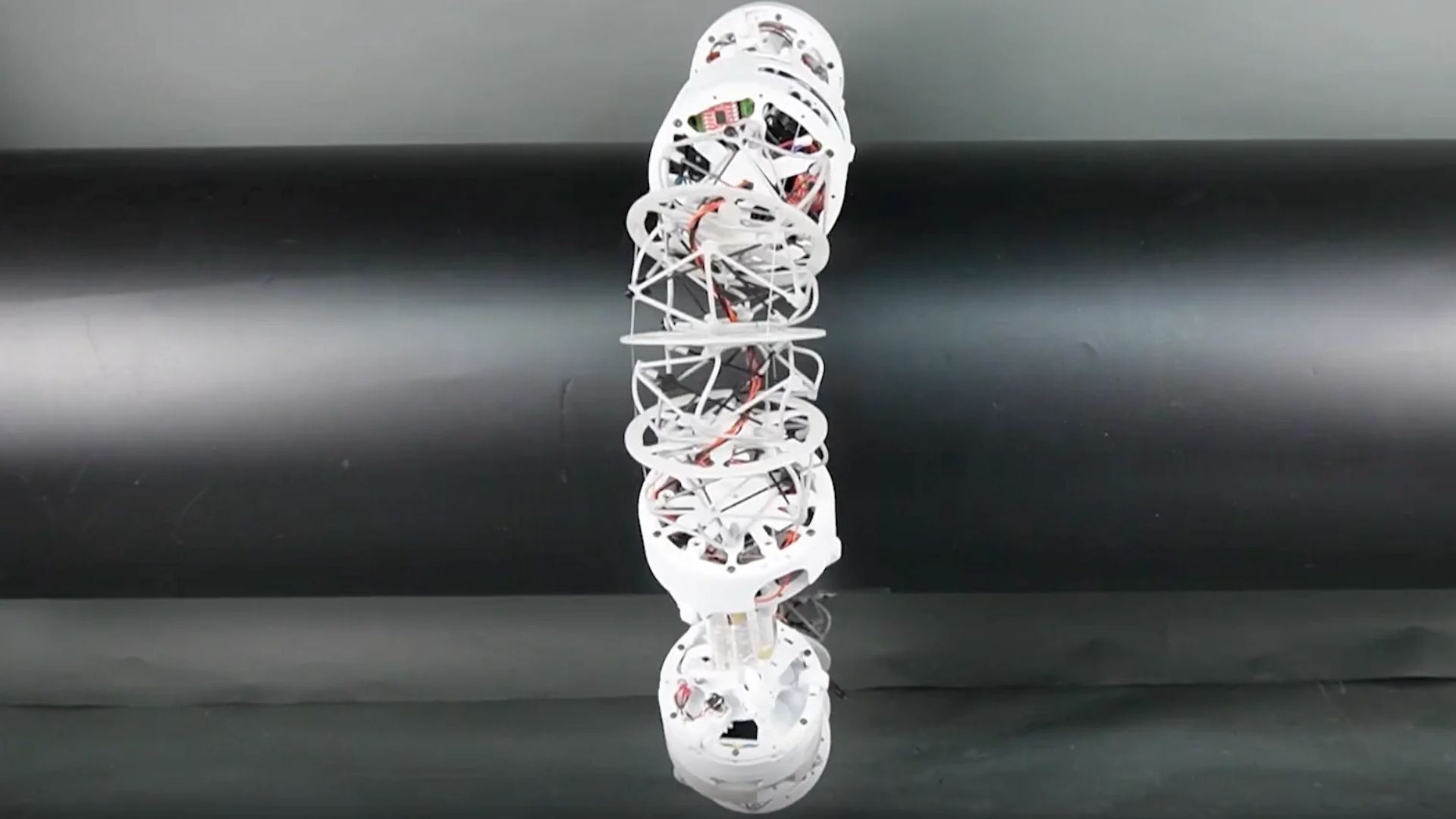
Engineers at Colorado State University have introduced a robotic system that departs from the fixed geometries of conventional mechanical arms. According to Interesting Engineering, the design utilizes tensegrity, a structural principle where rigid rods are suspended within a network of tensioned cables. This construction allows the tube-like bodies to collapse, stretch, and deform continuously, providing a level of flexibility similar to biological appendages like elephant trunks.
Each individual unit is equipped with mechanical gripping claws at both ends. These dual-claw mechanisms enable the robots to perform loco-manipulation, a process that combines movement and object handling within a single system. Interesting Engineering reports that the robots can navigate varied terrain using multimodal locomotion and use their flexible bodies to wrap around and lift loads of different sizes.
Beyond individual operation, the machines are designed for modular assembly. The mechanical claws allow units to connect to one another without the need for magnetic interfaces, which helps reduce alignment errors during docking. Once joined, the robots can form complex configurations such as loops, chains, or branching structures. This collective behavior allows a team of robots to coordinate their movements for transporting heavy objects or navigating challenging landscapes.
While the current prototypes require human piloting for most tasks, researchers have successfully demonstrated that two units can independently locate and connect with each other. Future development aims to increase autonomy and operating speeds, eventually allowing hundreds of units to work together. Interesting Engineering notes that these robotic collectives could be deployed to remote sites and then rearrange their physical structures to meet specific operational requirements in manufacturing or space environments.
The Industry Pulse Bottom Line
These elephant trunk-inspired robots demonstrate that tensegrity-based modular systems can outperform rigid designs in adaptability. By merging gripping and movement into a single flexible form, engineers are creating highly versatile collectives for complex, unstructured environments.