
C-BLIP Technology Sets New Speed Record for Ultrafast 3D Surface Profilometry
A research team at the Institut National de la Recherche Scientifique has developed a new imaging method capable of capturing 150,000 3D frames per second. As Interesting Engineering reports, the C-BLIP system overcomes traditional speed and cost barriers to document non-repeatable, high-velocity physical events with unprecedented precision for surface shape measurement.
Context from Industry Pulse
The engineering landscape is increasingly focused on high-precision measurement at the micro and macro scales. While recent breakthroughs recorded by Interesting Engineering include measuring record-low gravitational forces between silicon wafers and using AI to predict aerodynamic performance, C-BLIP fills a critical gap in observing physical mechanical failures and fluid dynamics. By moving beyond 100,000 frames per second, researchers can now quantify structural deformation during collisions or high-frequency vibrations in real-time. This capability complements other industry shifts, such as utilizing industrial waste in concrete or developing low-cost orbital refueling ports, by providing a tool to stress-test new materials and mechanical designs under extreme, one-shot conditions that were previously invisible to diagnostic sensors.
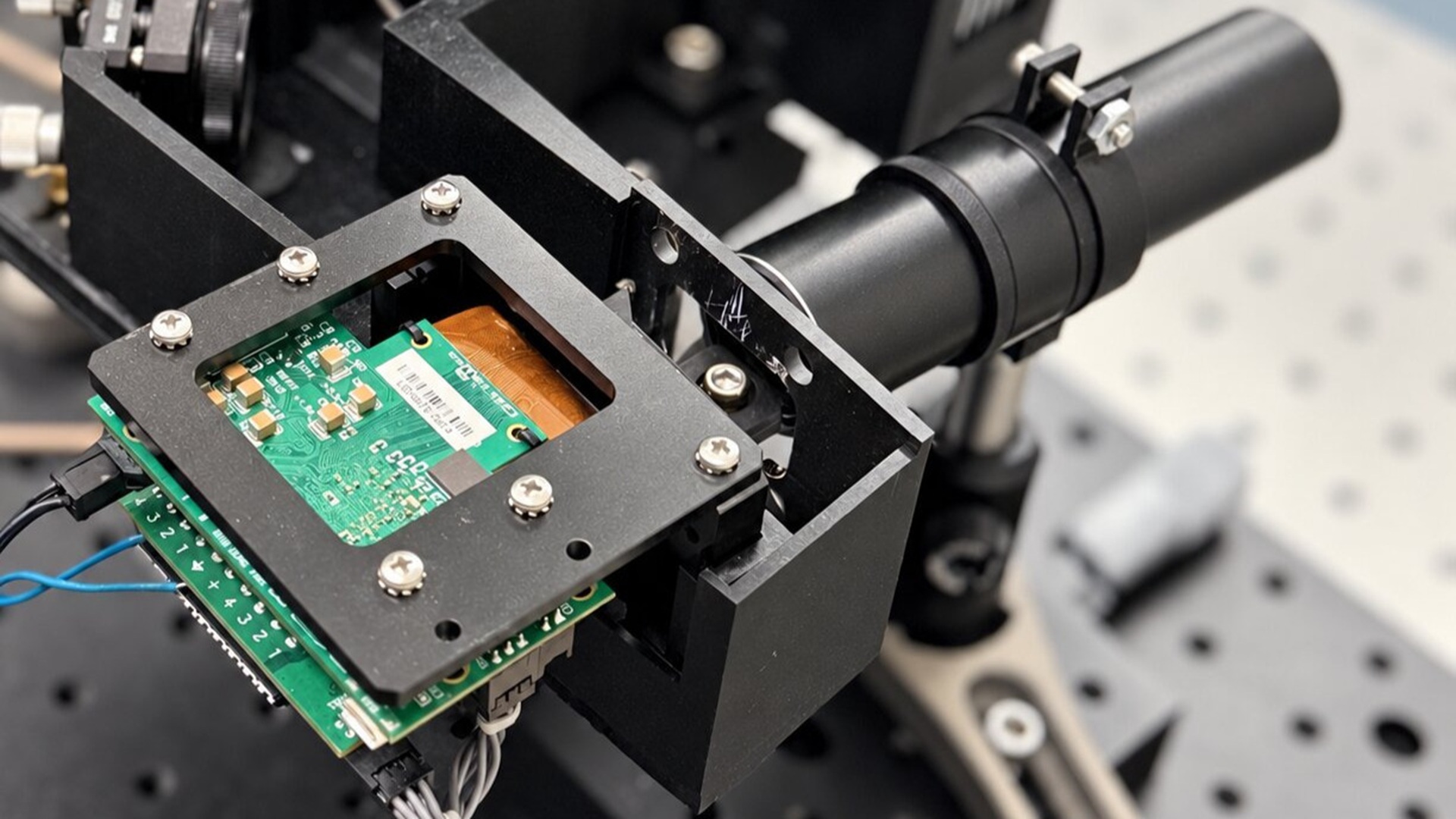
Engineers in Quebec have established a new benchmark in 3D profilometry by developing a system that records surface data at 150,000 frames per second. This technique, known as chromatically band-limited illumination profilometry or C-BLIP, allows for the observation of transient events that occur too quickly for conventional measurement tools. Led by Jinyang Liang at the Institut National de la Recherche Scientifique, the project focuses on capturing one-shot phenomena that cannot be easily replicated for multiple takes.
According to Interesting Engineering, the C-BLIP method addresses common limitations in ultrafast imaging, such as the high cost of specialized hardware and the heavy computational load required for image reconstruction. By utilizing a cost-effective optical design and eye-safe LED lights, the researchers have created a more accessible tool for diverse research environments. The system functions by projecting light patterns onto objects and analyzing how those patterns deform to map the three-dimensional geometry of the target.
During experimental testing, the team successfully documented several high-speed occurrences. These included the impact of a projectile on a turbofan blade and the complex aerodynamics of a falling maple seed. As Interesting Engineering notes, the imager was also sensitive enough to detect surface vibrations on a loudspeaker. By extracting acoustic data from these microscopic movements, the researchers were able to reconstruct a recorded voice message from the visual data alone.
While other imaging technologies can capture trillions of frames per second to track light in flight, they do not measure surface topography in the same manner. This specific record for 3D profilometry surpasses previous benchmarks of approximately 100,000 frames per second. Future iterations of the system may include GPU-accelerated processing to enable real-time visualization of these rapid events, potentially benefiting fields such as additive manufacturing, microfluidics, and high-rate material testing.
The Industry Pulse Bottom Line
C-BLIP offers a cost-effective, high-speed solution for 3D imaging, enabling engineers to analyze unpredictable mechanical events and aerodynamic behaviors at 150,000 frames per second without the need for expensive, specialized laboratory equipment.