
Microchip Unveils Zonal Ethernet Switches for Software-Defined Vehicles
Microchip Technology has begun sampling its LAN932xx automotive Ethernet switch families to support centralized compute and zonal networking. As Engineering.com reports, these Time-Sensitive Networking solutions offer scalable bandwidth up to 30 Gbps, enabling real-time reconfiguration for functional safety and cybersecurity. The hardware integrates automotive-qualified PHYs and dedicated security modules to streamline the development of next-generation vehicle architectures.
Context from Industry Pulse
The automotive industry is rapidly transitioning from legacy wiring harnesses to zonal architectures that mimic data center networking. This evolution is driven by the need for massive data throughput required by autonomous features and complex infotainment systems. According to Engineering.com, the LAN932xx switches address this by providing up to 18 external ports and 30 Gbps capacity. By integrating automotive-specific PHYs and meeting ASIL B safety standards, these components allow automakers to consolidate electronic control units. This consolidation reduces vehicle weight and complexity while providing a secure foundation for over-the-air updates, ensuring that the vehicle network can adapt to new software requirements throughout its operational lifespan.
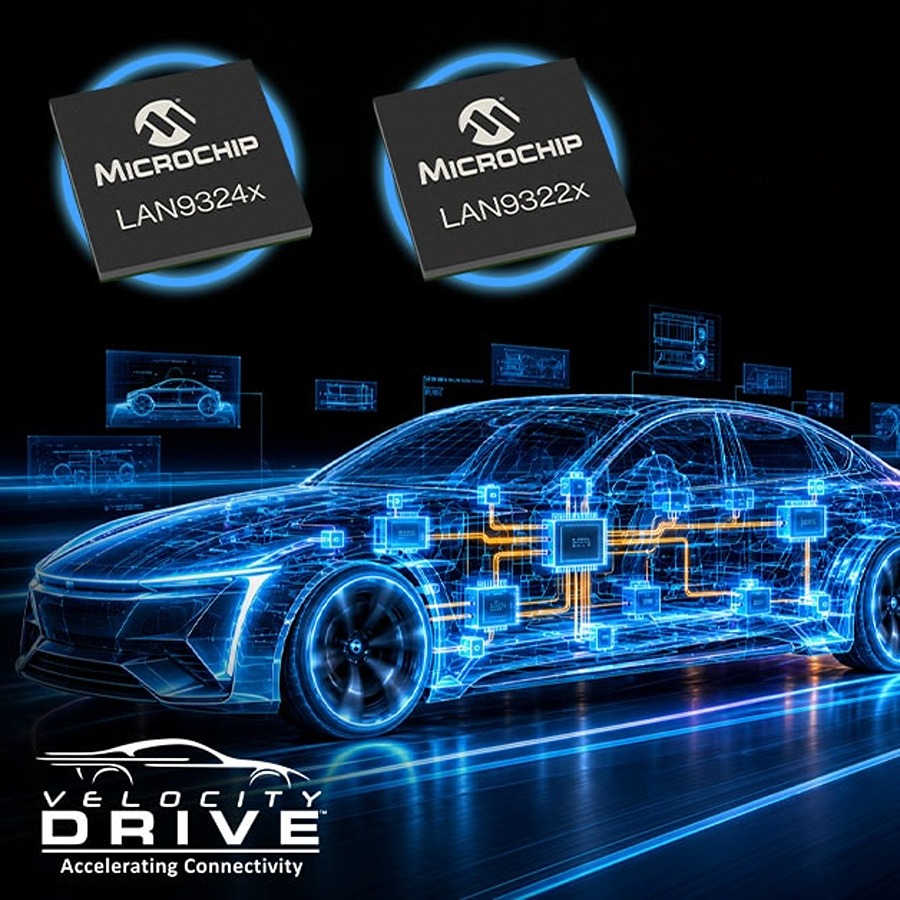
The shift toward software-defined vehicles requires networking hardware that can manage more than simple data transport. Microchip Technology addresses this requirement with the introduction of its LAN9324x and LAN9322x switch families. According to Engineering.com, these devices are designed for deterministic performance in zonal and central compute environments. The LAN9322x series focuses on compact edge applications, while the LAN9324x scales to support higher port counts and bandwidth for gateways and primary compute clusters.
Designers can access a variety of connectivity options ranging from 10 Mbps to 10 Gbps through integrated PHYs and SerDes. This flexibility allows for precise port mixing based on specific vehicle requirements. Engineering.com notes that the switches are fully self-managed, utilizing the VelocityDRIVE Software Platform. This standards-based management system uses YANG data models to facilitate local or remote configuration, potentially removing the need for manufacturers to maintain proprietary switch software.
Safety and security are central to the new hardware architecture. The switches feature a dual-core Arm Cortex-R52+ processor operating in lockstep and a dedicated Hardware Security Module. As Engineering.com reports, the devices include a deep packet inspection engine for intrusion detection and are compliant with ISO 26262 ASIL B standards. Every port is equipped with MACsec to ensure encrypted communication across the internal vehicle network.
Environmental resilience is also a factor for these automotive-qualified components. The switches are AEC-Q100 Grade 2 certified, capable of operating in ambient temperatures from minus 40 to 105 degrees Celsius. To mitigate supply chain risks, Engineering.com highlights that Microchip is utilizing geographically diverse fabrication and assembly sites. This strategy provides manufacturers with more reliable sourcing options for critical zonal networking components as vehicle designs become increasingly centralized.
The Industry Pulse Bottom Line
Microchip’s new TSN switches provide the high-bandwidth, secure, and self-managed infrastructure necessary for automakers to transition from hardware-heavy designs to agile, software-defined vehicle architectures with centralized control.