
ENCY 3.2 Update Enhances CAM Automation and Robotic Tooling Controls
The software developer has released ENCY 3.2, introducing refined toolpath controls and automated fixture positioning for machining projects. As Engineering.com reports, the update focuses on reducing redundant setup tasks by enabling tooling assembly reuse and improving finishing precision through scallop height geometric limits, allowing engineers to better balance surface quality with total cycle times.
Context from Industry Pulse
The ENCY 3.2 update arrives amidst a broader industrial push toward software-driven efficiency in manufacturing. While contemporary developments like NVIDIA’s GR00T 2 are exploring human-to-robot skill transfer, the CAM sector remains focused on optimizing the bridge between digital design and physical execution. By integrating workholding awareness directly into face milling and automating tool assembly management, ENCY addresses the practical bottleneck of manual setup. This reflects a shift toward higher-autonomy machining environments where geometric constraints, such as scallop heights and fixture clearance, are calculated automatically rather than requiring constant manual intervention from the programmer. These refinements aim to maximize machine uptime by reducing the administrative overhead of repetitive programming tasks.
"Users can now save a complete tool set in assembly mode and load it into another job. Standard tooling can be prepared once and reused as new parts are added."
The latest software iteration introduces a significant workflow improvement by allowing programmers to save and load entire tool sets in assembly mode. According to Engineering.com, this capability eliminates the need to rebuild identical tooling configurations when running different parts on the same machine. Centralized management ensures that updates to adapter settings or magazine positions automatically propagate across all operations using that specific tool. Furthermore, a new component panel provides a visual overview of magazine occupancy to streamline organization.
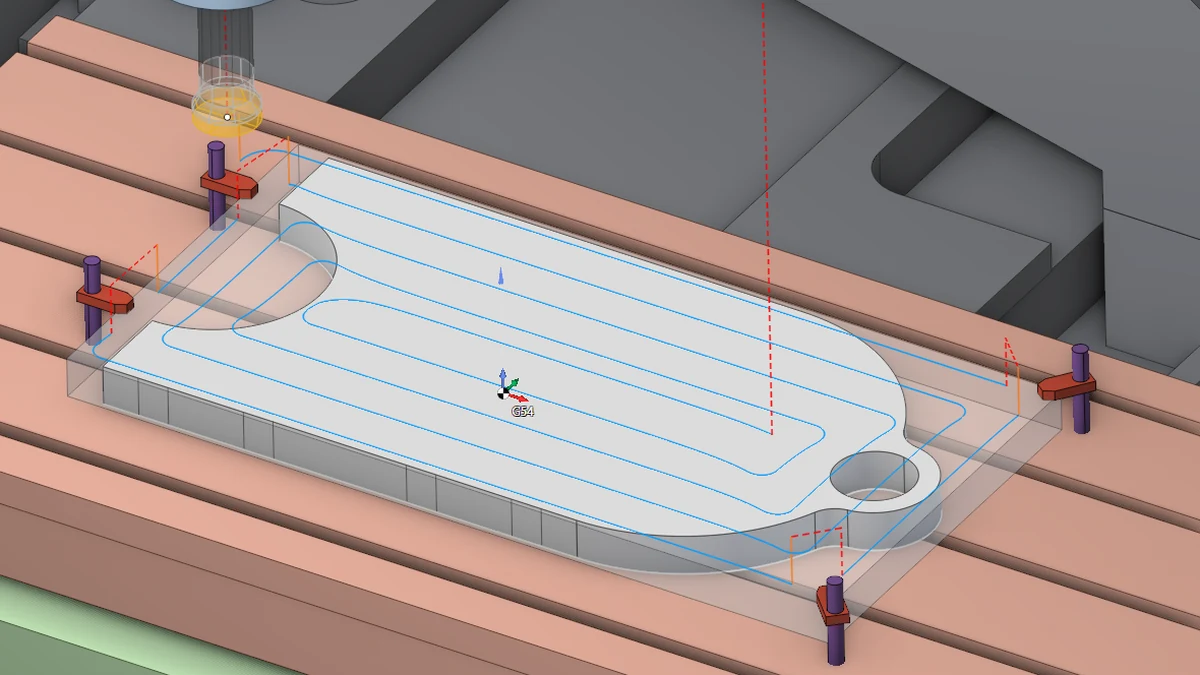
Workholding setup has been simplified through a new snapping feature. Engineering.com notes that users can now drag clamps toward the machine table or fixture plate, where the software automatically highlights valid levels and locks the component into place. This change minimizes manual coordinate entry during the build phase. In face milling operations, the software now recognizes fixture geometry to trim toolpaths, utilizing a clearance plane for transfer moves to avoid collisions with clamps while reducing air cutting in zigzag patterns.
Finishing operations receive more granular control via the Combo Finish and Roughing Waterline features. As Engineering.com reports, users can now define allowable scallop heights to establish geometric limits for pass spacing. This allows for tighter spacing on shallow slopes and avoids excessive levels on vertical walls, optimizing the amount of stock left for final passes. Programmers also gain the ability to finish specific surface regions sequentially within a single operation, simplifying project maintenance.
Robotic and sheet metal applications also see functional upgrades. Engineering.com highlights improved feature recognition for 6D contouring used in spatial trimming and cladding. For nesting tasks, the system now displays the dimensions of sheet remnants to assist with material recovery. The update further includes a faster project loading engine and an expanded undo functionality that tracks parameter changes, alongside general fixes for simulation and toolpath calculation speed.
The Industry Pulse Bottom Line
ENCY 3.2 streamlines the transition from programming to production by automating tool reuse and fixture integration, providing engineers with more precise control over surface finishes and robotic trimming workflows.