
AMD EPYC Embedded 9006 CPUs Debut With 256 Cores and PCIe Gen 6 Support
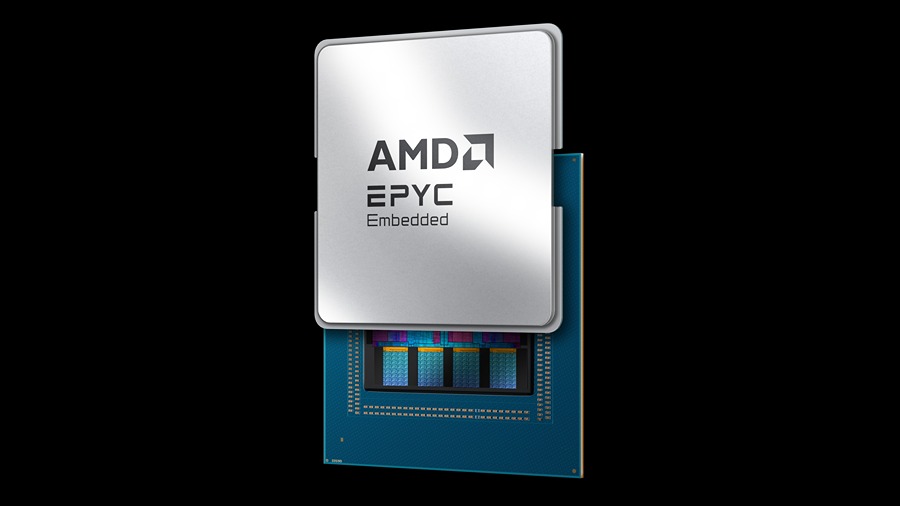
Advanced Micro Devices has introduced the EPYC Embedded 9006 Series SP7 processors, featuring the Zen 6 architecture. As reported by Engineering.com, these chips are designed for high-demand industrial applications, offering significant improvements in memory bandwidth and I/O throughput to support advanced networking, storage, and automated testing infrastructure.
Context from Industry Pulse
The launch of the EPYC Embedded 9006 series addresses a shift in industrial computing where AI-driven data volumes necessitate server-class performance in embedded form factors. By integrating PCIe Gen 6 and CXL 3.1, AMD is positioning these CPUs to handle the extreme I/O requirements of next-generation 800G firewalls and high-density NVMe storage arrays. The inclusion of post-quantum cryptography and the Caliptra root of trust signals a move toward securing infrastructure against emerging computational threats. Furthermore, the support for MRDIMM technology at 12,800 MT/s highlights a critical focus on eliminating memory bottlenecks in automated test equipment and large-scale parallel processing tasks.
"AMD EPYC Embedded 9006 CPUs combine up to 256 cores, scalable PCIe Gen 6 and CXL 3.1 connectivity, and advanced security from secure boot through runtime."
The new processor lineup scales up to 256 cores and 512 threads, providing a substantial leap in compute density for embedded environments. According to Engineering.com, the series utilizes the SP7 socket and introduces support for both PCIe Gen 6 and CXL 3.1 connectivity. These technical specifications are intended to facilitate faster data movement in enterprise storage controllers and high-speed network firewalls capable of managing 400G and 800G traffic flows.
Performance benchmarks detailed by Engineering.com indicate that the 9006 series achieves up to 1.8 times the throughput of the previous generation. Improvements also extend to memory architecture, where the processors feature sixteen DDR5 channels. These channels support RDIMM speeds reaching 8,000 megatransfers per second and MRDIMM technology capable of 12,800 megatransfers per second. This results in a memory bandwidth increase of approximately 2.7 times over prior models.
Security is a primary focus for the series, incorporating a dedicated security engine to establish a silicon-based root of trust. Engineering.com notes that the hardware includes post-quantum cryptography for firmware signing, which is designed to protect mission-critical systems against future decryption threats. The platform also utilizes the Caliptra open-source root of trust to provide remote attestation and verify device integrity during operation.
To meet the needs of long-term industrial projects, AMD is offering seven-year product longevity for these components. The 128-core version of the processor is scheduled for release on November 15, while additional variants with different core counts and power profiles are expected to ship by the conclusion of the year. These units target the expanding requirements of AI infrastructure and semiconductor automated test equipment.
The Industry Pulse Bottom Line
The EPYC Embedded 9006 series bridges the gap between traditional embedded controllers and high-performance server architecture, offering the core density and high-speed I/O required for the next generation of AI-integrated industrial and networking infrastructure.