Why Motivation Isn't Enough: What Learning Science Reveals About How People Actually Change
By Olga Usatenko · 2026-07-25
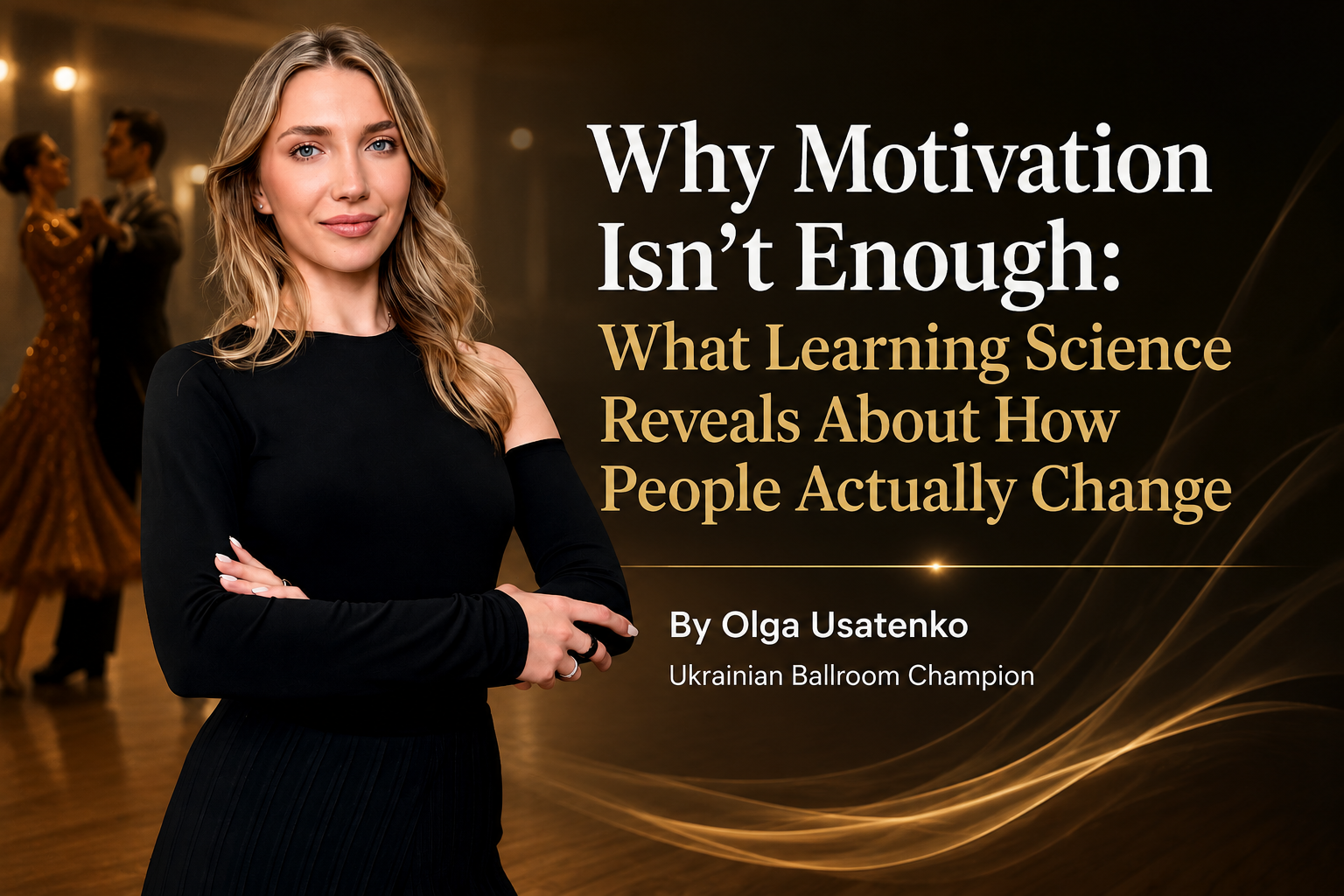
New research in psychology, neuroscience, and organizational behavior increasingly suggests that sustainable change depends less on motivation than on system design. Dance educator and researcher Olga Usatenko argues that discipline, motivation, and even identity are products of the systems surrounding us.
New research in psychology, neuroscience, and organizational behavior increasingly suggests that sustainable change depends less on motivation than on system design.
According to Gallup, only 23% of employees worldwide are actively engaged at work, while the remaining majority are either disengaged or actively disconnected from their jobs. At the same time, organizations spend billions of dollars every year on leadership development, motivation programs, and employee training, yet long-term behavioral change remains elusive.
The challenge extends far beyond business. UNESCO estimates that more than 250 million children globally fail to achieve basic learning outcomes despite attending school, while corporate learning studies consistently show that much of traditional training is forgotten within weeks when knowledge is not reinforced through practice and feedback.
A growing body of evidence from cognitive science points toward a different explanation: people rarely change because they simply "decide" to. Instead, lasting development emerges when environments make progress visible, connect effort with outcomes, and provide continuous feedback.
In this guest essay, dance educator and researcher Olga Usatenko argues that discipline, motivation, and even identity are not fixed personality traits but products of the systems surrounding us. Drawing on years of observing children's learning and combining practical experience with research in developmental psychology, she offers a perspective that challenges many traditional assumptions about education, management, and human development.
It starts with a seven-year-old in a ballroom studio and ends with a question about everything we build — schools, companies, families. Why do humans actually develop? After years of teaching children and researching the psychology of learning, I believe most of our answers are wrong, and the right one is hiding in plain sight.
By Olga Usatenko
There is a seven-year-old girl in my studio. Two months ago she couldn't hold a frame for eight bars of music. Yesterday she corrected her own footwork before I said a word, then looked up to check whether I'd noticed.
I've watched that exact moment hundreds of times, in hundreds of children. And at some point I stopped seeing a dance lesson and started seeing something much larger: a human being in the act of changing.
This article is not about dance. Dance is simply where I happened to be standing, for years, with an unusually clear view of a question most of us never examine directly.
Why do people change at all?
Change Is Not a Decision
We talk about human change as if it were an act of will. Someone "decides" to improve. A child "chooses" to apply herself. A team "commits" to excellence. The language implies that transformation begins with wanting.
Years of watching actual transformation, at the age when it's most visible, convinced me the sequence runs the other way.
People change when they receive evidence that their actions alter reality. Not encouragement — evidence. The moment a human being sees a causal line between something she did and something that happened, a switch flips that no speech can flip. She stops being a passenger in her own development and becomes, for the first time, its author.
Wanting doesn't produce that switch. Proof does. And most of the environments we build for people — classrooms, studios, offices, homes — are astonishingly bad at producing proof.
The Economics of Invisible Effort
Consider what we routinely ask of a learner, whether she is seven or thirty-seven.
Do difficult work now. Receive no record of it. Get evaluated occasionally, in terms too vague to act on. Trust that improvement is happening somewhere, invisibly, on faith. Repeat for years.
Then, when engagement collapses, diagnose the person: unmotivated, undisciplined, doesn't want it enough.
But a mind is an economic system. It invests attention and effort where returns are visible, and it cuts losses where they aren't. That's not weakness of character. It's rational accounting. Effort that leaves no trace is, from the brain's perspective, effort that didn't work — and no organism keeps repeating what doesn't work.
This is why the child staring at the studio floor is not lazy, why the student doodling through class is not broken, and why the employee doing the minimum is not a hiring mistake. In almost every case, they are responding correctly to an environment where the loop between action and consequence has been severed.
We keep trying to repair the person. The fracture is in the loop.
The Motivation Illusion
Why, then, do adults reach for motivation so instinctively?
Because motivation is what change feels like from the inside. When we remember our own best periods — the year we transformed, the project that consumed us — we remember the fire. So we conclude the fire caused the change, and we try to light it in others: speeches, rewards, inspiration, consequences.
We are mistaking the sensation for the mechanism. Look closely at any sustained transformation and beneath the fire you'll find structure: a training log, a mentor's regular feedback, a visible streak, a scoreboard, a ritual. The motivation wasn't the engine. It was the heat the engine gave off.
This confusion has a cost. It means that when someone stalls, we prescribe more fuel for an engine that was never built. Entire industries exist to inspire people inside systems where effort remains invisible — which is like shouting encouragement to someone rowing a boat with no oars, and concluding, when the boat doesn't move, that they didn't believe in themselves.
Identity Is a Ledger
Here is where it gets more interesting than behavior. Visible progress doesn't just sustain effort. It constructs the self.
Ask what a personality trait actually is. "I am disciplined." "I am someone who finishes things." "I am not a math person." None of these are facts about the soul. They are conclusions — verdicts a mind has reached after reviewing its own accumulated evidence.
Identity, in other words, is a ledger. Every visible outcome is an entry. Enough entries of the same kind, and the mind stops reading them as events and starts reading them as self.
In my studio, the ledger is literal. Each child keeps a notebook. After every lesson I write the corrections, the small victories, the work for home. Next lesson, we open it and close the loop: effort made at home earns a star, effort not made earns an honest blank. No rankings, no comparison between children — the only rival on those pages is the child of last week.
The stickers are worthless. The entries are not. Because somewhere around the twentieth page, a quiet reclassification happens. The child stops asking "was I good today?" and begins asking "did I improve?" She has read her own ledger and drawn a conclusion: I am someone who gets better at things.
No one can be told into that sentence. It can only be evidenced into existence. And it is, I would argue, the single most valuable sentence a human being can come to believe — because a person who believes it will walk toward difficulty for the rest of her life, and a person who doesn't will spend her life negotiating with it.
This is also why feedback and praise are not the same substance, though we blend them constantly. Praise is a verdict on the person; it creates a hunger for more verdicts, and a fear of the next one. Feedback is information about the loop; it creates capability. Praise makes people perform for you. Feedback makes them independent of you. One builds an audience-seeker. The other builds an author.
Discipline Is Weather, Not Climate of the Soul
All of this reframes a word we use carelessly: discipline.
We speak of discipline as a trait — something a person has, like height. But take the same child and place her in two environments. In one, her work vanishes weekly into vague approval. In the other, every effort is recorded, every loop is closed, progress is visible, and the structure repeats predictably while the content stays alive. She will look lazy in the first room and driven in the second.
Same child. Same soul. Different design.
Discipline is not a personality trait. It is an environmental outcome — what human beings reliably grow when cause and effect are made visible and the system is worthy of trust. Which means the question "why isn't she disciplined?" is almost always the wrong question. The right one is: what has her environment taught her about whether effort matters?
The Body Knows First
There is one more thing children taught me that our education systems have nearly forgotten: understanding does not begin in language.
A seven-year-old cannot explain weight transfer, timing, or emotional control. But she can do them, and having done them a thousand times, she owns them — long before she has any words for what she owns. The body learns first. Abstraction arrives later, as a description of what the body already knows.
Movement science calls this embodied cognition. But you don't need the term; you need only watch children learn anything real. They think through their hands, their balance, their breath. Concepts that would evaporate as explanations become permanent as experiences. And this is not a childhood quirk we outgrow — it's the human default we suppress. Adults, too, only truly understand what they have physically lived: no book about public speaking equals thirty seconds of a shaking voice in front of a room.
Yet nearly all formal education runs the opposite direction — abstraction first, experience maybe, evidence rarely. We explain, then test the explanation, and call the residue knowledge. Then we wonder why so little of it survives contact with life.
One Physics, Every Domain
Step back far enough and the separate worlds collapse into one.
The parent begging a child to practice. The teacher grading papers no one reads twice. The manager whose annual review is a monologue. The organization that announces values instead of building loops. All of them are working the same broken machine: demanding output from humans whose input has been made invisible, then blaming the humans.
And the repair is the same everywhere, because the physics is the same everywhere. Make effort visible. Close every loop. Deliver information, not verdicts. Keep the structure constant and the experience alive — repeat the skill, never the sameness. Let identity accumulate from evidence rather than announcements. Whether the human in question is seven or fifty-seven changes the vocabulary, never the mechanism.
I began my career thinking I was teaching children to dance. My research into the psychology of movement eventually gave the architecture academic names. But the honest sequence is that the studio taught the theory, not the reverse — years of small faces looking up to check whether the work was noticed, slowly revealing how development actually operates.
What those children showed me is uncomfortable and liberating in equal measure. Uncomfortable, because it removes our favorite excuse: if people around us aren't growing, the flaw is likely in the environments we designed, not the souls we assigned to them. Liberating, for exactly the same reason — because environments, unlike souls, can be redesigned by Tuesday.
Every educational system produces exactly what it is designed to produce.
If we want different people, we have to stop asking for more motivation — and start designing better environments.
---
Olga Usatenko is a dance educator, ballroom coach, and developer of a methodology for children's development through movement. Her research sits at the intersection of dance education, developmental psychology, and learning science, including published work on the psychology of dance and the Dance Growth Framework. She teaches competitive ballroom dance to children. LinkedIn