Gran Turismo 8: Release Date, Rumors, Features, and What Comes After GT7
By Vitalii Yermak · 2026-08-13
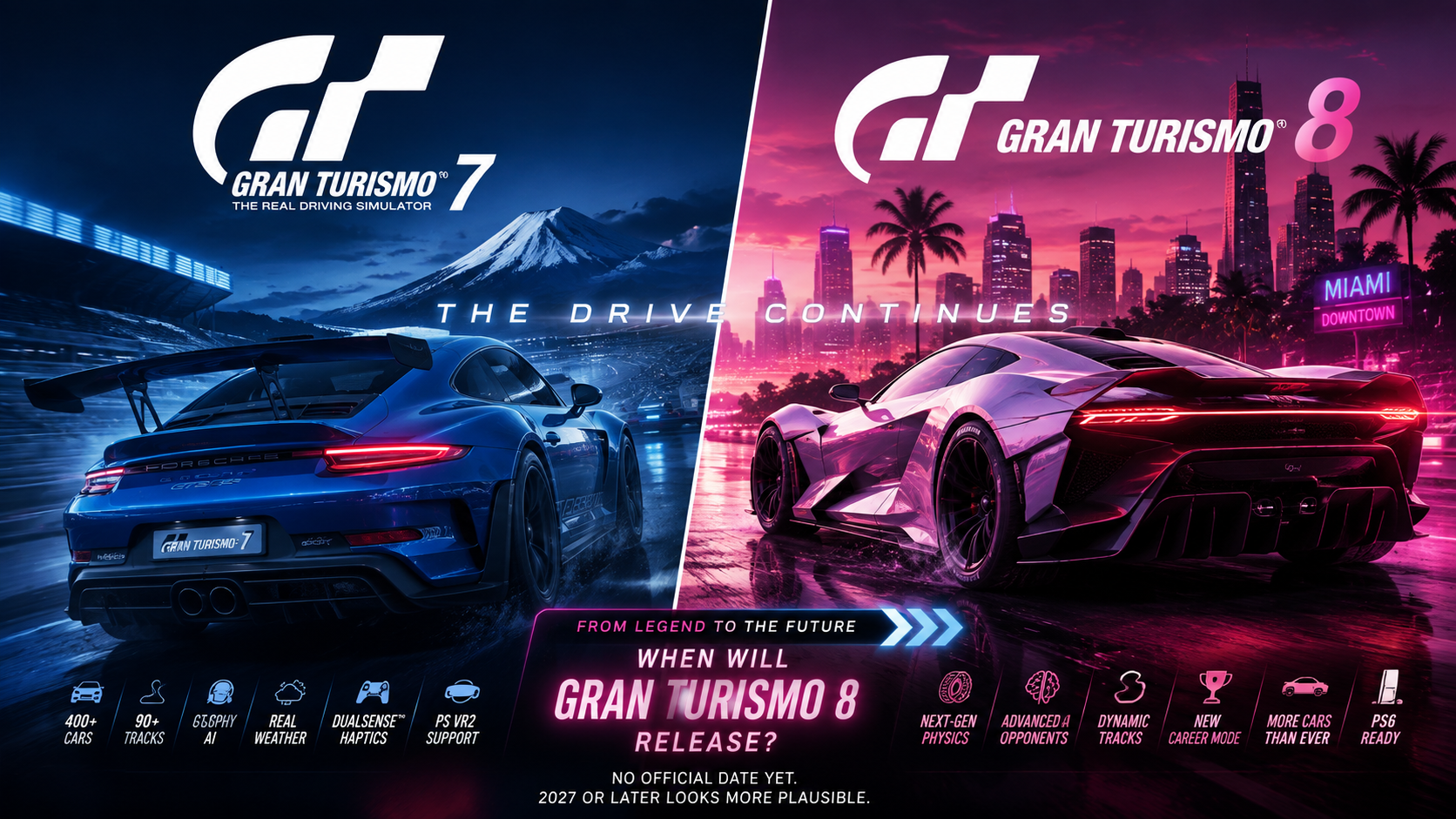
When will Gran Turismo 8 come out? We examine GT8 rumors, GT7 sales and player data, PlayStation 6 speculation, GT Sophy AI, cars, tracks and the features most likely to define the next Gran Turismo.
By Vitalii Yermak
Gran Turismo 7 is now more than four years old, yet it does not behave like a game approaching retirement. Polyphony Digital is still updating it, its monthly active audience remains above two million players, and the wider Gran Turismo franchise passed 100 million lifetime sales in 2025. That combination makes the obvious question increasingly difficult to ignore: when does Gran Turismo 8 arrive, and what exactly would justify replacing a GT7 that is still growing?
There is still no official Gran Turismo 8 announcement, no confirmed release date, no trailer and no platform list. Sony and Polyphony Digital have not publicly named the next numbered game as of August 2026. Anyone offering a precise date is speculating.
What we do have is something more useful: nearly three decades of release history, a very mature GT7, a development philosophy Kazunori Yamauchi has explained in interviews, and several technological directions already visible inside the current game. Put those together and the likely shape of Gran Turismo 8 becomes much easier to discuss.
When Will Gran Turismo 8 Come Out?
Sony and Polyphony Digital have not announced an official Gran Turismo 8 release date. Based on GT7's continuing support, Polyphony's historical release cadence, and the likely timing of Sony's next hardware generation, 2027 or later currently looks more plausible than a 2026 launch. This is an editorial estimate, not an official release window.
Is Gran Turismo 8 coming in 2027? Possibly. Will Gran Turismo 8 be on PS5 or PS6? Nobody outside Sony knows, and both a cross-generation release and a next-generation exclusive remain defensible predictions. Everything below explains why those are the two realistic answers.
Gran Turismo Is Approaching 30 Years Old — and Has Sold More Than 100 Million Copies
The first Gran Turismo appeared in 1997 on the original PlayStation. Polyphony Digital called it The Real Driving Simulator, a description that has survived every console generation since.
By June 25, 2025, the franchise had passed 100 million units sold worldwide. Polyphony's own timeline places Gran Turismo 6 in 2013, Gran Turismo Sport in 2017 and Gran Turismo 7 in 2022.
That history matters when predicting GT8 because Polyphony does not release numbered sequels on a conventional two- or three-year cycle. Gran Turismo 6 arrived in 2013. Gran Turismo Sport followed four years later, although it was deliberately a different kind of Gran Turismo. GT7 then arrived in March 2022, nearly five years after Sport and almost nine years after GT6.
The next numbered game therefore does not have an obvious calendar slot.
There is another complication: GT7 has become unusually durable. At the 2025 Gran Turismo World Series Finals, Yamauchi said GT7 still had more than two million monthly active users, with new users continuing to arrive almost four years after launch. He described the situation as unusual even by Sony and Polyphony standards.
That gives Polyphony little commercial reason to rush.
So When Could Gran Turismo 8 Actually Be Released?
The safest answer is that 2027 or later looks more plausible than a 2026 release. That is an Industry Pulse estimate, not leaked information.
As of August 2026, Polyphony is still actively supporting GT7. The current official Gran Turismo product page presents the game as an evolving platform, with the Spec III update and the paid Power Pack expansion adding new races, endurance events and GT Sophy 3.0. GTPlanet also reports another GT7 vehicle update being prepared for August 2026.
A publisher preparing to replace a game within a few months can still support the outgoing title, of course. But GT7's current trajectory feels more like prolonged maturity than an immediate sunset.
The stronger possibility is that Sony positions GT8 around its next major hardware cycle. That immediately raises the PlayStation 6 question.
Sony has not announced a PS6 release date either, so any attempt to connect GT8 directly to the next console remains speculation. Still, Gran Turismo has always been unusually valuable as a hardware showcase. Cars, reflective surfaces, weather, lighting, high frame rates, haptic feedback and VR give Sony a convenient way to demonstrate what a new PlayStation can do.
GT7 already served that role for PS5 despite also shipping on PS4. Sony highlighted 4K output, HDR, targeted 60fps gameplay, ray tracing in selected modes, DualSense haptics and adaptive triggers as core PS5 features. A GT8 built without PS4 constraints could go considerably further.
My expectation is therefore straightforward: if Sony's next console cycle begins around the period widely expected by the industry, Gran Turismo 8 makes enormous strategic sense as either an early-generation PS6 title or a cross-generation release centered on the new hardware. There is no confirmation of that today.
Why GT7 Makes Predicting GT8 Harder Than Previous Sequels
GT7 launched on March 4, 2022 for PS4 and PS5. At release it already combined several identities Gran Turismo had developed over the years: campaign progression, collecting, tuning, online competition, photography and car culture.
The GT Café became the organizing layer for much of the single-player game. Players acquire cars through Menu Books, learn about their history, progress through collections and unlock systems across the world map.
This was a deliberate response to Gran Turismo Sport. Yamauchi later explained that Sport had been experimental and had diverged from what many traditional Gran Turismo players expected. With GT7, he wanted to give players something closer to the Gran Turismo they had been waiting for while retaining the innovations Sport introduced.
GT8 therefore cannot simply restore classic Gran Turismo again. GT7 already did much of that work. The next game needs another reason to exist.
GT7 Versus GT6: The Difference Is Deeper Than Graphics
Gran Turismo 6 is a useful reference point because it shows how dramatically the franchise has changed.
GT6 launched on PlayStation 3 in December 2013 with more than 1,200 cars, 40 locations and 107 layouts according to Polyphony's official product page. Its enormous vehicle count remains one of the numbers fans regularly use when comparing modern Gran Turismo games with earlier installments.
GT7 launched with more than 400 cars and more than 90 track routes. On raw garage size, GT6 looked larger. That comparison is misleading unless we account for asset quality.
Modern Gran Turismo cars are vastly more expensive to produce. In January 2023 interviews, Yamauchi said creating a single car from scratch takes roughly 270 days — about nine months — covering physics, chassis, drivetrain and visual modeling, and that Polyphony was producing around 60 new vehicles per year at that stage.
That explains one of the central changes from GT6 to GT7: quantity has become much more expensive because fidelity has become much more ambitious.
GT6 already had changing weather, time transitions and an astronomical night-sky system. It had Career Mode, B-Spec, extensive online features and more than 1,200 cars. GT7 pushed elsewhere. Its weather and lighting simulation uses large amounts of meteorological observation data. Its PS5 presentation adds high-resolution graphics, HDR, sophisticated reflections and detailed controller feedback. The DualSense can communicate ABS behavior, tire slip and road texture through triggers and haptics.
Then came PlayStation VR2 support and GT Sophy. That last development may tell us more about GT8 than any graphics upgrade.
GT Sophy Could Become the Defining Technology of Gran Turismo 8
Gran Turismo Sophy began as a collaboration between Polyphony Digital, Sony AI and Sony Interactive Entertainment. The project used deep reinforcement learning to create an AI racing agent capable of competing with elite human Gran Turismo drivers.
Since then, Sophy has moved from research project to playable GT7 feature. It has expanded across tracks and cars, and the Power Pack now advertises GT Sophy 3.0 as part of its racing experience. Research has continued as well. A 2025 paper presented a vision-based racing agent using onboard visual and sensor information that achieved champion-level performance in Gran Turismo 7.
This opens a much more interesting possibility than simply making GT8's opponents faster. Traditional racing-game AI often follows predictable behavioral rules. Sophy creates the possibility of opponents that race in a more fluid, adaptive and human-like way.
Imagine a GT8 career where different AI drivers have recognizable styles. One protects the inside line aggressively. Another conserves tires. Another makes mistakes under pressure. A rival learns how you tend to attack a corner over the course of a championship.
Polyphony has not announced such a system. But the technical direction is already visible. For GT8, AI could become part of the simulation itself rather than an isolated mode.
What Gran Turismo 8 Needs to Improve Most: The Career
If there is one area where GT8 has an opportunity to make an obvious leap, it is single-player structure.
GT7's Café is elegant. It teaches car history, encourages collecting and gives new players a clear route through a huge simulation. It can also feel unusually curated.
Gran Turismo's older career modes created a stronger sense of personal progression: buy something ordinary, improve it, earn licenses, enter increasingly serious competitions and gradually build a garage. GT7 contains those ingredients, but the Menu Book structure often determines what the player should collect next.
A stronger GT8 career could keep the cultural intelligence of the Café while giving the player considerably more freedom. I would like to see regional championships, manufacturer relationships, endurance careers, team management elements and seasons where choices genuinely alter progression.
There is room for a modern version of B-Spec too. GT6 allowed players to hand races to an AI driver. Combine that concept with Sophy and GT8 could offer something much more sophisticated: recruit or develop AI drivers, manage endurance events, study telemetry and switch between driving and race strategy.
That would make GT8 feel like a new game rather than GT7 with more polygons.
More Realistic Tires May Matter More Than Better Reflections
The obvious prediction for GT8 is better graphics. That will happen. The more interesting frontier is tire simulation.
In his 2026 interview, Yamauchi identified tires as the hardest vehicle component to reproduce accurately because grip changes with temperature, road surface, load and other physical conditions.
That matters enormously. At the simulation level, tires determine almost everything the driver feels: braking distance, traction, slip angle, steering response, degradation and the transition from grip to loss of control.
A next-generation Gran Turismo could model track temperature, tire temperature and surface evolution with much greater precision. Add dynamic rain to that system and conditions could become genuinely local rather than simply wet track or dry track.
A circuit might be dry on one side and damp under trees elsewhere. Rubber could accumulate across a weekend. Standing water could move. Different tire compounds could behave more distinctly during warm-up. For serious players, changes like these would matter more than another increment in photorealism.
Cars in GT8: Don't Expect GT6 Numbers on Day One
One persistent fan expectation is the return of an enormous 1,000-plus-car garage. I would not expect it at launch.
GT6's 1,200-plus figure came from a different asset-production era. Modern Polyphony models are built for much higher visual and physical standards, and Yamauchi has explicitly discussed the resources required for individual vehicles.
The more plausible strategy is continuity. GT7's cars are already created at extremely high fidelity. Yamauchi said in 2026 that current models are deliberately detailed enough to remain useful into the future.
That means many GT7 assets could form the foundation of GT8. If Polyphony can carry forward much of the existing garage while upgrading physics, materials and platform-specific rendering, GT8 could launch with a much larger high-quality catalog than GT7 originally did. That is an inference, but it fits Polyphony's current asset strategy.
Which Cars Are Likely to Define GT8?
The bigger question concerns the changing definition of car culture. Yamauchi has spoken openly about this. He has noted that enthusiasts increasingly drive SUVs and that Gran Turismo needs to represent modern automotive culture rather than endlessly reproducing only the cars enthusiasts loved decades ago.
That suggests GT8 will probably broaden the mix of EVs, high-performance SUVs and software-defined vehicles while preserving the historic cars that give the franchise its identity.
Gran Turismo's relationships with manufacturers also continue to deepen. The Polestar 5 appeared virtually before the road car's market launch, illustrating how Gran Turismo is becoming part simulation, part automotive media platform and part digital showroom.
That role will likely become more important in GT8. Automakers are increasingly able to provide Polyphony with detailed engineering data before public launches. A future GT game could become one of the places where new performance cars are first experienced by millions of people.
What About Tracks?
GT7's Spec III added new real-world circuits in late 2025, and Polyphony continues expanding the game. GT8 will almost certainly inherit many of these assets.
The real opportunity is elsewhere: deeper race weekends and more meaningful circuit conditions. The Power Pack has already added full weekends with practice, qualifying and main events, along with 24-hour endurance racing. That feels like a prototype for where a future Gran Turismo career could go.
GT8 should make qualifying normal rather than exceptional. It should make endurance racing a core part of progression. Weather forecasts should affect tire strategy. Pit stops should matter. Championship points should create pressure across multiple races.
Gran Turismo has all the simulation components required for this. What it still lacks is a career structure that consistently connects them.
PSVR3 — or a Much Bigger VR Ambition?
GT7 on PSVR2 remains one of the strongest arguments for virtual reality in racing games. Driving already works unusually well in VR because the physical position of the player maps naturally to the cockpit.
If GT8 launches during the next PlayStation generation, an upgraded VR experience feels likely, although Sony has announced nothing about a successor to PSVR2.
The most meaningful improvement might actually come from hardware performance rather than a headset specification: higher resolution, cleaner image reconstruction, better mirrors, denser grids and fewer visual compromises.
Gran Turismo has already demonstrated that full-game VR works. GT8 could make it feel routine.
Gran Turismo 8 Rumors: What They Actually Say — and What They Don't
There is a lot of GT8 speculation online. Very little of it qualifies as evidence. The useful facts are these:
- Polyphony has acknowledged that GT7 has a finite lifespan. In 2023, Yamauchi discussed the possibility that the game's updates would eventually end rather than continuing forever. - GT7 remains highly active in 2026. Polyphony continues releasing updates and maintaining a large monthly audience. - Sony and Polyphony have not officially announced Gran Turismo 8. - There is no confirmed GT8 release year. - There is no confirmed platform. - There is no confirmed car list, track list, trailer or feature list.
Reports suggesting a 2027 release or a connection to PlayStation 6 should therefore be treated as forecasts. They are plausible forecasts. They are still forecasts.
Gran Turismo 8 Expected Features: My Prediction
If I had to describe GT8 today, based solely on the direction Polyphony is already taking, I would expect five major priorities.
First, a deeper integration of Sophy into normal racing and career progression.
Second, a more sophisticated single-player career, with race weekends, qualifying, endurance racing and greater freedom than GT7's Menu Book progression.
Third, next-generation physics, especially tires, track surface evolution and dynamic weather.
Fourth, greater continuity with GT7's existing cars and circuits, allowing Polyphony to start with a mature content base rather than rebuilding everything from zero.
Fifth, a stronger connection between Gran Turismo and the real automotive industry, with digital vehicle launches, manufacturer partnerships and increasingly accurate data-driven models.
The visual leap will be obvious. The more important leap should happen underneath.
Why Polyphony Can Afford to Wait
The strange thing about Gran Turismo 8 is that its biggest obstacle may be the success of Gran Turismo 7.
Four years after launch, GT7 is still attracting more than two million monthly active users. The franchise has passed 100 million lifetime sales. Polyphony has continued adding cars, circuits, AI systems and paid content. There is little pressure to abandon that ecosystem prematurely.
That may ultimately benefit GT8.
Gran Turismo has always worked best when Polyphony takes an almost unreasonable amount of time over details most players will never consciously notice. Yamauchi said a single modern car takes roughly 270 days — about nine months — to recreate. Nürburgring took years of work. Tires remain difficult enough to keep a simulation studio occupied after nearly three decades.
The series is entering an unusual phase. GT7 has become mature enough to function almost as a platform, while the technology around it — AI racing agents, automotive data, rendering, VR and vehicle simulation — is advancing quickly.
Gran Turismo 8 therefore has an opportunity that GT7 did not. It does not need to restore Gran Turismo. GT7 already did that. It needs to decide what The Real Driving Simulator means for the next decade.
Photographs and key art in this article are sourced from the official Gran Turismo website, gran-turismo.com. Gran Turismo, GT Sophy, PlayStation and related marks are trademarks of Sony Interactive Entertainment and Polyphony Digital. This article is independent editorial analysis and is not affiliated with or endorsed by Sony.