
Retailers See 83% Higher Revenue Per Visit from AI-Driven Traffic Sources
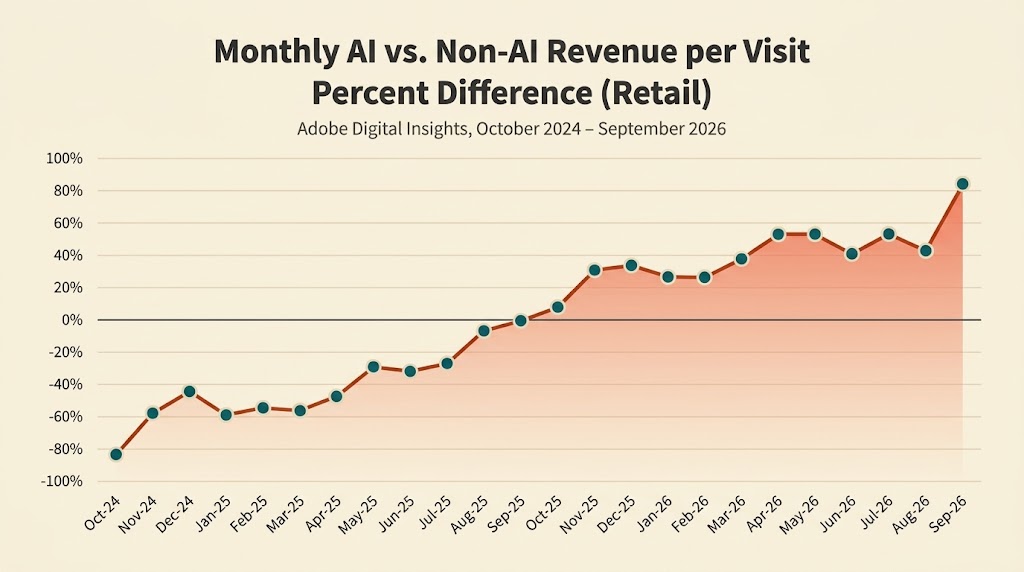
According to data from Adobe reported by MarTech, retail shoppers arriving via AI referral sources now generate 83% more revenue per visit than those from traditional channels. This shift marks a significant evolution in the commercial value of AI-assisted search, as these visitors demonstrate higher intent and deeper engagement across various digital storefront categories.
Context from Industry Pulse
The surge in AI-driven retail performance coincides with a broader industry shift toward integrating AI into the core of the customer experience. While recent acquisitions, such as Salesforce purchasing Cresta and Bond acquiring Jam, focus on enhancing CRM and support capabilities, the Adobe data highlights a critical gap in front-end optimization. Most retail homepages remain optimized for human browsing rather than AI indexing. As AI referrals evolve from a curiosity into a primary revenue driver, the focus for marketing operations is shifting toward measurable outcomes like cart behavior and customer value rather than simple referral volume. This transition requires a new approach to content structure that prioritizes AI readability alongside traditional user experience.
Retailers are seeing a dramatic shift in the quality of traffic originating from artificial intelligence platforms. MarTech reports that AI-referred visitors converted 90% better than non-AI traffic in September 2026. This represents a complete reversal from August 2025, when AI traffic actually underperformed other sources by 9%. The growth in volume is equally stark, with AI-driven visits to U.S. retail sites increasing 71% year-over-year and surging over 1,700% since late 2024.
The behavior of these shoppers suggests they arrive at retail sites further along in the purchasing journey. MarTech notes that visitors from AI sources spend 73% more time on sites, view 25% more pages, and add items to their carts at a 53% higher rate than average users. This indicates that AI assistants may be handling the preliminary research phase, leaving the brand’s landing page to finalize the transaction rather than initiate the discovery process.
Despite the high value of these visitors, many retail websites remain difficult for AI systems to interpret. Adobe’s Citation Readability Score found that the average U.S. retail homepage is only 63% understandable to AI. The discrepancy is even wider in specific sectors, where general merchandise homepages scored as low as 40%. These low scores are often caused by layouts heavy on navigation and promotions which provide little context for automated systems to extract or cite.
Conversely, content that focuses on product specifications and company policies performs much better. Electronics retailers currently lead in readability with a score of 79%, bolstered by technical documentation like setup guides and troubleshooting articles. MarTech suggests that while readability scores do not strictly prove a causal link to revenue, they provide a roadmap for where marketing teams should focus their optimization efforts to capture high-value AI traffic.
The Industry Pulse Bottom Line
Marketing teams must prioritize AI readability by moving beyond promotional layouts toward explanatory content. High conversion rates from AI referrals suggest that landing pages should now focus on closing sales rather than starting the discovery journey.