
Tonkin Liu Unveils Timber Heritage Craft Centers Flanking York Minster
London-based Tonkin Liu has completed the Centre of Excellence for Heritage Craft Skills, comprising two glulam buildings designed to facilitate the restoration of York Minster. According to Dezeen, the Heritage Quad and Technology Hub provide modern workshops and digital tools for stonemasons working to preserve the historic Gothic cathedral against climate-driven degradation.
Context from Industry Pulse
The completion of these facilities highlights a growing intersection between traditional craftsmanship and modern sustainable architecture. By selecting glulam and timber for the Heritage Quad and Technology Hub, Tonkin Liu has created a functional distinction between the new support infrastructure and the historic stone fabric of York Minster. This project, which has been shortlisted in the mixed-use category of the current Dezeen Awards, follows other notable Tonkin Liu works such as the biometric tower in Manchester and the Crystal Palace swing bridge. The focus on accelerated conservation timelines reflects the urgent need for specialized heritage infrastructure as environmental factors increase the rate of decay for centuries-old masonry and Gothic architecture.
The new architectural additions represent a significant infrastructure investment for the conservation of the Grade I-listed York Minster. As Dezeen reports, the project consists of two distinct structures: the rectangular Heritage Quad and the triangular Technology Hub. These buildings provide the first new historical-precedent constructions on the site in a century, specifically designed to accelerate the cathedral's restoration timeline by four decades over the coming hundred years.
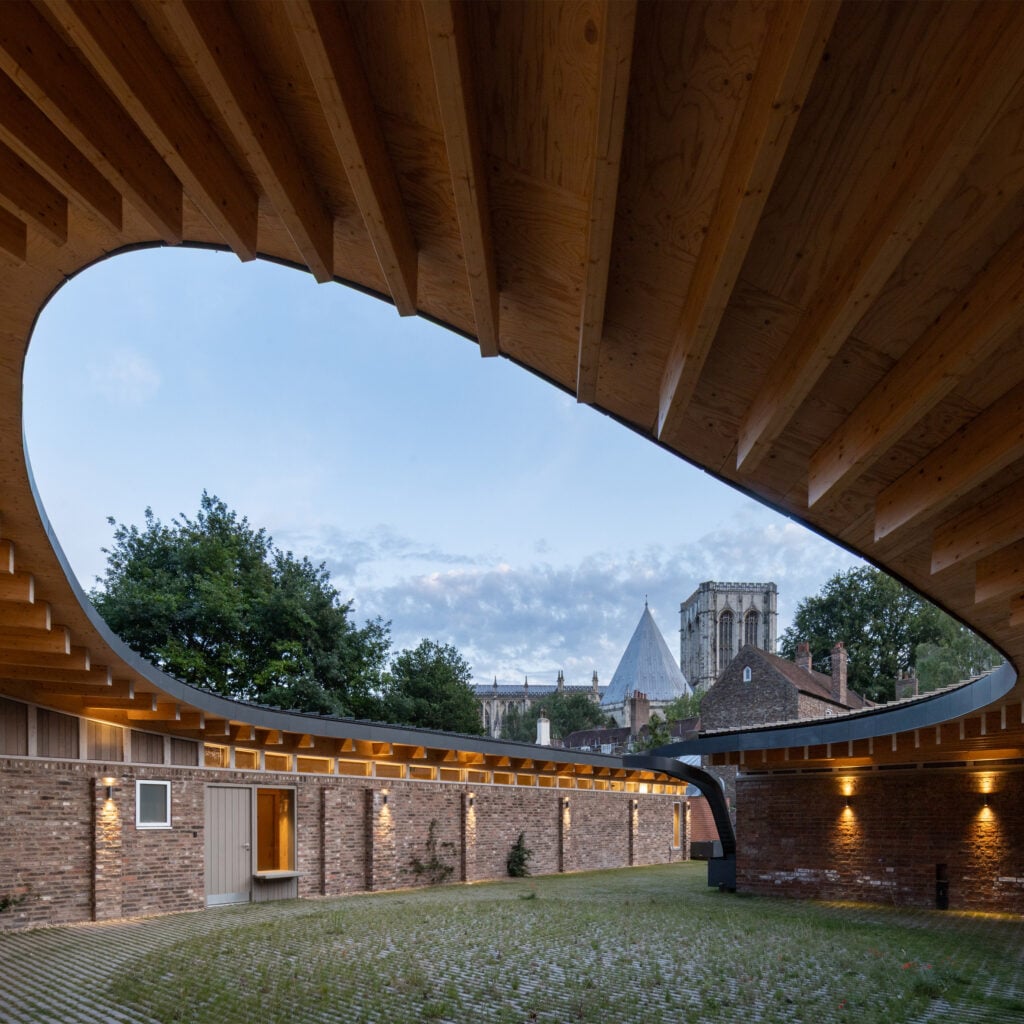
In the Heritage Quad, Tonkin Liu utilized a combination of repurposed and extended existing structures situated near the medieval city walls of York. This facility integrates workshops, educational spaces, and apprentice housing under a unified glulam and plywood roof. The architectural design features a curved roofline that serves functional purposes, such as channeling rainwater into storage tanks and providing stone masons with framed views of the cathedral while they work.
On the opposite side of the Minster, the Technology Hub serves as a center for advanced digital stone-cutting tools. This steel-and-glulam building is defined by its triangular footprint and a roof covered in photovoltaic panels. To meet strict local planning regulations regarding height and sightlines, Tonkin Liu implemented parabolic fan vaults. This design choice allows natural light to flood the workshop while ensuring the structure does not obstruct views of the Minster from nearby residential areas.
Both structures purposefully utilize timber to distinguish them from the stone-heavy Gothic cathedral they serve. Dezeen notes that the geometry of the buildings draws inspiration from ecclesiastical traditions, utilizing arches and radiating trusses to echo the cathedral’s perpendicular Gothic style. By separating the material palettes, the architects reserved stone exclusively for the historic monument while using modern timber engineering to support the craftspeople tasked with its long-term survival.
The Industry Pulse Bottom Line
Tonkin Liu demonstrates how modern timber engineering and digital fabrication can integrate into sensitive heritage sites, providing the infrastructure necessary to safeguard historic monuments against the accelerating effects of climate change.