
Global Portfolio Highlights Concrete as a Versatile Medium for Art Gallery Design
A new architectural survey from Dezeen showcases eight international art galleries that utilize exposed concrete to create contemplative environments. The collection features work from Pritzker Prize winners and explores how structural concrete can be adapted for diverse scales, from expansive elevated museum extensions to subterranean domes and monolithic pavilions housing single artworks.
Context from Industry Pulse
The emphasis on concrete in contemporary gallery design aligns with broader architectural activity reported by Dezeen and Designboom, ranging from residential projects like Taller Alberto Calleja’s concrete Casa Nova in Mexico to specialized hybrid spaces such as a concrete and metal automotive gallery café in Hong Kong. This material focus coincides with a period of high-profile architectural reveals, including Kengo Kuma’s pyramidal brick bathhouse and Peter Morris’s art deco-inspired residential work. By featuring works from Pritzker-winning firms alongside smaller studios, the survey indicates that concrete's utility persists across varying budgets and geographical constraints, serving as a reliable medium for both avant-garde forms and structural simplicity.
Architectural designs for art spaces are increasingly turning to concrete to define the relationship between structure and light. In California, Swiss architect Peter Zumthor designed the David Geffen Galleries as a curving extension to the Los Angeles County Museum of Art. As reported by Dezeen, this elevated structure snakes above the street level on seven pavilions and is wrapped in a continuous ribbon of glazing. The project demonstrates how concrete can achieve fluid, organic forms while maintaining heavy structural integrity across urban thoroughfares.
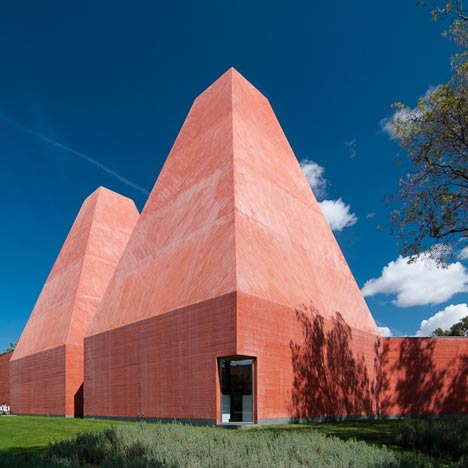
In Europe and Asia, concrete is being used to create specific atmospheric conditions for singular artistic experiences. In Portugal, Eduardo Souto de Moura utilized red-concrete walls and pyramid-like chimneys for the Casa das Histórias Paula Rego. Meanwhile, Tadao Ando constructed a subterranean concrete dome in South Korea to house a cast-iron installation by Antony Gormley. According to Dezeen, this 25-meter-wide cave-like space features a central oculus that serves as the primary light source, emphasizing the material's ability to create quiet, focused interiors.
Technological and textural applications vary widely across the surveyed projects. The Ginkgo Gallery in China, designed by MORE Architecture, features board-marked surfaces that create horizontal patterns across scooped ceilings. In contrast, the Richard Serra gallery at the Glenstone Museum in Maryland utilizes cast-in-place structural concrete paired with stainless steel. Dezeen notes that this rectangular space relies entirely on skylights for illumination, highlighting a trend where concrete serves as a neutral, durable backdrop that directs all focus toward the exhibited sculptures.
Adaptability is further demonstrated in projects like the Anselm Kiefer Pavilion in Germany by David Chipperfield Architects. This monolithic addition was built specifically to accommodate a singular large-scale artwork that was previously too large for the main museum. Similarly, the Nubuke Extended gallery in Ghana by Baerbel Mueller and Juergen Strohmayer uses a raised concrete volume to create a dual-purpose site, providing a high-ceilinged exhibition space above and a shaded gathering area below. These projects illustrate that concrete remains a primary material for architects seeking to balance monumental scale with functional intimacy.
The Industry Pulse Bottom Line
Concrete continues to dominate gallery architecture by offering a versatile range of textures and forms that prioritize light control and structural longevity for both permanent installations and revolving exhibitions.