
Stanford Engineers Build Photonic Chip to Unmask Hidden Light Details
Stanford University researchers have developed a silicon photonic chip capable of separating partially coherent light into distinct beams. According to Interesting Engineering, the device uses an optimization algorithm and a network of interferometers to isolate underlying optical modes, potentially allowing imaging systems like telescopes and microscopes to capture data previously lost to interference.
Context from Industry Pulse
The development of this photonic chip addresses a long-standing limitation in optical engineering where mixed light signals often obscure fine spatial data. By moving beyond intensity-only measurements, the Stanford team has created a programmable method to manage partially coherent light. This advancement aligns with broader trends in silicon photonics where electronic-like control is applied to optical signals. The ability to reverse the chip's function to generate specific coherence structures adds further utility for optical sensing. While the current prototype handles a limited number of modes, the proof of concept suggests that scaling this technology could redefine the precision of both terrestrial microscopy and space-based observation.
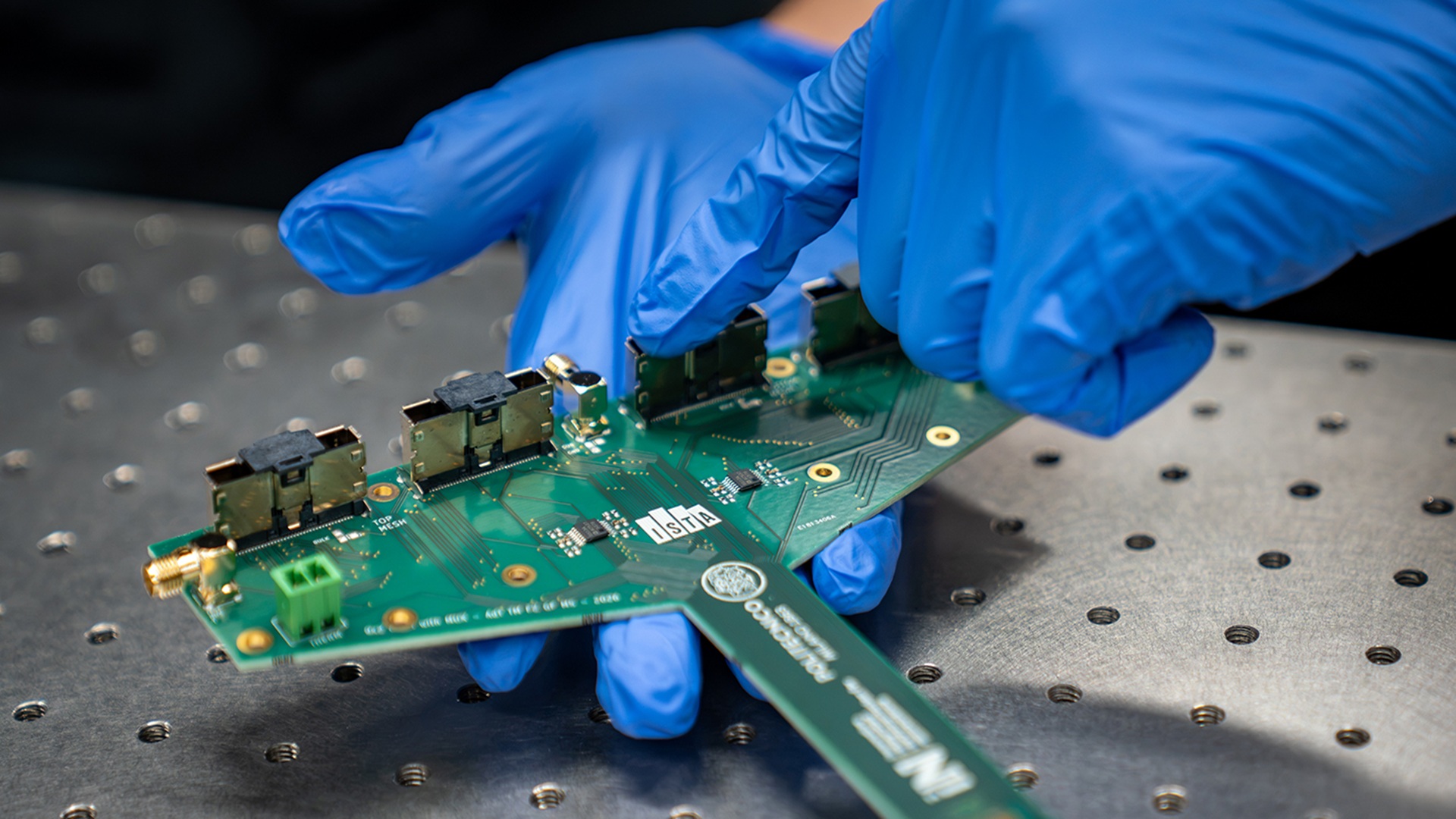
Engineers have successfully demonstrated a hardware solution for a theoretical challenge in optics that had remained unsolved for decades. The fingernail-sized device utilizes a self-configuring silicon photonic circuit to analyze mixed optical fields. By processing light through a series of interferometers, the system can identify and physically route individual coherence modes to separate output channels. As Interesting Engineering reports, this allows for the recovery of spatial and phase information that conventional cameras typically fail to record.
The experimental setup involved feeding two independent infrared lasers into a nine-input device. The chip utilized a specific optimization algorithm to diagonalize the coherency matrix of the light field, effectively producing orthogonal modes that do not interfere with one another. This process achieved a fidelity rate exceeding 98 percent when compared to standard reference tomography methods. A subsequent experiment confirmed the hardware remains effective when processing three distinct modes.
Traditional optical systems are generally optimized for coherent light, such as that produced by lasers. However, natural and ordinary light sources often produce partially coherent fields where overlapping contributions can mask critical details. Interesting Engineering notes that the new chip can distinguish between these overlapping contributions, which could prove vital for high-resolution microscopy. For instance, the technology could help separate the light from two fluorescent particles that would otherwise appear as a single feature.
The research team is currently working with NASA to determine if this photonic approach can improve deep-space observations. Telescopes often struggle with bright astronomical features that may actually contain light from multiple distinct stars. By separating these modes, astronomers could gain a clearer understanding of distant galaxies. Beyond the scope of imaging, the developers suggest the programmable architecture could eventually enhance optical communication, sensing, and computing technologies by providing better control over light structures.
The Industry Pulse Bottom Line
This photonic breakthrough enables the physical separation of overlapping light signals, offering a new tool for high-precision imaging and NASA-led astronomical research that requires resolving hidden details in complex optical fields.