
German Physicists Use Magnetic Fields To Bridge Graphene Bandgap For Solar Cells
According to reporting from Interesting Engineering, researchers at Helmholtz-Zentrum Dresden-Rossendorf have developed a method to utilize graphene as a primary semiconductor in photovoltaic applications. By applying a magnetic field and specific voltages to thin carbon sheets, the team successfully directed electron flow to overcome the material's natural lack of a bandgap.
Context from Industry Pulse
The engineering community is currently prioritizing efficiency gains across diverse hardware sectors, from the development of high-speed micro-LEDs to the optimization of propulsion systems for single-aisle aircraft. While graphene has long been praised for its conductivity, its inability to maintain the electron-hole separation required for power generation relegated it to a secondary role behind silicon. This HZDR breakthrough suggests a path toward tunable electronics that capture infrared light, a spectrum where traditional silicon cells struggle. As materials science continues to dominate academic fellowships and laboratory breakthroughs, the industry should monitor whether these magnetic field requirements can be miniaturized for commercial hardware integration.
"The advantage of this approach is that the charge transport can be adjusted to different light energies by changing the voltage or switching off the electrodes."
Researchers at the Helmholtz-Zentrum Dresden-Rossendorf in Germany have proposed a methodology to utilize graphene as a core material for solar cells and light sensors. According to Interesting Engineering, this approach could potentially replace silicon in specific electronic applications, allowing light to function directly as a power source. While graphene is a single-atom-thick hexagonal lattice of carbon known for high conductivity, it naturally lacks the bandgap found in semiconductors like silicon. This absence of a bandgap usually prevents the material from efficiently separating excited electrons from their corresponding holes to generate electricity.
To overcome this physical limitation, scientists initially explored physical modifications to the material. As Interesting Engineering reports, Ralf Schützhold, a professor at HZDR, suggested that cutting or folding graphene to create tiny edges could act as guardrails. When combined with a magnetic field, these edges would theoretically direct electrons and holes in opposite directions. However, this mechanical approach was deemed difficult to scale for commercial or industrial use, leading the team to investigate more practical alternatives using electrical fields.
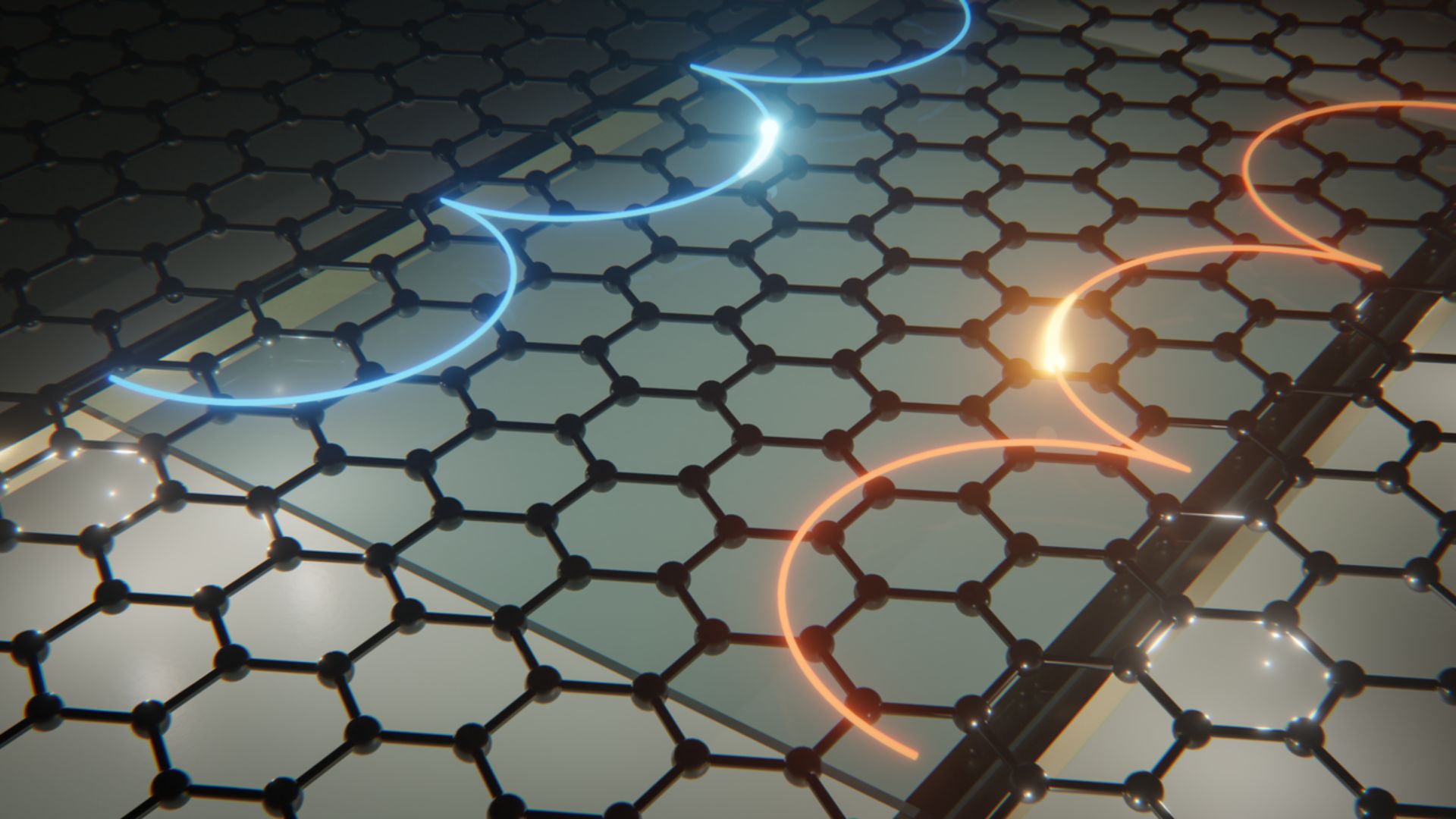
The refined method involves applying electric voltage through narrow metal electrodes placed on an insulating layer atop the graphene. This setup creates potential barriers that serve as electronic guardrails. Interesting Engineering notes that when a magnetic field is introduced, the resulting circular paths of the charge carriers are converted into directed motion by these voltage-created barriers. A negatively charged barrier reflects electrons while a positive one attracts them, allowing for the precise separation and collection of charges necessary to produce a current.
This graphene-based architecture offers significant advantages over traditional silicon cells, particularly regarding the light spectrum. As Interesting Engineering explains, while silicon is limited to visible light, graphene can capture infrared photons that are typically too weak to trigger electron-hole pairs in standard semiconductors. The research indicates that a magnetic field of 0.1 Tesla and micrometer-scale spacing are sufficient for infrared conversion. Furthermore, the system is highly adjustable; operators can tune the charge transport for different light energies by simply varying the voltage or toggling the electrodes.
The Industry Pulse Bottom Line
This discovery transforms graphene from a passive conductor into a functional semiconductor capable of harvesting infrared energy. If scalable, this architecture offers a viable alternative to silicon in environments where light energy is too weak for conventional solar cells.