
Seoul National University Researchers Develop 0.6-Volt Ferroelectric Capacitor
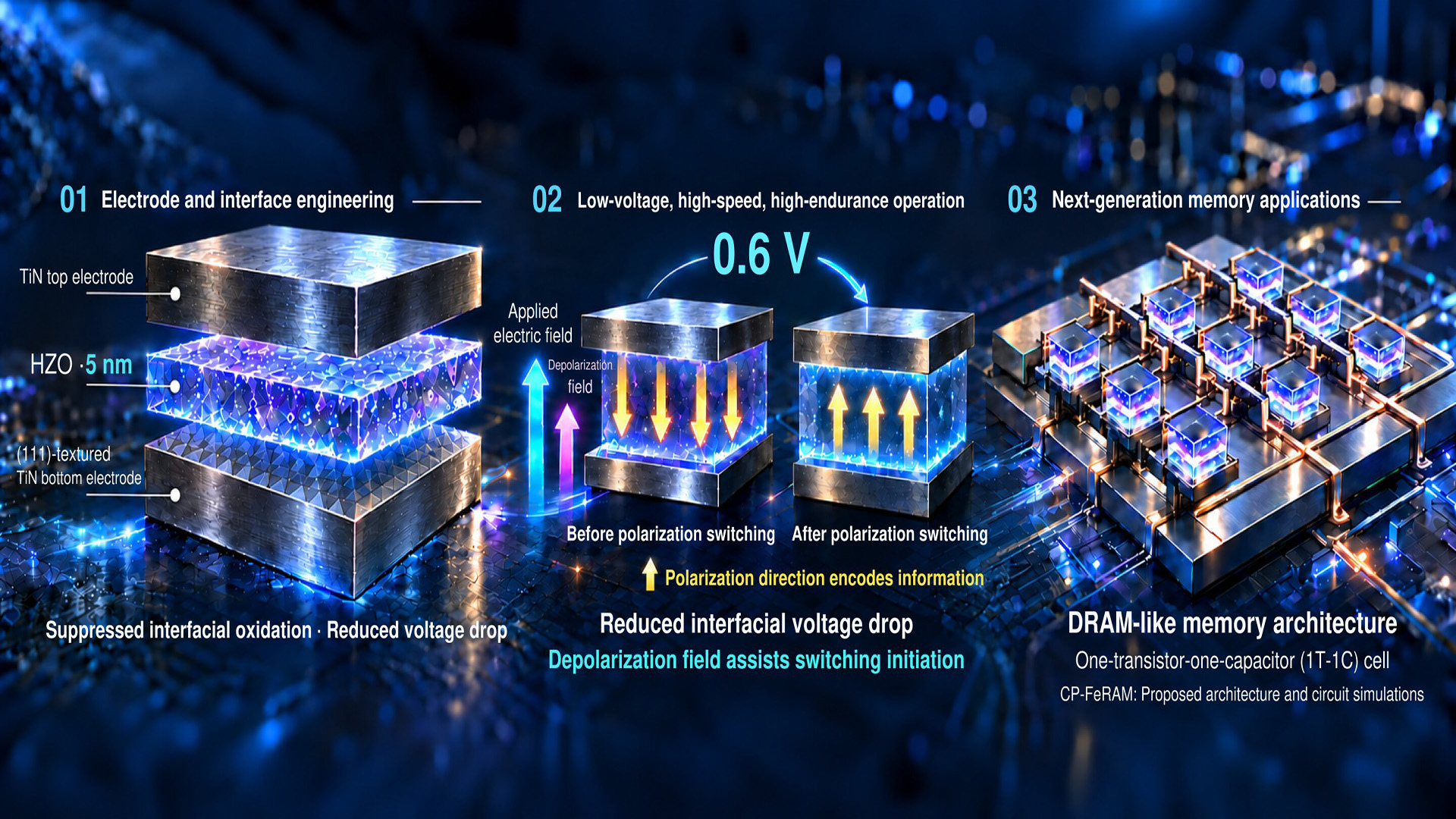
A Seoul National University team, alongside Samsung Electronics, has developed a ferroelectric memory capacitor capable of switching at 0.6 volts. As reported by Interesting Engineering, the device survived 1 trillion cycles without permanent electrical failure, potentially offering a low-power, non-volatile alternative to standard DRAM in future AI servers and smartphone hardware.
Context from Industry Pulse
The collaboration between Seoul National University and Samsung Electronics addresses a primary bottleneck in modern computing: the energy cost of volatile memory. Because DRAM requires constant electricity to maintain data, it generates heat and consumes significant power in high-density AI server environments. By utilizing hafnium zirconium oxide—a material already familiar to the semiconductor manufacturing industry—this team has demonstrated a path toward non-volatile storage that mimics DRAM speeds without the leakage issues. The use of 0.6-volt switching is particularly significant as it aligns with the low-voltage requirements of advanced logic circuits, potentially allowing memory and processing to integrate more efficiently on a single die.
"The researchers found switching tended to get faster as device area shrank, and the paper projects sub-nanosecond reversal at capacitor sizes relevant to DRAM."
Engineers are seeking alternatives to dynamic random-access memory because current designs lose electrical charge and require constant power to refresh stored data. According to Interesting Engineering, ferroelectric memory avoids this inefficiency by storing bits via material polarization. While hafnium zirconium oxide is a common material for these applications, increasing its switching speed usually necessitates higher voltages that degrade the component over time.
The research team addressed this trade-off by modifying the interface between a five-nanometer film and the titanium nitride electrodes. By controlling the crystal orientation and suppressing oxidation at the boundary, the researchers reduced voltage loss and enabled more uniform switching. Interesting Engineering reports that an internal field, which typically acts as a drawback in ferroelectric designs, was leveraged to initiate switching at lower energy levels.
Performance tests revealed that the capacitor flipped half of its polarization in 42 nanoseconds at 0.6 volts, dropping to 8 nanoseconds when increased to 1 volt. Although these speeds currently sit above the nanosecond threshold, the team used measurements to project that shrinking the device area to sizes relevant for DRAM would result in sub-nanosecond reversal. The capacitor demonstrated high durability, maintaining stability through 600 billion cycles at 0.6 volts and 1 trillion cycles at 1 volt.
While the technology has not yet been integrated into a finished memory chip, simulations suggest the design remains readable even after significant charge loss. Interesting Engineering notes that the researchers also tested a common-plate memory array to ensure uniform behavior across neighboring devices. The project received funding from Samsung Electronics and aims to provide a scalable solution for high-density and embedded memory systems.
The Industry Pulse Bottom Line
This breakthrough in ferroelectric capacitors offers a high-endurance, low-voltage alternative to DRAM. If extrapolated speeds hold during miniaturization, this architecture could significantly reduce power consumption in AI-driven data centers and mobile devices.