
OGR Torino Exhibition Fuses Quantum Mechanics with Contemporary Art
As Designboom reports, a new exhibition titled The Quantum Effect has opened at OGR Torino. Curated by Daniel Birnbaum and Jacqui Davies, the show utilizes mirrors, primates, and monoliths to investigate complex physics through a creative lens, featuring works by Mark Leckey, Yayoi Kusama, and Tomás Saraceno that challenge traditional perceptions of linear time.
Context from Industry Pulse
The Quantum Effect at OGR Torino represents a growing intersection between high-level physics and contemporary curation. By involving Ulf Danielsson, Secretary of the Nobel Committee for Physics, the curators anchor speculative art in established theoretical frameworks like Heisenberg’s Uncertainty Principle and Dirac’s Equation. The inclusion of primates and monoliths specifically draws from mid-century cinematic tropes to bridge the gap between abstract mathematics and public consciousness. This multidisciplinary approach utilizes established art history, particularly Duchampian concepts of repetition and fracture, to provide a tangible entry point into the intangible world of quantum theory, reflecting a broader cultural interest in the limitations of human perception and linear time.
"The influence of the Dadaist artist is both present and absent in these referential works, existing in a kind of impossible state of influence."
The exhibition at OGR Torino functions as a visual dialogue between artistic expression and theoretical physics. According to Designboom, the curators collaborated with Professor Ulf Danielsson of Uppsala University to integrate essential scientific equations into the show. These mathematical formulas are displayed on black monoliths, referencing cinematic history while being juxtaposed with footage from popular culture. This framing suggests a deep connection between the speculative nature of science fiction and the rigorous study of quantum theory.
A significant portion of the show traces the enduring influence of Marcel Duchamp. Designboom notes that the exhibition highlights Duchamp’s use of fracture and repetition through a 1923 Man Ray photograph and Sturtevant’s 1992 photographic interpretation of his work. Modern installations continue this theme of fragmentation, such as Cerith Wyn Evans’s mobile constructed from cracked windshields and a film by Mark Leckey depicting a body shattering a glass wall. These pieces serve as metaphors for the multiple simultaneous states and uncertainty found in quantum mechanics.
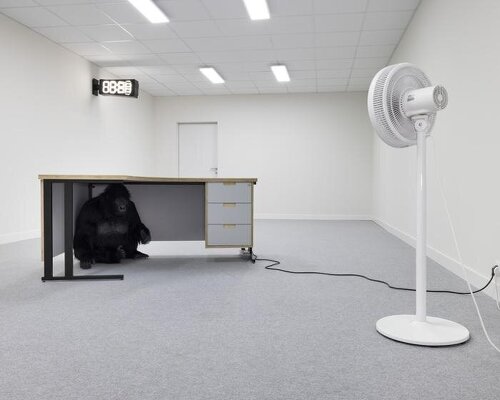
Primate imagery serves as another central motif, often used to question the progression of human history. Designboom describes Rirkrit Tiravanija’s 2025 installation featuring man-ape figures interacting with a replica of a Duchamp comb. Similarly, Ryan Gander contributes an office-themed space containing a hidden ape and a digital clock displaying a non-existent time of 88:88. These elements collectively disrupt the idea of a simple, straight progression from ancestor to modern man.
The installation design further emphasizes themes of disorientation. Visitors enter through a series of mirrors and view projections that collapse their own perception of the space. As Designboom reports, the goal of the exhibition is not to provide a definitive explanation of the universe but to embrace its elusiveness. Through the intricate webs of Tomás Saraceno and other diverse artistic gestures, the curators create a space for wonder and speculation regarding the fundamental nature of reality.
The Industry Pulse Bottom Line
The Quantum Effect demonstrates how curators can leverage popular culture and scientific expertise to translate complex theoretical concepts into immersive environments, challenging traditional narratives of human progress and the nature of time.