
Igor Dzukovski Debuts Tidal Wave Carbon Fiber Transparent Surfboard Prototype
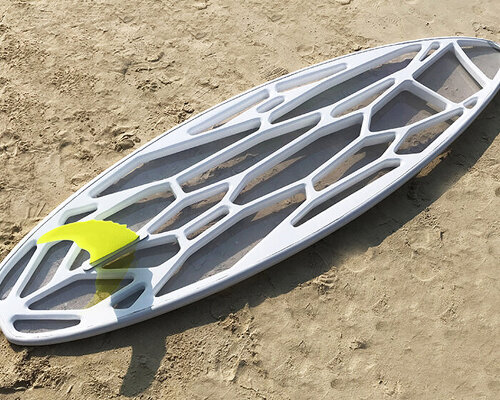
Industrial designer Igor Dzukovski has developed Tidal Wave, an experimental surfboard prototype that utilizes a carbon-fiber skeleton and clear resin panels. According to Designboom, the project prioritizes sensory engagement with the marine environment over traditional performance metrics by creating an optical frame that reveals the water directly beneath the rider.
Context from Industry Pulse
The Tidal Wave prototype reflects a broader design movement toward exposing structural mechanics and utilizing advanced fabrication to enhance environmental interaction. By incorporating 3D printing and carbon-fiber ribbing as visible design features, Dzukovski aligns with contemporary trends seen in recent art factories and robotic interfaces where tectonic elements are treated as aesthetic subjects. The project's presence at major design summits in Dubai highlights a shift in performance equipment from purely functional tools to immersive optical frames. This transparency-focused approach mirrors recent installations that use water and light to facilitate a deeper understanding of natural landscapes through material innovation.
The Tidal Wave prototype replaces the opaque surfaces of traditional surfboard construction with a structural transparency intended to incorporate light, depth, and currents into the aesthetic of the board. As Designboom reports, the design is anchored by an exposed white carbon-fiber skeleton featuring organic, fluid ribbing. These skeletal elements frame large transparent apertures that allow for uninterrupted sightlines through the deck to the ocean floor.
Material selection for the board balances visual clarity with the physical requirements of aquatic handling. The carbon-fiber frame provides necessary structural stiffness and a lightweight profile. To manage the skin of the board, Dzukovski utilized clear panels that allow ambient light and water reflections to pass through the body of the craft. This approach treats the surfboard as a tectonic feature rather than a simple platform for surface graphics.
At the stern, the board features a custom pectoral fin produced through additive manufacturing. Designboom notes that this 3D-printed component utilizes a complex sculptural geometry to improve maneuverability and water-flow control. The fin is finished in a high-visibility fluorescent yellow, providing a sharp chromatic contrast against the white frame and translucent resin skin. When illuminated by sunlight, the layered construction of the 3D-printed material becomes visible through the translucent finish.
Tidal Wave has been showcased internationally as a study in advanced composites and digital fabrication. The project was previously exhibited at Expo 2020 Dubai and Dubai Design Week 2021. By exposing the internal structural pattern and removing visual barriers between the surfer and the sea, the designer attempts to reframe the equipment as a tool for environmental observation.
The Industry Pulse Bottom Line
Dzukovski’s Tidal Wave prototype demonstrates how advanced composites and additive manufacturing can be leveraged to prioritize environmental visibility, shifting the focus of sporting equipment from surface-level aesthetics to structural transparency.