
Jakob Kudsk Steensen Explores Deep-Sea Agency in Psychosphere Installation
Artist Jakob Kudsk Steensen has unveiled Psychosphere, a five-year multimedia project examining the origins of life and biological agency. According to Designboom, the installation premiered at the Cisternerne in Denmark before traveling to the 2025 United Nations Ocean Conference, utilizing deep-sea footage and sculptural elements to challenge human-centric views of the natural world.
Context from Industry Pulse
Deep-sea ecosystems are increasingly becoming a focal point for both creative inquiry and industrial interest. Steensen’s work arrives amid heightened global debate over deep-sea mining, where the tension between resource extraction and biodiversity preservation is paramount. By integrating data from research vessels like the REV Aurora, the project aligns aesthetic exploration with scientific documentation. The collaboration with Melanie Challenger provides a philosophical foundation that moves environmental discourse away from anthropocentrism. By presenting this work at the United Nations Ocean Conference, the project transitions from a museum curiosity to a visual argument for expanded legal protections for non-human organisms in the most remote parts of the planet.
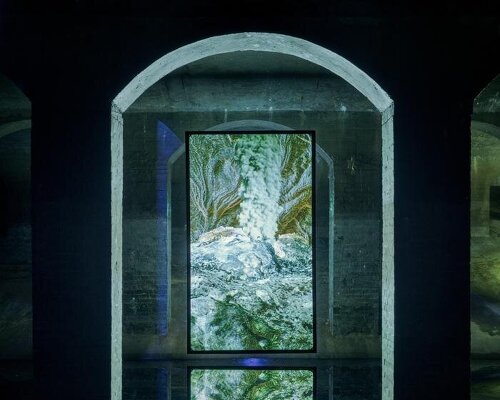
The installation at Frederiksberg Museums utilizes the unique architecture of the Cisternerne, a former water reservoir in Copenhagen. As Designboom reports, the cold and humid environment creates natural puddles that mirror the projected visuals, simulating the experience of diving beneath the ocean surface. The work combines the artist’s own footage from the Azores and Aeolian Islands with scientific data gathered by the research vessel REV Ocean/REV Aurora. This collaborative effort involves composers and scientific researchers to visualize volcanic sites where life originally emerged from non-organic matter.
Central to the exhibition is the concept of the psychosphere, a term developed by theorist Melanie Challenger. According to Designboom, this framework suggests that the ability to act with purpose distinguishes living beings from passive matter. By framing the ocean as a collection of diverse agents rather than merely a pool of genetic resources, the project encourages a shift in environmental values. It specifically addresses how species survival mechanisms differ from the passive degradation seen in inanimate objects like rock or water.
Three distinct sculptural series anchor the physical space of the exhibition. Designboom notes that the central piece, titled Abiogenesis, is joined by Orogeny, a collection of interactive glass works inspired by ancient desert sites. A third series, Amorphous, uses resin and fiberglass to recreate the forms of extinct sea lily specimens based on archival sketches. These physical elements complement the digital recreations of underwater volcanic landforms and marine fossils, bridging the gap between biological history and speculative art.
Beyond its museum debut, the project has transitioned into a diplomatic tool for environmental advocacy. Designboom indicates that an immersive LED tunnel version of the work was presented at the 2025 United Nations Ocean Conference. This iteration aims to influence the dialogue surrounding deep-sea mining by emphasizing the inherent rights of organisms living in extreme environments. By highlighting the complexity of these ecosystems, Steensen’s work argues against prioritizing resource extraction over the protection of interconnected deep-sea species.
The Industry Pulse Bottom Line
Psychosphere demonstrates how immersive digital art can serve as a catalyst for environmental policy, using scientific collaboration to reframe deep-sea organisms as biological agents with intrinsic value.