
Artist SpY Installs 20-Meter Surveillance Monolith in Madrid Plaza de Cibeles
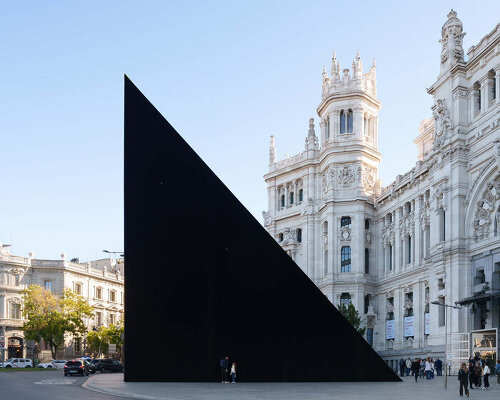
Urban artist SpY has debuted PANOPTICON, a massive matte black triangular installation in Madrid that uses closed-circuit television to examine modern surveillance. According to Designboom, the 20-meter temporary structure sits in the Plaza de Cibeles, challenging the public's relationship with privacy and observation by turning pedestrians into both the observers and the observed through live video feeds.
Context from Industry Pulse
The PANOPTICON installation by SpY aligns with current creative explorations into the intersection of public space and permanent connectivity. As reported by Designboom, this Madrid project arrives alongside other global works questioning the politics of utopia and the nature of mediated vision in an age of constant tracking. By utilizing CCTV cameras and high-angle video feeds, the installation transforms Bentham’s eighteenth-century architectural theory into a tangible experience for the digital era. It addresses the tension between the classical stone architecture of Madrid and the invisible digital layers that now define urban movement, mirroring a broader industry trend of using large-scale public art to critique the pervasive nature of institutional and digital observation.
"The dark, monolithic geometry introduces an abrupt formal contrast against the ornate historic facade of the Palacio, directly intercepting established sightlines across the civic square."
The installation occupies a central position within the Plaza de Cibeles, situated directly in front of the historic Palacio de Cibeles. As Designboom reports, the structure is designed as an equilateral triangle with 20-meter sides, featuring a monolithic matte black finish that provides a stark aesthetic contrast to the ornate stone architecture of the surrounding city. This geometry serves to physically block established sightlines and alter the natural flow of pedestrian traffic through the square.
While the exterior presents an opaque and imposing volume, the lower section of the installation is punctured with discreet viewing apertures. Designboom notes that these openings invite visitors to look inside the framework, where they encounter digital display monitors. These screens are connected to a network of CCTV cameras mounted at the apex and along the upper rim of the triangle, creating a closed-circuit loop within the public space.
Inside the structure, the monitors broadcast fragmented, real-time footage of the area surrounding the installation. Visitors viewing these feeds see high-angle perspectives of pedestrians, street traffic, and architectural details. This mediated vision places the observer in an elevated vantage point, effectively projecting live surveillance of the public square back to the people occupying it.
According to Designboom, the project draws conceptual inspiration from Jeremy Bentham’s eighteenth-century panopticon model. By utilizing modern tracking technology, the artist explores how digital systems and camera mediation govern movement and privacy in contemporary urban environments. The work serves as a physical representation of the apparatuses that monitor modern society, forcing a direct interaction with the mechanics of public observation.
The Industry Pulse Bottom Line
SpY’s PANOPTICON demonstrates how large-scale architectural interventions can force public engagement with invisible surveillance systems, turning a civic square into a live laboratory for studying the effects of the panopticon on modern privacy.