
SKNYPL Repurposes Construction Scaffolding for Lugano Biennale Installation
Architecture practice SKNYPL has introduced a multi-site installation for the 6th Biennale Svizzera del Territorio in Lugano. According to Designboom, the project utilizes modular scaffolding and safety mesh to create public observation platforms that overlook urban voids and threatened nineteenth-century villas, challenging the current criteria for architectural preservation in Switzerland.
Context from Industry Pulse
The 6th Biennale Svizzera del Territorio, themed Handle with Care, provides the backdrop for this investigation into the fragility of the built environment. Lugano presents a unique paradox where visible municipal maintenance masks the steady loss of nineteenth and twentieth-century heritage. This project aligns with a broader architectural discourse on adaptive reuse and the ethics of demolition. By utilizing the very materials that signal an end to a building's life—scaffolding and safety mesh—SKNYPL forces a confrontation with the temporary nature of urban fabric. The installation shifts the utility of construction infrastructure from a tool of transition to a platform for civic reflection and preservation advocacy.
As Designboom reports, the installation titled Sit For A While addresses the friction between urban upkeep and the demolition of historic structures. SKNYPL developed the project following extensive archival research and a review of municipal documents. Their findings highlighted a specific urban pattern in Lugano where unprotected twentieth-century buildings and older villas are frequently razed, creating significant gaps in the city's architectural landscape despite its well-maintained reputation.
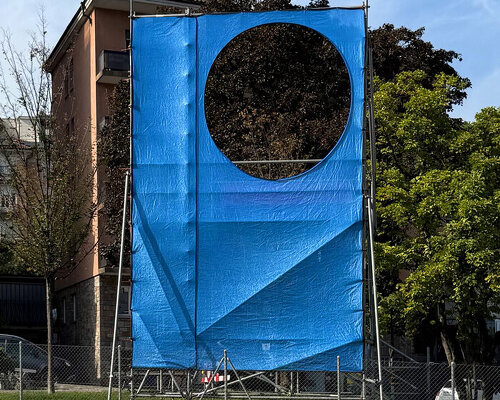
The studio utilized standard construction materials including scaffolding pipes, walkboards, and synthetic safety mesh to build the intervention. Designboom notes that these materials were intentionally selected because they are typically associated with site turnover and impending destruction. By converting these temporary industrial elements into elevated seating areas, the architects have reframed the way the public interacts with contested urban spaces.
The project occupies two distinct locations within the city. The first site is situated at Piazzale di Besso near the central railway station. This blue-clad installation sits within an unbuilt void left behind by a structure that was demolished years ago and never replaced. It serves as a vantage point for residents to observe the lingering silence of the empty plot and reflect on the memory of the location.
The second site is located at Via Pazzalino 1, where a green-mesh platform faces a decommissioned municipal school. This specific building is currently the subject of administrative debate and faces a potential teardown. Designboom indicates that the translucent enclosures at both sites provide quiet spaces for observation, forcing viewers to confront the architectural lifecycle of existing buildings and the criteria used to determine their survival.
The Industry Pulse Bottom Line
SKNYPL’s use of construction infrastructure as a medium for public observation highlights the tension between urban development and preservation, turning sites of demolition into spaces for critical civic engagement.