
Waiting For Ideas Debuts Optical Turntable and Conceptual Tokyo Listening Room
Parisian design studio Waiting For Ideas has unveiled the PP-2, a second-generation aluminum turntable that utilizes optical technology to read vinyl grooves. As Designboom reports, the release is accompanied by a conceptual architectural project titled Pause, which envisions a transparent glass listening cube suspended over water in Tokyo featuring a subterranean record library.
Context from Industry Pulse
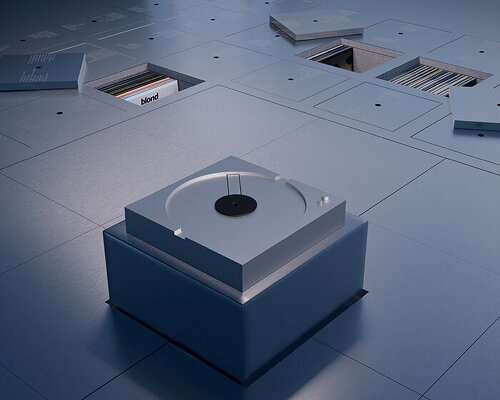
The transition from the PP-1 to the PP-2 highlights a design philosophy that prioritizes minimalist industrial aesthetics alongside advanced optical hardware. By removing the traditional tonearm and concealing the playback mechanism within a solid aluminum block, Waiting For Ideas shifts the focus from mechanical operation to the object as a sculptural piece. The accompanying Pause concept further expands this by integrating the media library into the floor of a glass cube. This architectural approach treats vinyl not just as a playback format, but as a structural element that dictates the layout of a dedicated listening environment, emphasizing the physical ritual of interacting with analog media.
"the music library becomes part of the architecture itself, and choosing an album involves physically opening the floor."
The PP-2 represents an evolution of the studios previous hardware, maintaining a minimalist CNC-machined aluminum aesthetic that lacks a visible tonearm. According to Designboom, the device functions by placing records upside down, allowing a concealed internal mechanism to read the media from below. While the exterior remains consistent with the original design, the internal hardware has been significantly upgraded to include an optical stylus system.
This new technology utilizes light to monitor the physical movements of a needle as it traverses vinyl grooves. Designboom notes that while the needle maintains physical contact with the record, the system avoids the magnets and coils used in traditional cartridges. This design choice reduces the stylus mass, which the studio claims allows for more precise tracking and the retrieval of finer audio details. The internal components also feature an axial-flux direct-drive motor that performs speed adjustments 1,000 times per second and an analog preamplifier specifically designed for optical pickups.
In addition to the hardware, the studio introduced an architectural vision called Pause. This concept, documented by Designboom, places the turntable at the center of a glass structure in central Tokyo. The design replaces traditional wall shelving with a grid of floor panels. Each panel serves as a hatch that conceals a portion of a music library, with artist names engraved directly onto the floor surfaces.
The architectural proposal emphasizes the ritual of music selection by requiring listeners to physically open the floor to retrieve albums. The surrounding glass walls and water feature are intended to provide a visual buffer from the urban environment. While the Pause listening room remains a rendered concept, the PP-2 turntable has entered production with a multi-week assembly lead time. New hardware features include RCA outputs for hi-fi connectivity and a protective door to shield the stylus from debris.
The Industry Pulse Bottom Line
The PP-2 and its conceptual listening room reflect a growing intersection between high-end audio engineering and minimalist architecture, where the physical act of record collecting is elevated into a spatial experience.