
Vintage Wienermobile Pedal Cars Head to Auction in Rare Single-Lot Offering
Two unridden Oscar Mayer Wienermobile pedal cars from the 1990s are heading to auction as a single lot on Bring a Trailer. According to Designboom, these new-old-stock collectibles represent the enduring legacy of a promotional vehicle that has served as a fixture of American visual culture and mobile advertising since its 1936 debut.
Context from Industry Pulse
The Wienermobile represents a rare example of 1930s experimental marketing that has survived through decades of shifting media landscapes. Originally a metal-bodied curiosity for the streets of Chicago, the vehicle survived the transition from physical road shows to the television era and back again. Its evolution involves contributions from notable industrial designers like Brooks Stevens, who helped codify the rounded, mid-century aesthetic now mirrored in the 1990s pedal cars. The fact that Kraft Heinz continues to operate six full-sized units nearly 90 years later underscores the lasting power of high-concept, whimsical automotive branding in establishing long-term consumer recognition.
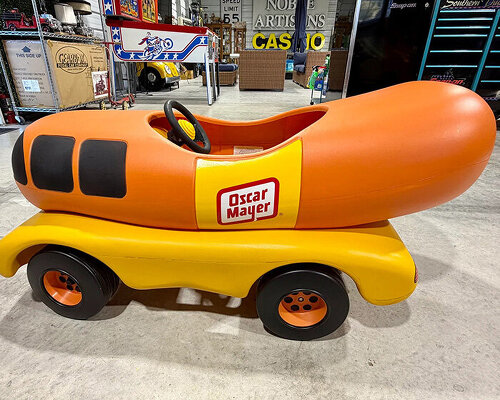
The upcoming auction features two distinct miniature interpretations of the famous hot dog-shaped vehicle, manufactured by Bird Corporation and Konek Inc. As Designboom reports, both units maintain the classic orange-and-yellow color scheme but utilize different construction methods. The Bird Corporation version is built with a one-piece plastic body over a yellow chassis, whereas the Konek model features a two-piece orange body and specific dimensions of roughly 114 centimeters in length. Both toys include metal frames, molded yellow seats, and black steering wheels equipped with yellow horn buttons.
These pedal cars are part of a long history of brand extensions following the 1936 introduction of the original Wienermobile. The first full-size version was proposed by Carl G. Mayer and constructed by the General Body Company in Chicago. That metal-bodied prototype measured four meters long and served as a mobile stage for promotional characters. The design evolved significantly in 1958 when industrial designer Brooks Stevens introduced a bubble-nose aesthetic that better integrated the bun and wiener elements into a cohesive silhouette.
While Oscar Mayer briefly paused the program in the late 1970s to focus on television marketing, public demand led to its revival for the company's 50th anniversary in 1986. Designboom notes that the vehicles have since become permanent fixtures at parades and supermarkets across the United States. Today, the fleet is managed by parent company Kraft Heinz, which operates six full-size vehicles that continue to drive the brand's physical presence on American roads.
The auction of these 1990s toys highlights how the Wienermobile transitioned from a simple advertising experiment into a collectible icon. By translating the automotive design into child-sized ride-ons, the manufacturers replicated details like faux headlights, grilles, and black window graphics. The presence of these new-old-stock examples at auction offers a look at how promotional designs are preserved as cultural artifacts long after their production cycles end.
The Industry Pulse Bottom Line
The auction of these vintage pedal cars proves that successful promotional design can transcend its original purpose, evolving from a simple mobile billboard into a sought-after collectible that defines American visual culture.