
Marius Boekhorst Reimagines Floral Still Lifes Through Geometric Patterned Glass
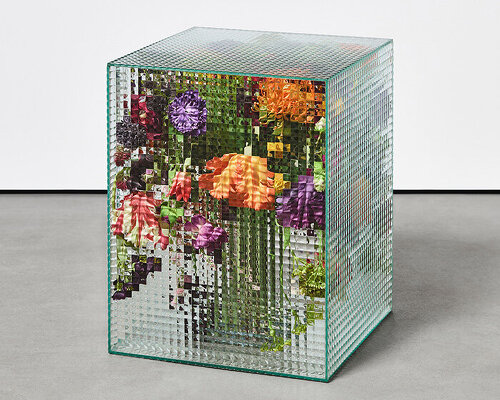
Dutch artist Marius Boekhorst has debuted the Violet series, a collection of three-dimensional sculptures that utilize architectural patterned glass to deconstruct botanical forms. As reported by Designboom, the project explores the tension between rigid geometric structures and organic life, transforming flowers into abstract mosaics of light and color through refractive glass panels.
Context from Industry Pulse
The Violet series emerges within a broader design landscape currently focused on rethinking human relationships with the natural world. According to Designboom, this work is part of an exploration into posthuman aesthetics, where the focus shifts away from human-centric measures toward a dialogue between living materials and emerging structural technologies. Boekhorst’s use of industrial glass to filter organic matter reflects a growing interest in interspecies architecture and regenerative landscapes. This movement, supported by global cultural platforms like INDX|GLOBAL, seeks to place traditional artistic subjects like botany in conversation with architectural intelligence to discover new ways of experiencing the planet's biodiversity through a filtered, structural lens.
"The glass functions like a lens framing nature while interrupting its representation, applying a filter over the original image."
The Violet series employs materials traditionally reserved for domestic utility, such as window partitions and doors, to serve a purely aesthetic function. According to Designboom, Boekhorst utilizes the textured surfaces of these glass types to act as a physical lens, distorting the floral arrangements held within. By arranging these panels into geometric volumes, the artist creates a layered visual experience where petals and foliage are no longer seen as distinct biological entities but as fragmented patches of vibrant pigment.
Specific iterations of the work, including the Violet Pixel and Violet Frosted installations, highlight different optical effects. Designboom notes that the Pixel variant uses a grid-like structure to break imagery into small, sharp squares of color, while the Frosted version softens the subjects into blurred, ethereal gradients. This mechanical interruption of the natural form forces a slower pace of observation, as the viewer must navigate the transparency and distance created by the glass shell to recognize the underlying botanical subjects.
Beyond the three-dimensional sculptures, the project has been adapted into a series of two-dimensional art prints. These works maintain the fragmented visual language of the original sculptures but translate the depth and materiality of the glass into a flat, graphic format. Designboom explains that the central theme across both mediums is the coexistence of structure and nature, where neither the rigid glass nor the irregular flowers dominate the composition.
By treating glass as a canvas and flowers as paint, Boekhorst redefines the traditional still life for a modern context. The intersection of surfaces creates a dense interplay of refraction, where pinks, reds, and greens merge into overlapping shards. This methodology effectively obscures the exact shapes of leaves and petals, replacing botanical detail with a study on how light and texture can reshape the perception of familiar objects.
The Industry Pulse Bottom Line
Marius Boekhorst’s work demonstrates how industrial materials can be repurposed to challenge traditional botanical representation, signaling a shift toward abstract, tech-mediated interpretations of the natural world in contemporary art.