
Kongjian Yu and Turenscape Pioneer Ecological Infrastructure in Urban China
A new publication by Charles Waldheim examines two decades of work by Chinese landscape architect Kongjian Yu. According to Designboom, the study analyzes 60 built experiments by Turenscape that utilize the sponge city concept, transforming degraded industrial zones into regenerative habitats that manage flood risks and pollution while integrating natural systems into the urban fabric.
Context from Industry Pulse
The work of Kongjian Yu represents a significant shift in urban planning, moving away from hard engineering toward soft, adaptive systems. This approach, documented in Landscapes for Adaptation: Evidence from China, aligns with contemporary theories like sympoiesis, where environments are produced collectively by multiple species rather than controlled by humans alone. By integrating water treatment, habitat creation, and public space into single sites like Houtan Park and Yichang Yunhe Park, Turenscape addresses the urgent needs of climate volatility. However, the success of such green infrastructure depends on long-term factors beyond initial design, including habitat connectivity, water quality maintenance, and the ability of various species to survive within human-centric urban priorities.
Designboom reports on the evolution of urban landscape design through the work of Kongjian Yu, whose firm Turenscape has spent twenty years implementing ecological infrastructure across China. These projects move beyond traditional concrete flood control, instead treating landscape as an active system for managing climate volatility and ecological change. By utilizing wetlands and existing water bodies, these designs seek to create shared habitats where human and non-human life coexist.
In Shanghai, the Houtan Park project serves as a primary example of this adaptive strategy. Completed for the 2010 World Expo, the 14-hectare site replaced a degraded shipyard and steel factory with a constructed wetland. As Designboom notes, the park features a sequence of terraces and cascades that treat approximately 2,400 cubic meters of polluted river water daily. The system successfully improved water quality from a lower grade to a level suitable for non-potable use while providing flood protection and bird habitats.
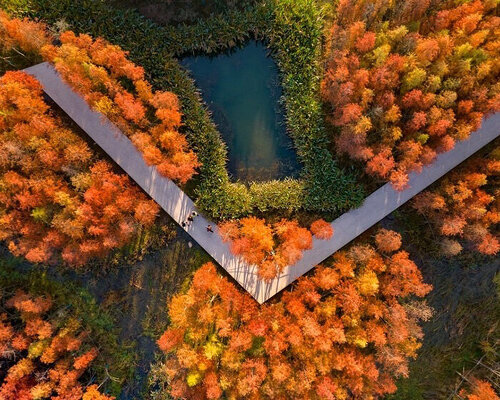
Similar regenerative methods were applied at Yichang Yunhe Park in Hubei province. Finished in 2013, the 12-hectare development converted twelve abandoned fish ponds into a green sponge. This design emphasizes minimal intervention, using the original water bodies to remediate contaminated stormwater. Elevated walkways allow public access without disrupting the ecological functions of the site, demonstrating how damaged industrial landscapes can be reconsidered as vital urban resources.
The Turenscape approach also extends to waterway restoration, as seen in the 2010 Yinzhou Central River Transformation in Ningbo. By softening engineered riverbanks with wetland planting, the project maintains the river's role in city infrastructure while fostering biodiversity. These interventions suggest that ecological urbanism does not require untouched wilderness, but rather a sophisticated reimagining of existing drainage channels and flood-control systems to support wider biological relationships.
The Industry Pulse Bottom Line
Turenscape’s sponge city projects prove that industrial remediation can serve dual purposes: providing critical urban flood management while simultaneously restoring biodiversity through the strategic use of constructed wetlands and recycled landscapes.