
Julia Lohmann Reimagines Material Ethics Through Bio-Sculptural Kelp Installations
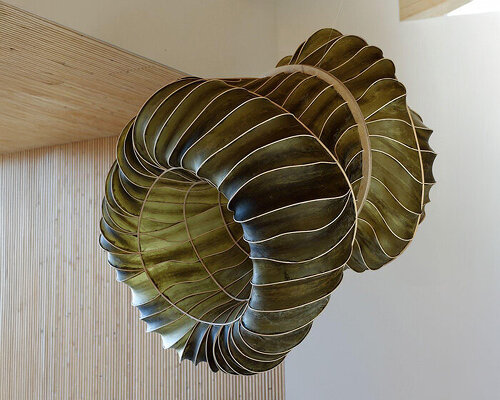
German designer Julia Lohmann is showcasing a series of towering seaweed structures at London’s Design Museum for the 2025 More than Human exhibition. According to Designboom, these installations explore the intersection of marine biology and industrial design, questioning how the rising demand for natural resources affects the living ecosystems from which they are harvested.
Context from Industry Pulse
The exhibition at London’s Design Museum arrives as the design industry increasingly seeks regenerative alternatives to concrete and synthetic polymers. While recent architectural developments, such as Kengo Kuma’s brick bathhouse and concrete galleries in Mexico and Hong Kong, demonstrate a continued reliance on traditional heavy materials, Lohmann’s work signals a shift toward bio-fabricated structures. By utilizing the Department of Seaweed’s research, Lohmann bridges the gap between sculptural art and functional architecture. This movement toward living materials aligns with emerging technologies like 3D printing and spatial computing, which are also being used to rethink how physical objects and structures are conceptualized and manufactured in a post-industrial landscape.
Lohmann’s recent work centers on the Kelp Council installation, which features five large sculptures arranged in a circular formation. As Designboom reports, these translucent pieces utilize ribbed frameworks to mimic the appearance of deep-sea organisms. The project invites human participants to consider the environmental conditions of marine life, moving away from traditional human-centered design perspectives. The designer uses the material’s natural tendencies to dictate the final form of her work, particularly seen in the way kelp contracts and pulls at its supports during the drying process.
This methodology represents a continuation of Lohmann’s long-term research into the origins of common materials. Designboom notes that her 2004 Waltraud Cow-Bench first challenged viewers by returning leather to a bovine shape, highlighting the often-ignored connection between consumer products and their biological sources. This philosophy later shifted toward the ocean during a 2013 residency at the Victoria and Albert Museum, where she established the Department of Seaweed to study the aesthetic and structural potential of kelp through collaborative scientific research.
Her larger-scale experiments include the 2020 Hidaka Ohmu pavilion, a six-meter-wide structure that utilizes seaweed panels to filter light. By placing visitors inside these organic environments, Lohmann emphasizes the physical texture and presence of marine algae as a viable architectural component. Other works, such as the Kombu Ahtola, demonstrate how the inherent unpredictability of drying seaweed can serve as a co-designer in the creative process, shaping the geometry of the rattan frames it covers.
Beyond aesthetics, the work addresses the ecological implications of seaweed cultivation. Designboom explains that while algae is a popular sustainable alternative to synthetic materials, its extraction must account for the complex habitats kelp forests provide for other species. Lohmann’s sculptures serve as a speculative platform for discussing resource management, suggesting that the future of sustainable design depends on preserving the environments that produce these raw materials.
The Industry Pulse Bottom Line
Lohmann’s kelp installations demonstrate that sustainable design must evolve beyond simple material substitution to include ecological stewardship, ensuring that the industrialization of bio-materials does not deplete the marine ecosystems they are meant to protect.