
Biotic Architecture: ecoLogicStudio Integrates Living Organisms into Urban Design
London-based design firm ecoLogicStudio is redefining domestic and urban environments by integrating metabolic biological cycles into functional structures. As reported by Designboom, the studio’s latest work explores how algae and fungi can act as essential infrastructure, transforming homes and cities into living ecosystems that actively capture carbon and generate energy.
Context from Industry Pulse
The work of ecoLogicStudio represents a shift from passive sustainable materials to active biotechnological systems. By utilizing organisms like Spirulina and Chlorella, the studio addresses urban challenges such as CO₂ sequestration and air purification through metabolic integration. Their projects, ranging from the Urban Algae Folly to the CryoflorE model, demonstrate that biological processes can be harnessed for both energy generation and climate regulation. This methodology suggests that future architecture may move away from inert materials toward living biopolymers and mycelium networks, effectively turning buildings into extensions of the human microbiome and broader ecological networks.
"We are now more and more aware that our own nature is cyborgian and collective, and that our own identities extend far beyond the limits of our bodies."
Founded in 2005 by Claudia Pasquero and Marco Poletto, ecoLogicStudio has spent two decades developing a built environment that moves beyond sterile isolation toward biological collaboration. Their recent project, DeepForest³, debuted at the Triennale Design Museum in Milan. Designboom notes that the installation serves as a hypothesis for domestic transformation, utilizing 3D-printed biopolymer shells that host living mycelium networks fed by coffee grounds. The structure integrates the metabolic cycles of algae and fungi to create a tangible biotechnological living system within a museum setting.
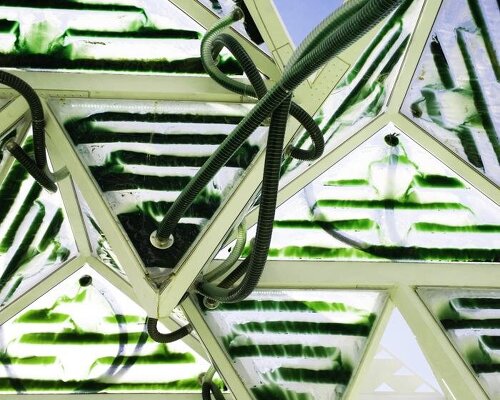
This approach to biotic architecture extends to public installations such as the Urban Algae Folly, which was first showcased at EXPO Milano 2015. The pavilion features triangular panels housing Spirulina, a microalgae that thrives on human-emitted carbon dioxide while providing shade. According to Designboom, the growth of the algae increases on sunny days, creating a symbiotic relationship where the occupants and the organism support each other's cycles. This project exemplifies the studio's philosophy that architecture should work with microbial life to capture carbon rather than excluding nature from the built form.
In Nyon, Switzerland, the studio applied these principles to healthcare through the AirBubble project. Designboom describes this as a circular, semi-transparent garden containing 350 liters of Chlorella algae cultures housed in borosilicate glass bioreactors. The system is capable of filtering 150 liters of polluted air per minute. By combining medicinal plants with air-purifying algae, the project challenges traditional assumptions about healthy spaces, positioning living organisms as vital infrastructure for human well-being.
Scaling these concepts to the urban level, the studio developed CryoflorE in collaboration with the Synthetic Landscape Lab at the University of Innsbruck. Exhibited at MUDAC’s 2025 Solar Biennial, this model simulates a cityscape where cyanobacteria generate electrical currents through photosynthesis. Designboom reports that the system channels these electrons through copper wires embedded in the streetscape. This research represents a move toward bio-solar energy networks, where urban density is powered by the same biological processes that sustain the natural world.
The Industry Pulse Bottom Line
Designers are increasingly moving toward biotic architecture where living organisms serve as active infrastructure. By integrating algae and fungi into structural designs, studios can create self-sustaining environments that purify air and generate renewable energy.