
ASSISTANT Design Studio Completes Monolithic Concrete Memorial at Fukuden-ji Temple
Japanese architecture firm ASSISTANT has unveiled a perpetual care grave at the historic Fukuden-ji Buddhist temple in Odawara. As Designboom reports, the memorial utilizes geometric volumes and local groundwater to create a contemplative threshold between life and death, moving away from traditional grave markers toward a sculptural architectural experience.
Context from Industry Pulse
The memorial at Fukuden-ji reflects a specific intersection of traditional religious philosophy and modern industrial materiality. By utilizing Hanchiku rammed-earth techniques alongside cast concrete, the project by ASSISTANT emphasizes the temporal nature of architecture. This sits within a broader design landscape where permanent structures are increasingly expected to display the passage of time through weathering. Furthermore, the use of site-specific groundwater from Odawara integrates the monument into the local geography, moving the concept of a grave marker from a purely symbolic object to an environmental experience. It highlights a shift toward using geometric abstraction to represent complex spiritual concepts like the Five Elements of Esoteric Buddhism.
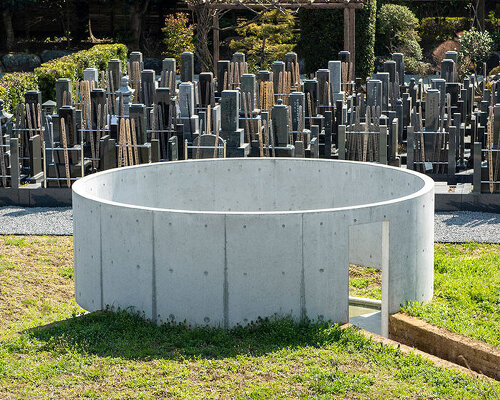
Located on the grounds of a Shingon Buddhist temple established in 1136, the project occupies a 225-square-meter site. According to Designboom, the design team at ASSISTANT utilized elementary geometric forms to evoke the Five Elements of Esoteric Buddhism. The layout features a square plot divided by a diagonal triangle, centered by a massive cylindrical drum made of cast concrete that functions as the primary memorial space.
The structure is characterized by its apparent weightlessness despite the heavy materials used. Designboom notes that the central concrete cylinder is suspended over a shallow reflecting basin. This pool is fed by groundwater sourced from the local Tomizu area of Odawara. The gap between the water surface and the concrete wall creates the illusion that the monument is hovering, establishing a boundary that separates the realm of the living from that of the departed.
Visitors navigate the memorial through a narrow approach path defined by layered rammed-earth walls. This construction method, known as Hanchiku, was selected to highlight the natural weathering of materials over time. As Designboom explains, the contrast between the industrial concrete and the compacted earth is intended to represent the physical process of returning to the terrestrial ground.
The interior of the hollow cylinder remains open to the elements, featuring an oculus that frames the sky. This circular aperture allows light to enter the chamber, casting dynamic shadows across the interior water basin throughout the day. By architecturalizing the Buddhist concept of the threshold, the studio has created a space that prioritizes atmospheric contemplation over conventional funerary signage.
The Industry Pulse Bottom Line
ASSISTANT’s memorial demonstrates how minimalist geometric volumes and raw material weathering can translate ancient religious boundaries into modern architectural thresholds, prioritizing atmospheric experience over traditional commemorative forms.