
Avian Adaptations and Cross-Species Design Signal Posthuman Architecture Shift
A convergence of avian ingenuity and human design is redefining architecture as a shared effort between species. According to Designboom, birds are increasingly integrating anthropogenic waste into their nests, from anti-bird spikes to fiber-optic cables. This phenomenon has prompted architects like Jeanne Gang and MIT researchers to study and facilitate interspecies construction as a model for future building.
Context from Industry Pulse
The evolution of avian construction reflects a broader architectural trend where human-made materials and non-human intelligence intersect. As birds incorporate plastic and military-grade hardware into their habitats, the distinction between natural and synthetic architecture blurs. This shift is not merely a survival tactic but a form of posthuman authorship where birds reorganize the Anthropocene’s waste. Simultaneously, human architects are moving away from finished, static structures toward open frameworks that require animal participation. By treating the nest as a repository of design knowledge, the industry is exploring a model where buildings are no longer finished at the point of construction but are continuously adapted by the species that inhabit them.
Recent observations documented by Designboom highlight how birds are repurposing hostile human architecture. In Antwerp, magpies have been found tearing metal anti-bird spikes from buildings to use as structural reinforcement for their nests. These sharp points, originally designed to exclude birds, are repurposed to defend chicks from predators, mimicking the function of thorny branches. Similarly, Amsterdam coots have utilized layers of plastic waste to build durable nests that last across multiple seasons, contrasting with traditional vegetation that decomposes annually.
Technological debris has also entered the avian building cycle. Designboom reports that birds near the front lines in Ukraine are weaving fiber-optic cables from discarded military drones into their structures. These examples are being studied by historians like Matthew Holmes, who suggests that nest composition serves as a direct snapshot of the Anthropocene. Historical precedents include Dust Bowl-era crows using barbed wire when natural vegetation was scarce, showing a long-standing pattern of birds adapting to industrial landscapes.
Architectural firms are now looking to these feathered builders for design intelligence. In Chicago, Studio Gang is showcasing the Best Nest exhibition, which explores how avian geometry and environmental responses can inform large-scale building designs. The studio is also investigating how to mitigate the hazards posed by glass architecture to migrating birds, positioning them as active participants in the urban architectural exchange.
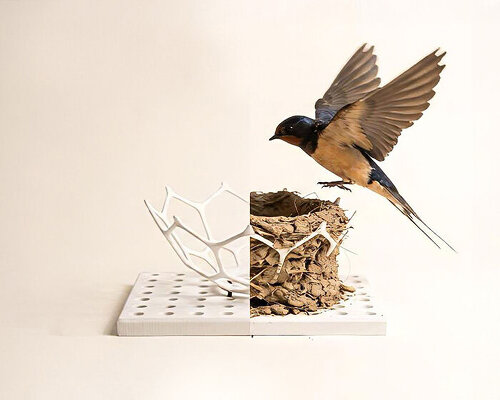
Collaborative construction is being furthered by the MIT-LUMA Lab through its Bird+House project. As reported by Designboom, researchers are using 3D-printing technology to create nesting scaffolds for barn swallows. Rather than providing a finished product, the team prints incomplete structures from biomaterials, allowing the birds to finalize the design with their own materials. This approach shifts the human role from sole author to facilitator, establishing a framework where the final form is determined by the inhabitant.
The Industry Pulse Bottom Line
The transition toward posthuman architecture suggests a future where authorship is shared. By designing incomplete structures for animal completion, architects are moving from rigid urban control toward flexible, multi-species environments that prioritize ecological integration over purely human aesthetics.