
Carsten Höller Integrates Four Monumental Slides Into Mexico City Architecture
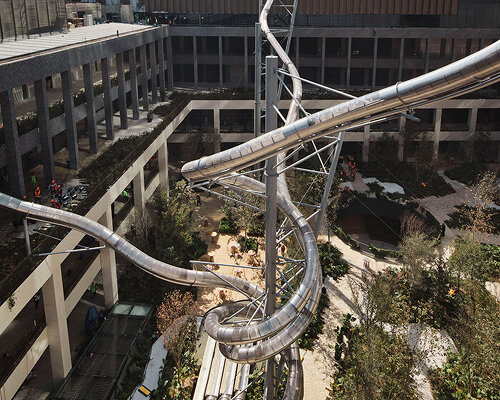
Belgian artist Carsten Höller is set to debut Mexico City Slides in December 2026, a permanent installation at the Antara complex in Colonia Granada. According to Designboom, the project features four stainless steel spiral structures that serve as functional transit between corporate offices, luxury hospitality spaces, and public cultural venues within the Sordo Madaleno-designed development.
Context from Industry Pulse
The Mexico City Slides project highlights a growing trend in mixed-use development where monumental art is used to bridge disparate commercial sectors. By linking high-stakes corporate environments like Google’s offices with luxury hospitality and public gardens, developer SOMA and architecture firm Sordo Madaleno are utilizing Carsten Höller’s work to create a unified identity for the Antara expansion. This installation follows a lineage of similar architectural experiments by Höller at the New Museum and Hayward Gallery, suggesting that large-scale interactive art is increasingly viewed as a viable method for enhancing urban pedestrian flow and public engagement in dense metropolitan hubs like Colonia Granada.
The installation at Arte Abierto Polanco represents a continuation of Carsten Höller’s long-term exploration of slides as architectural interventions. According to Designboom, the four monumental structures vary in scale, with heights ranging from 12 to 38 meters and lengths stretching between 31 and 90 meters. These slides weave through the mixed-use Antara development, physically linking Google’s offices, the upcoming Rosewood Mexico City hotel, and various dining establishments to a centralized cultural venue.
As Designboom reports, the project is commissioned by developer SOMA and its nonprofit foundation, Arte Abierto, in collaboration with the architectural firm Sordo Madaleno. The structures are designed to accommodate four simultaneous riders who descend from different points in the complex to arrive at a shared landing area. This design choice aims to remove social and functional hierarchies by placing corporate employees, hotel guests, and diners in a shared physical state of descent.
Since beginning his work with this medium in 1998, Höller has installed similar pieces at global institutions including the Tate Modern, Vitra Campus, and Moderna Museet. Designboom notes that the Mexico City installation is part of a broader expansion marking the twentieth anniversary of Antara. The site, which was originally an industrial area, now includes 2,500 square meters of public gardens and landscaped terraces intended to enhance pedestrian connectivity.
Access to the slides will be free to the public starting in December 2026. The installation coincides with a wider cultural program at the site, which includes an exhibition by the Danish collective SUPERFLEX. By integrating these playful yet imposing sculptures into the urban fabric, the project challenges traditional perceptions of commercial and workplace environments through a shared sensory experience.
The Industry Pulse Bottom Line
Mexico City Slides demonstrates how developers are leveraging high-profile artistic interventions to soften the boundaries between private enterprise and public space, transforming functional transit into a shared cultural asset.