
Mari Nagem Installation Explores Intersection of Space Colonization and Earth Ecology
Artist Mari Nagem is currently exhibiting The Tropics, The Moon, and Mars at CUE Art in New York. According to Designboom, the multi-media show uses scientific research to contrast the high-tech ambitions of planetary colonization with the fragile state of terrestrial ecosystems, questioning why human innovation often prioritizes artificial survival over existing biological intelligence.
Context from Industry Pulse
The exhibition highlights a paradoxical shift in design and science where advanced computational tools are increasingly used to reconstruct or monitor what was once self-sustaining nature. In Fortaleza, Nagem’s research into shade distribution utilized satellite imagery and AI to ultimately conclude that biological tree canopies remain more efficient than architectural cooling solutions like the traditional Brazilian cobogó. This underscores a recurring theme in contemporary creative work: the use of high-tech media to advocate for the preservation of low-tech, ancient biological systems. By utilizing AI for birdsong reconstruction and sensors for forest monitoring, the artist positions technology not as a replacement for nature, but as a lens to view its accelerating disappearance.
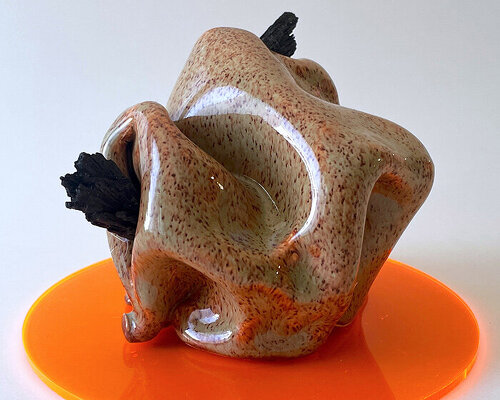
The installation at CUE Art utilizes saturated red lighting to transform the gallery into a speculative extraterrestrial environment. As reported by Designboom, this aesthetic choice bridges the gap between dreams of living on Mars and the harsh realities of environmental degradation on our home planet. Within this space, sculptural motorized branches and ceramic formations serve as physical manifestations of ecological crises, referencing industrial processes such as mineral extraction.
One central work, Flora Futura (The Survival Dance), utilizes motorized stands to animate bare branches. Designboom notes that this piece is rooted in ESECAFLOR, a scientific experiment in the Brazilian Amazon that studies tree responses to extreme drought. By mechanicalizing these plants, the artist explores the threshold between adaptation and death, suggesting that the technology used to observe climate change may eventually be all that remains of the forests themselves.
In addition to sculpture, Nagem incorporates digital data into large-scale public art. Her ground painting titled 41°C, created for COP30, visualizes thermal satellite data from the Tefé River. Designboom details how the 43-meter-long work represents the 2023 Amazonian drought that resulted in massive losses of river dolphin populations. By scaling temperature data to the human body, the artist makes invisible climate shifts tangibly immediate for viewers.
Technological mediation of the natural world extends to the auditory realm in Siren, a collaborative piece that employs artificial intelligence. According to Designboom, this work uses algorithms to reconstruct the songs of extinct South American birds, broadcasting them through ceramic speakers that resemble nests. This synthetic remembrance highlights a growing tension: while technology can simulate the voices of the past, it cannot replace the complex ecological relationships that have been lost to extinction.
The Industry Pulse Bottom Line
Nagem’s work suggests that the future of design lies not in escaping Earth for Mars, but in using advanced technology to better understand and integrate with the existing biological systems that already support human life.