
Arts at CERN Program Bridges Particle Physics and Immersive Creative Design
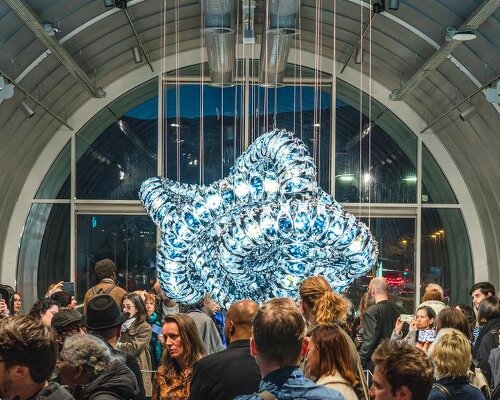
The European Laboratory for Particle Physics is expanding the reach of its scientific research through Arts at CERN. As Designboom reports, the initiative pairs global creators with scientists to translate complex concepts, such as four-dimensional rotation and subatomic data streams, into kinetic sculptures and audiovisual installations that demystify the mechanics of the universe.
Context from Industry Pulse
The Arts at CERN initiative represents a strategic effort to humanize high-level science by converting raw data into sensory experiences. While physics often relies on abstract equations like mass-energy equivalence, these artistic interventions use materials like brass, polymers, and electronics to create physical interfaces for the public. By hosting residencies such as Connect India and Collide Stockholm, the laboratory facilitates a rare exchange where scientific tools are repurposed for creative storytelling. This approach moves the conversation from the theoretical results of particle collisions to the architectural and visual representation of data, allowing for a broader cultural understanding of the technological infrastructures that document the universe.
The intersection of high-energy physics and creative expression is finding new ground at the Geneva-based laboratory responsible for the Large Hadron Collider. Through dedicated artist residencies and commissions, the facility is moving beyond its reputation for pure science to foster works that visualize the invisible. Designboom notes that these collaborations allow artists to work alongside researchers to interpret the data produced by experiments like ATLAS, which tracks particle collisions.
One significant example of this translation is the 2023 sculpture by Julius von Bismarck titled Round About Four Dimensions. This kinetic work uses a series of software-controlled aluminum and stainless steel edges to create a physical tesseract. The installation serves as a three-dimensional projection of a four-dimensional rotation, a concept that is typically impossible for the human mind to visualize. By utilizing expanding and contracting lengths, the piece brings an intangible physical theory into a perceivable, tangible form.
In another collaboration highlighted by Designboom, the artistic group Semiconductor utilized data from the ATLAS detector to create an immersive installation named HALO. This cylindrical work presented a slowed-down representation of proton collision data through light flashes and sound. By mirroring the physical structure of the Large Hadron Collider's components, the piece allowed viewers to inhabit a space that approximated the scale and activity of the laboratory’s most advanced machinery.
CERN continues to support these cross-disciplinary efforts through programs like the Collide Stockholm residency. This award was recently granted to Emilija Škarnulytė, whose work explores the infrastructures that exist between human perception and deep time. These initiatives suggest that the tools of physics can serve as a foundation for cultural exploration, helping to interpret the hidden systems of the natural world through sensory encounters that go beyond the limits of traditional equations.
The Industry Pulse Bottom Line
The integration of creative residencies at CERN proves that immersive design can function as a cognitive bridge, turning abstract subatomic data into tangible installations that make complex scientific theories accessible to a non-technical audience.