
Europe’s Biggest Gas Tank Is Open to US LNG. Nobody Will Insure It
For gas producers from Oklahoma to Louisiana, Ukraine offers a seasonal storage option measured in hundreds of Bcf. Its price depends on who takes on the war risk.
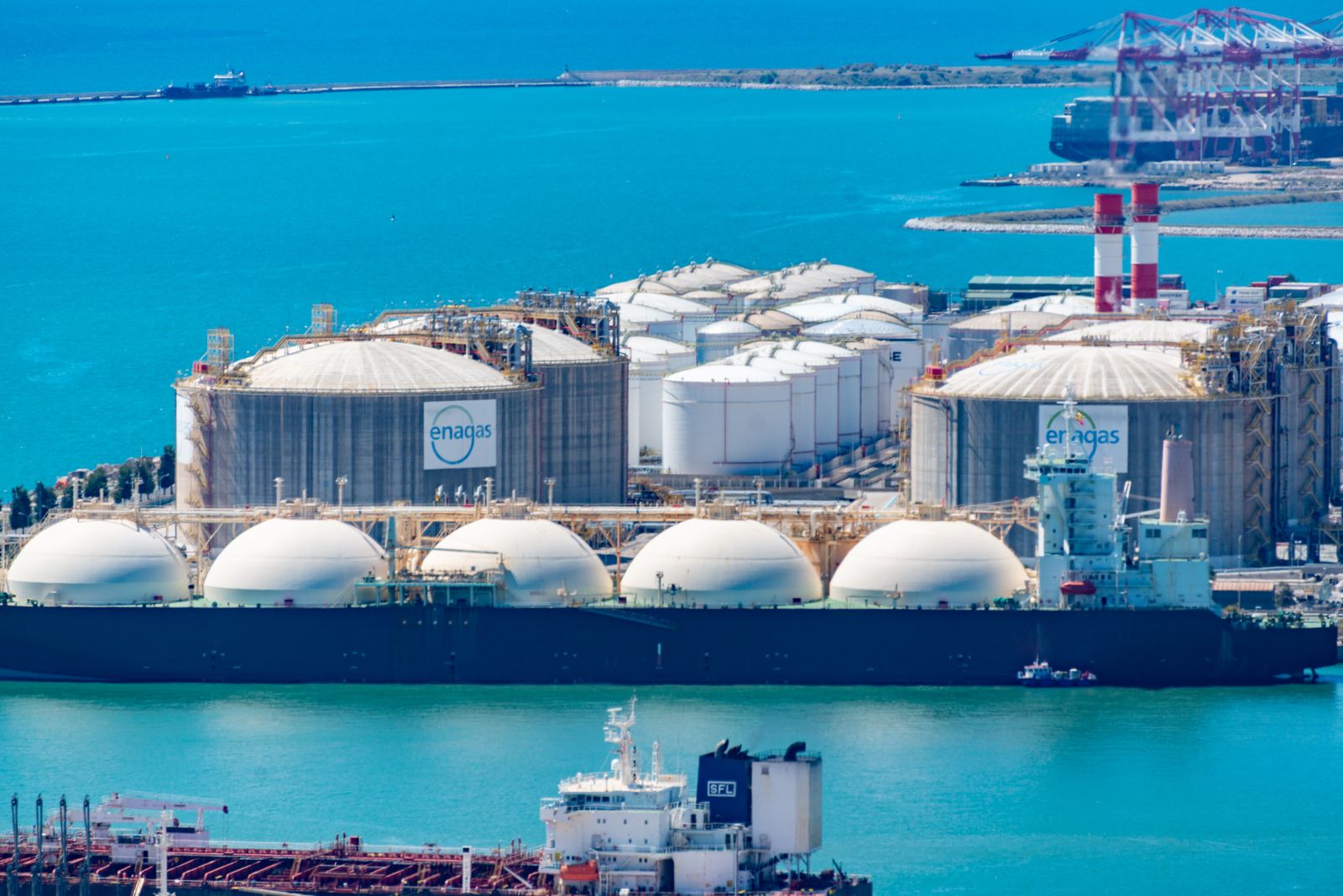
Last fall, the tanker GasLog Houston loaded a cargo of liquefied natural gas at Venture Global’s Plaquemines plant in Louisiana. The buyer was not a European utility but Ukraine’s DTEK. The company bought the gas free on board, chartered the vessel itself, and less than a month later discharged it at Klaipėda in Lithuania. From there, the gas moved by pipeline into Ukraine, home to Europe’s largest gas storage system.
Europe is the main market for American gas, taking more than two-thirds of US LNG exports, and starting in 2027 the EU shuts the door on Russian gas for good. Ukraine is offering that gas a place to be stored, and the channel already works. But there is no publicly known war-risk cover for gas that foreign traders keep in Ukrainian storage. Until that changes, the “Ukrainian hub” remains a promise, not a business.
Europe’s Biggest Gas Tank
Ukraine has about 1.1 Tcf of underground gas storage capacity. That is the largest in Europe and roughly a third more than Germany, the EU leader, with about 830 Bcf. By American standards, it is one and a half times what Michigan holds, the state with the most storage in the US at 688 Bcf, and nearly a quarter of the entire country’s capacity. A single site, Bilche-Volytsko-Uherske in the Lviv region, holds about 600 Bcf, nearly as much as all of Michigan’s storage combined.
This fall, Ukraine’s storage is fuller than in any of the past three years. When withdrawals began on October 29, it held about 564 Bcf, roughly 48 Bcf above the government’s target. About a third of it, 176 Bcf, sits under the customs warehouse regime, meaning it can be stored without customs clearance and shipped back to the EU. How much of it belongs to foreign traders is not publicly disclosed.
Ukraine does not need an LNG terminal of its own for this. It has no regasification on the Black Sea, so US LNG is unloaded in Poland, Germany, Lithuania or Greece and travels the rest of the way by pipeline. Four such routes opened in 2025–2026.
The real ceiling is not storage volume but pipeline capacity at the EU border. Through Poland, for example, Ukraine can bring in 140–175 Bcf a year. And in Europe’s interconnected grid, “American gas in Ukrainian storage” exists mainly on paper, in contracts; physically, what crosses the border is a molecule from the common European stream.
Demand for American gas is nonetheless real, and it comes in two forms. State-owned Naftogaz plans to import up to 35 Bcf of US LNG this year, mostly through Poland’s Orlen, and is building a portfolio of up to 70 Bcf a year. Privately owned DTEK has a direct contract with Venture Global and charters its own tankers out of Louisiana, though on a much smaller scale: two publicly known cargoes of about 3.5 Bcf each.
Who Pays for the Road
For the American exporter, the story mostly ends at the loading dock. Whatever happens to the value after that (freight, regasification, transit, the middleman’s margin) is divided up without it.
The road to Ukraine is expensive. The costliest route is the very one Washington promotes most, the Vertical Corridor: transit from Greek terminals to the Ukrainian border costs about $3.7–4.4 per MMBtu, 21–76% more than northern routes through Poland or Lithuania, according to The Green Tank, a Greek think tank that opposes new LNG infrastructure in the region. In other words, transit across Europe alone costs as much as the gas itself at Henry Hub, before liquefaction and the Atlantic crossing.
Ukraine’s two buyers travel this road differently. Naftogaz buys US gas mostly through Orlen, which holds long-term contracts with American exporters. Neither side discloses what the middleman earns or what Naftogaz pays. The state company’s purchases are largely financed by international partners through loans and grants.
DTEK works differently: it buys gas at Venture Global’s plant free on board, charters the tanker itself and pays with its own money. In early 2026, the company described LNG imports into Ukraine’s gas system as profitable.
For an American exporter, the difference matters. Demand that rests on donor loans cannot underpin the 20-year contract needed to take a final investment decision on a new plant. A private buyer that can make money on imports can, but for now it buys in 3.5 Bcf cargoes.
The Risk No One Insures
The main obstacle to a Ukrainian gas hub is not price or logistics. It is the war. In the first seven months of 2026 alone, Naftogaz recorded 279 attacks on its infrastructure, more than the 229 in all of 2025.
The storage sites themselves are far less vulnerable than they seem. The gas sits in reservoirs deep underground, while pipelines are more exposed, analysts at Brussels-based Bruegel note. What gets hit is the surface: compressors, wellhead equipment, pipes. So the risk for a trader is not that the gas disappears, but that it cannot be withdrawn and returned to the EU in time, when it is needed.
The market has already priced that risk. After strikes on Ukrainian storage sites in spring 2024, foreign traders’ volumes fell to near zero, S&P Global reported. Technically, the system can handle more: an Energy Community stress test found it could inject and withdraw about 175 Bcf of European traders’ gas. The Ukrainian side insists gas can be returned to the EU border even under attack. But a trader needs a policy, not a promise.
Three different things need cover here: the infrastructure itself, gas on its way to and from storage, and the commodity gas that foreign owners keep in the reservoirs. The closest thing to cover appeared only in October 2026, when a war-risk insurance facility run by the EBRD, the EU and Aon, expanded to €150 million, began covering gas-related assets in transit and storage. But it is designed for Ukrainian businesses and sold through local insurers. In June, the US International Development Finance Corporation and the World Bank’s MIGA set up a war-risk insurance framework for the US-Ukraine reconstruction investment fund, which covers investments, not commodity stocks. Neither reaches the third layer: there is no publicly known instrument covering a foreign trader’s gas in Ukrainian storage.
The problem is not new. Back in 2023, Columbia University’s Center on Global Energy Policy wrote that storing third-party gas in Ukraine required public guarantees and suggested that the EBRD and donors in the EU and US take on the war risk. Bruegel urged the EU the same year to give traders explicit insurance. Three years on, neither recommendation has become a working mechanism.
There is one more barrier, this time inside the EU. The regulation phasing out Russian gas requires proof of the country of origin before gas enters the bloc’s customs territory. Traders operating in Ukraine are asking Brussels to exempt gas coming out of Ukrainian storage; otherwise, the new procedure eats into the very flexibility that makes storing gas there worthwhile.
An Option for America’s Gas Industry
While the war continues, Ukraine will remain a small channel for American gas. Naftogaz plans up to 35 Bcf of US LNG this year, DTEK brings in individual cargoes, and 176 Bcf of gas of undisclosed ownership sits under the customs warehouse regime. The scale Washington talks about is possible only after a ceasefire. 2020 offers a benchmark: that year, according to Columbia University, foreign traders kept about 350 Bcf in Ukrainian storage.
Does this matter to the people drilling wells in Oklahoma or Louisiana? Ukraine itself is a rounding error for them: 35 Bcf a year is about 0.6% of US LNG exports. But the problem Ukrainian storage could solve is very real for them.
Oklahoma is a gas state, and it lives and dies by price. In 2024, Henry Hub at times fell below $2.50, while local producers’ average breakeven was $3.49, the Federal Reserve Bank of Kansas City calculated. Conversely, when Europe rushed to buy American gas in 2022, the state’s rig count rose from 50 to 69. For a producer, the worst season is summer, when there is too much gas and too few buyers. Storage that fills up in summer, when gas is cheapest, adds demand exactly when it is needed most.
The industry is already looking for long-term, reliable buyers. Expand Energy, the largest US natural gas producer, headquartered in Oklahoma City, signed a 20-year agreement in April to supply the Delfin LNG project in Louisiana. Tulsa-based Williams, whose pipelines feed Gulf Coast terminals, expects demand for export gas to grow from about 20 to more than 30 Bcf a day by the end of the decade. The bottleneck, the company says, will be pipes, not supply.
Producers are not the only ones who stand to gain. In summer 2020, when the world was awash in gas and European storage was full, US exporters cancelled roughly 100 cargoes in June and July alone. Around the same time, foreign traders moved record volumes into Ukrainian storage. Vitol, Trafigura and Shell stored gas in Ukraine as recently as 2023. But for all of them, the business model depends on one thing: whether they can get their gas out of storage, guaranteed, when they need it.
For this industry, Ukraine is not a market but an option: several hundred Bcf of seasonal capacity on the EU border that can be put to work after a ceasefire. The price of that option is set not by geology but by insurance. US institutions such as the DFC already cover war risk for investments in Ukraine, but there is no publicly known mechanism for commodity gas owned by foreign traders. And if anyone in the United States has a direct commercial interest in pushing for one, it is not the diplomats. It is the people who produce, sell and trade gas.

Editor, Business, Finance & Energy Markets
Stepan Kroka is a senior business journalist and an editor at Industry Pulse covering business, finance, economics and energy markets.