Why Reporting Speed Is Becoming the Decisive Variable in Livestock Production
By Dmytro Rozhko · 2026-07-27
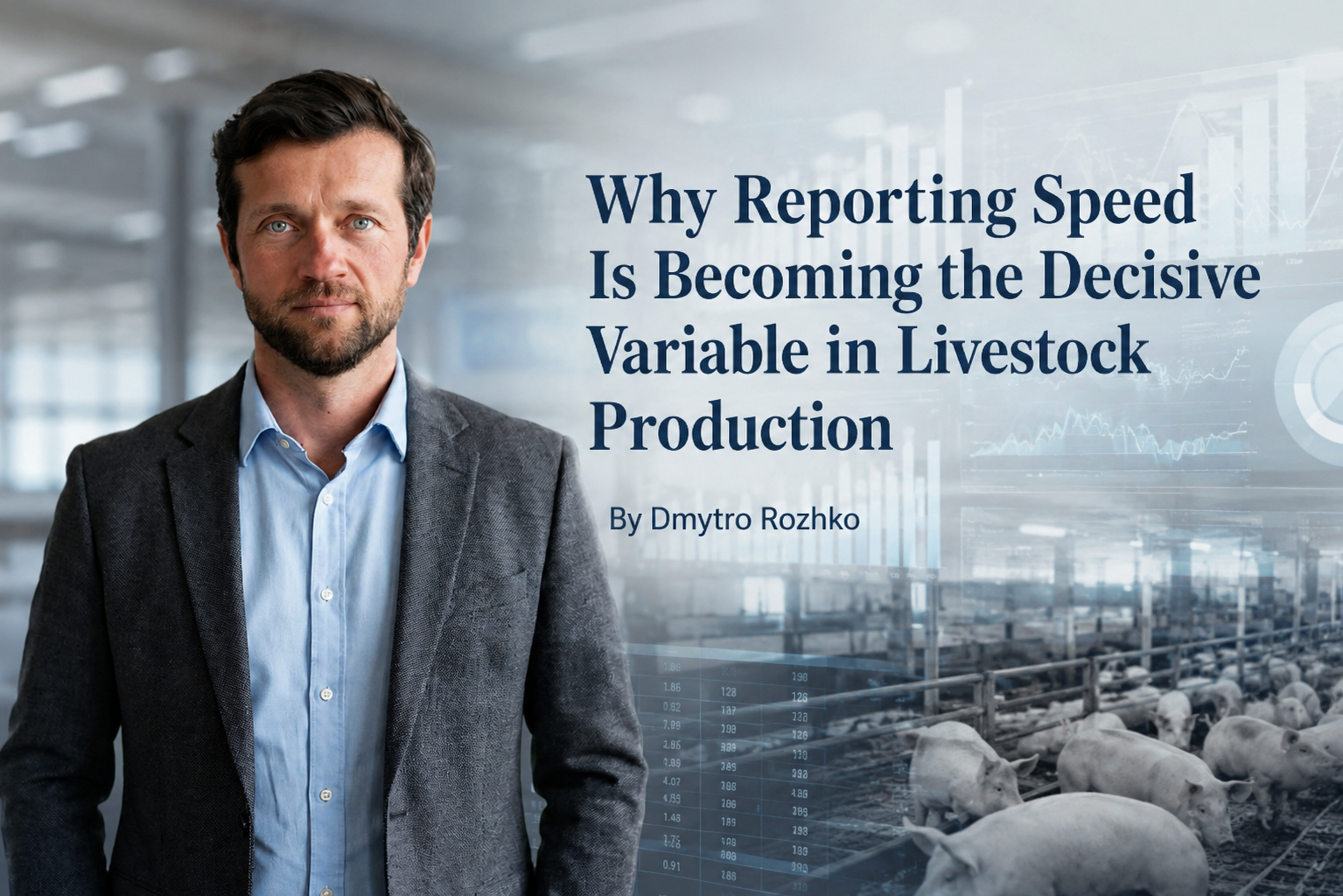
The infrastructure to measure animal protein production has existed for decades and much of it is public. What separates operations is no longer what they record, but how long it takes a recorded number to reach the person who can act on it.
The infrastructure to measure animal protein production has existed for decades and much of it is public. What separates operations is no longer what they record, but how long it takes a recorded number to reach the person who can act on it.
Ask an operations manager at a commercial livestock enterprise what feed conversion is running on a particular barn, and the answer usually exists. It is backed by records, comparable against previous groups, and often better documented than the equivalent figure at a mid-sized manufacturer.
The answer also arrives with a date attached. That date, rather than the number, is the subject worth examining.
The Measurement Infrastructure Is Not Missing
The standard version of the agricultural digitization argument holds that producers do not measure what happens inside their operations. The record does not support it.
PigCHAMP has run a formal benchmarking program since 2001, aggregating production data across hundreds of thousands of animals and publishing annual summaries for the United States and Canada that remain freely available going back two decades. The U.S. Department of Agriculture's Economic Research Service has published annual cost and return accounts for hog enterprises since 1975, at a level of detail most industries never reach: separate accounts for farrow to finish, feeder to finish, farrow to weanling and weanling to feeder operations, updated as recently as May 2026.
An industry that did not measure would not have built that apparatus and maintained it for fifty years. Feed conversion, average daily gain, mortality, cost of gain and capacity utilization are established metrics with established benchmarks, and the operators know their numbers.
The constraint sits elsewhere, and it is rarely named.
The Variable That Appears On No Scorecard
Every production report in this sector records levels. Almost none records data age: how long ago the reported figure was true.
The omission matters for a structural reason rather than a statistical one. No survey is required to see it. If a figure is assembled after the group it describes has been marketed, the interval between the event and the report is the interval in which nothing could be done about it.
An operation that identifies a feed conversion deviation on day three is managing production. An operation that identifies the same deviation on day thirty is documenting an outcome. In most cases both recorded the same underlying data on the same day. Their production numbers may be identical. Their data age is not.
Where The Delay Is Built In
A typical enterprise runs production records in one system, feed and mill data in a second, veterinary and treatment records in a third, and financial accounting in a fourth. Each functions. Each is maintained by competent people. None exchanges data with the others without a person in the middle, working monthly, from delivery tickets and exported reports.
Every reconciliation step adds delay and another point at which a figure can be transcribed incorrectly. The consequence is architectural rather than personal. Cost of gain, the single number indicating whether current animals are earning or losing money, requires all four systems to agree before it can be calculated. It is therefore assembled last.
The metric closest to the decision arrives later than every metric that feeds it.
Why This Now Carries Commercial Weight
The United States produces roughly 11 percent of the world's pork and in 2024 exported more than three million metric tons valued above 8.6 billion dollars, according to figures published by the National Pork Board drawing on USDA Foreign Agricultural Service data.
Commodity pork moves largely on price and cut specification. The contracted end of that trade is different. Where institutional buyers in retail, food service and industrial processing commit to volume months ahead, the commitment is underwritten by consistency, and consistency across a production cycle depends on how quickly deviation is identified and corrected.
An operation that discovers variance at settlement can explain it. An operation that discovers it in week two can prevent it. Only one of those is a supply guarantee.
What Faster Reporting Does Not Fix
Restraint is warranted about the size of the claim.
Reporting speed does not correct a weak genetic package, a poorly designed ventilation system, an unfavorable feed market, or a contract structure that leaves an operator limited control over inputs. It addresses one category of loss: the avoidable portion, caused by conditions already visible in existing records before they became visible in results.
That category is worth managing. It is not the whole margin, and any argument implying otherwise deserves suspicion.
Where The Change Begins
Most improvement programs in this area fail in a recognizable pattern. They begin by adding metrics. Within six months there is a new report nobody opens and additional recording work carried by the people who were already busiest.
Three steps, in sequence, produce more.
Start with metrics already recorded daily. Mortality and daily gain by barn, moved from per-group reporting to weekly, cost nothing to accelerate because the entries already exist. Feed conversion belongs in a second wave, because reporting it weekly by barn requires feed intake measured by barn, which many sites cannot do without additional weighing capacity. That is precisely why it is the metric that arrives last.
Stop one figure from being typed twice. Identify the number that currently requires someone to re-key data from a delivery ticket or invoice into a second system, and replace the manual entry with a scheduled export from the system that already holds it. That removes the delay and the transcription risk at the same point, usually within an existing software licence.
Give three thresholds an owner and a defined response. Not a full list, which nobody has, and not a report circulated to everyone, which reaches nobody. Three: what counts as a deviation, who receives it, and what that person may do without waiting for a scheduled meeting.
What these steps share is that they change reporting cadence before they change anything else. Whether an operation later needs additional measurement capacity is a separate question, better answered once the existing numbers arrive on time.
The operations that will lead animal protein production over the coming decade will not be those with the largest herds or the most sophisticated systems. Well equipped facilities are frequently managed poorly, and the reverse is also true. They will be the operations that shortened the distance between what is happening and what is known, and that learned to ask one question about their own reporting: of the numbers this business is managed by, how old is the freshest one?
---
Dmytro Rozhko is a Ukrainian agribusiness executive with more than 16 years of experience in livestock production, operational management and vertically integrated food businesses. Based in California, he serves as the U.S. representative of the Association of Ukrainian Pig Breeders and is the founder of FeatherOS. He is the Section Editor for Agribusiness and Industrial Operations at Industry Pulse.
Disclosure: The author is the founder of FeatherOS, an early-stage venture developing operational monitoring technology for animal production. FeatherOS is in pilot validation and is not a commercial product. No product, platform or vendor is named or recommended in this article.
Sources
- PigCHAMP Benchmarking program and published annual benchmark summaries, PigCHAMP Inc., Ames, Iowa. - Commodity Costs and Returns, hog enterprise accounts, USDA Economic Research Service, updated May 2026. - Facts and Statistics, National Pork Board, citing USDA Foreign Agricultural Service.