The Megawatt Premium: Why Wall Street is Trading Square Feet for Grid Capacity
Nathan Caldwell · Real Estate · 2026-08-15
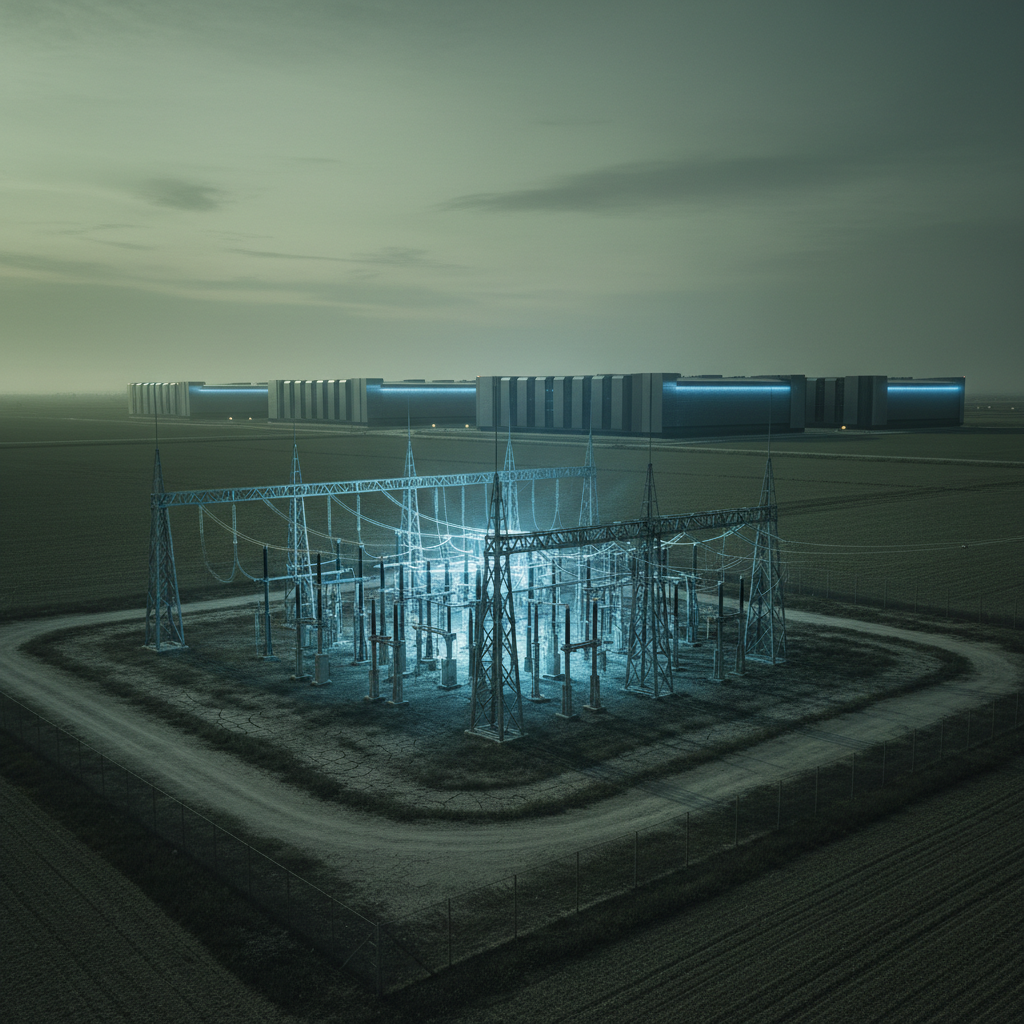
Industrial land valuation has permanently decoupled from logistics. In the AI era, developers are pricing dirt entirely on its proximity to the electrical grid.
In a nondescript stretch of rural Ohio, seventy miles from the nearest interstate interchange and lacking access to commercial rail, a barren 500-acre soybean farm recently traded hands for a price per square foot rivaling prime logistics centers outside Newark. The buyer was not an agricultural conglomerate, nor was it a traditional warehouse developer. It was a holding company explicitly engineered to acquire a single, invisible asset: the right to plug into a high-voltage electrical substation sitting immediately across the county line.
For the past century, commercial real estate valuation has rested on an unshakeable triad of physical proximity: access to consumer density, access to transit infrastructure, and access to labor. The rise of e-commerce reinforced this logic, pushing industrial warehouse development into concentric rings around major population centers, optimizing for the "last mile" of delivery.
But a profound decoupling is underway. The insatiable energy demands of next-generation artificial intelligence infrastructure have fractured the industrial real estate market. We have entered the era of the Megawatt Premium.
The fundamental unit of value for large-scale industrial land is no longer the square foot. It is the megawatt. Land is being priced almost entirely on its "time-to-power"—the duration required to secure a utility interconnection agreement and draw hundreds of megawatts from the regional grid. As tech giants scramble to build the gigawatt-scale data centers necessary to train frontier AI models in 2026, real estate developers have quietly transformed into shadow utility prospectors.
To understand this shift, one must look at the bottleneck throttling the global AI arms race. It is not a shortage of silicon, nor a lack of capital. It is grid capacity. Traditional data centers, which housed enterprise cloud operations, drew between 20 and 50 megawatts. The facilities currently being commissioned by hyperscalers like Microsoft, Amazon, and Google require anywhere from 300 to 1,000 megawatts. To put this in perspective, a single 500-megawatt campus consumes roughly the same amount of electricity as a city of 400,000 homes.
The American electrical grid, fragmented and aging, was never designed to accommodate massive, concentrated point-loads materializing in arbitrary locations. Consequently, the wait times for utility interconnection studies—the bureaucratic process required to ensure a new facility will not destabilize the local grid—have blown out from a few months to, in some regions, half a decade.
This administrative logjam has birthed a lucrative arbitrage in the real estate sector. A new class of developers is ignoring traditional site selection metrics entirely. They are scouring utility maps, identifying substations with excess capacity or planned transmission upgrades, and aggressively acquiring the adjacent acreage.
These developers have no intention of pouring concrete or erecting steel. Their entire business model consists of submitting interconnection requests to regional transmission organizations like PJM Interconnection or ERCOT. Once the utility grants the power allocation, the developer flips the "power-entitled" dirt to a hyperscaler or a specialized data center real estate investment trust (REIT) for an exorbitant markup. The land itself is effectively a mere physical placeholder for a paper contract with the local utility.
The financial mechanics of this arbitrage are staggering. Raw agricultural land in markets like Indiana, Texas, or the Carolinas might appraise at $20,000 an acre. However, if that same acreage successfully secures a 300-megawatt interconnection agreement, its valuation can instantly surge past $500,000 an acre. The dirt is incidental; the buyer is acquiring a fast-pass through the utility queue.
This dynamic is radically distorting the broader industrial real estate market. Traditional logistics developers, seeking to build warehouses for retailers and manufacturers, are suddenly finding themselves priced out of entirely illogical markets. A logistics firm looking for a plot near a minor highway in Virginia or Ohio cannot compete with a data center prospector willing to pay a 2,000 percent premium simply because the site happens to sit atop a fiber trunk and a 345-kilovolt transmission line.
We are witnessing the emergence of "power-zoning," an informal but rigid hierarchy where proximity to energy infrastructure dictates highest and best use. Warehousing and light manufacturing are being physically pushed outward, forced to accept inferior transit access because they cannot justify the land costs in power-rich corridors.
The knock-on effects extend deeply into municipal finance. Local governments, initially eager to welcome data centers for their massive property tax contributions, are beginning to realize the infrastructure strain. A hyper-dense AI data center employs very few people—often fewer than fifty technicians—meaning it generates negligible local economic multiplier effects. It does not revitalize nearby retail, nor does it fill local schools. Worse, by monopolizing the local grid capacity, a single data center campus can effectively embargo the surrounding region from further commercial development. If the substation is maxed out, no new factories, hospitals, or large-scale residential subdivisions can be built until the utility undertakes a decade-long transmission upgrade.
Some municipalities are beginning to push back, attempting to implement energy-density zoning restrictions to preserve grid capacity for job-creating industries. But local zoning boards are vastly outgunned by the balance sheets of tech conglomerates, who frequently bypass local regulators by negotiating directly with state governments and regional utility commissioners, promising broader statewide infrastructure investments in exchange for prioritized power access.
Naturally, the extreme premiums currently being paid for power-entitled land have sparked a speculative frenzy. Much like the fiber-optic trenching boom of the late 1990s, the current rush is attracting capital that poorly understands the underlying technical constraints. Private equity groups are snapping up land near power plants, assuming all proximity equates to access.
This assumption is dangerously flawed. The electrical grid operates on complex physics, governed by thermal limits and voltage stability. Being geographically close to a power plant does not guarantee the ability to draw power from it. If the specific transformers at the local substation lack step-down capacity, or if the transmission lines lack the necessary ampacity rating, the geographical proximity is useless. Millions of dollars are currently being stranded in parcels of land that look perfect on a map but are technically invisible to the grid.
A deeper structural threat to this real estate arbitrage lies on the technological horizon. The hyperscalers are acutely aware that their growth is constrained by public grid bureaucracy. In response, they are aggressively funding behind-the-meter generation solutions. Small modular nuclear reactors (SMRs), advanced geothermal systems, and localized hydrogen fuel cell arrays are receiving billions in venture and corporate capital.
If tech companies can successfully commercialize off-grid generation, they will fundamentally break the current dependency on macro-grid interconnection queues. A Microsoft or an Amazon would no longer need to pay a 2,000 percent markup to a land speculator in Ohio. They could simply buy cheap, remote acreage anywhere in the world, deploy their own modular power generation, and connect via satellite or long-haul fiber. The moment generation becomes truly decoupled from the legacy grid, the Megawatt Premium will collapse, leaving speculators holding vastly overvalued agricultural land.
Yet, that technological escape velocity remains several years, if not a decade, away. Commercializing and deploying SMRs faces immense regulatory and supply chain hurdles. Until then, the hyperscalers remain tethered to the existing grid infrastructure, and the real estate developers who control the access points will continue to extract a heavy toll.
For institutional investors and real estate portfolio managers, the underwriting calculus must be entirely recalibrated. The historical reliance on transit proximity and demographic heat maps is insufficient for predicting industrial land values in the AI era. Assessing a site now requires deep technical diligence into utility infrastructure: understanding regional transmission organization queues, analyzing load-flow studies, and predicting substation upgrade timelines.
The definition of prime real estate is permanently shifting. The old adage of "location, location, location" has not disappeared, but the criteria for a good location have been rewritten. In the sprawling, power-hungry architecture of the modern economy, the most valuable dirt is no longer where the roads meet. It is where the grid allows you to plug in.