The Interconnect Premium: Why Next-Gen Manufacturing Is Squatting in Rust Belt Ruins
Nathan Caldwell · Manufacturing · 2026-08-21
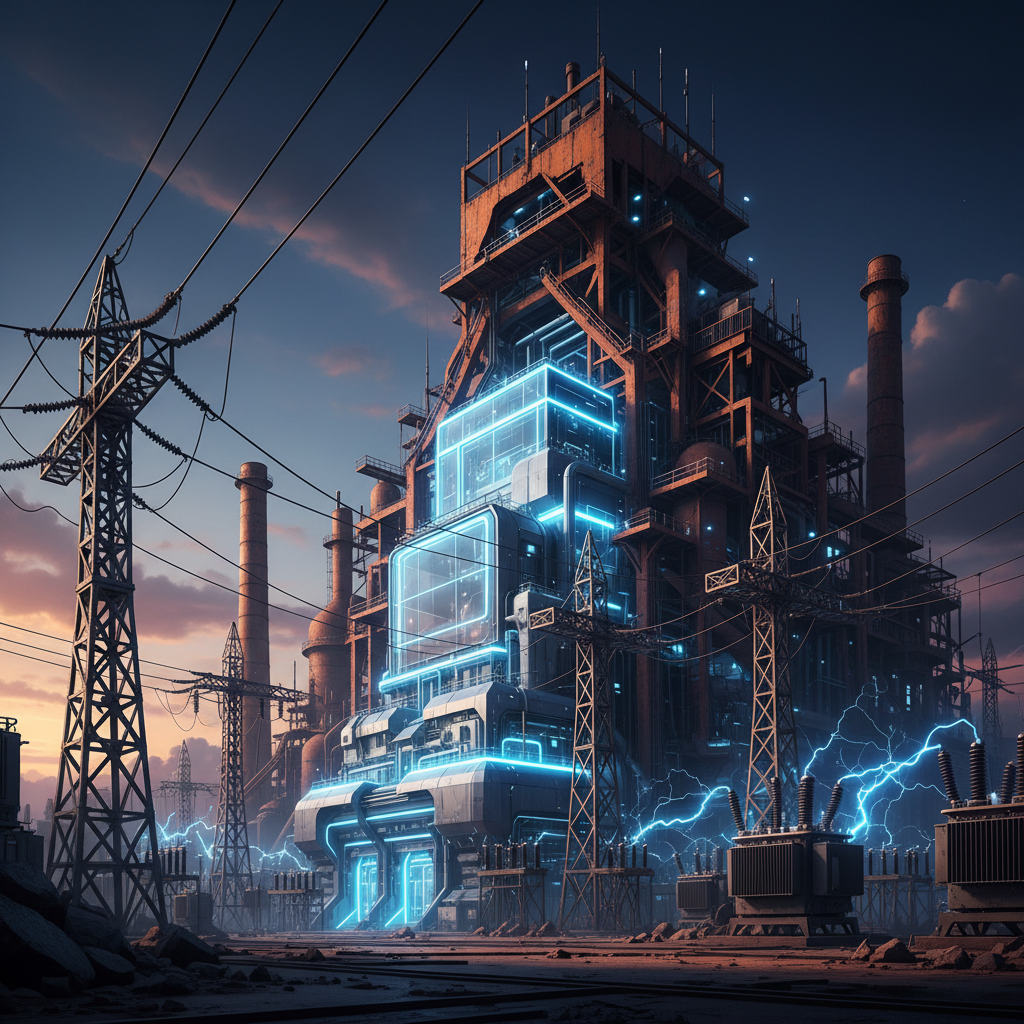
Advanced manufacturers are aggressively acquiring dilapidated 20th-century factories. They aren't looking for logistics or labor—they are buying a backdoor into the electrical grid.
Drive through the industrial corridors of the American Midwest this summer, and you will notice a bizarre architectural phenomenon. Gleaming, hyper-automated gigafactories—producing everything from solid-state batteries to next-generation biologics—are not rising on pristine greenfield sites. Instead, they are being aggressively crammed into the rotting footprints of abandoned 20th-century paper mills, dilapidated steel foundries, and defunct chemical plants.
To the untrained eye, this looks like a triumph of industrial renewal. Politicians routinely cut ribbons at these sites, celebrating the return of American manufacturing to its historic heartlands. But speak to the site selection engineers and private equity sponsors bankrolling these projects, and a very different reality emerges.
These advanced manufacturers have zero interest in the local labor pool, the existing rail spurs, or the civic heritage of the Rust Belt. They are buying these ruins for a single, invisible asset: the legacy grid interconnects.
The most severe bottleneck in American re-industrialization is no longer capital, supply chains, or even skilled engineering talent. It is time. Specifically, the time required to secure high-capacity electrical hookups and industrial wastewater discharge permits for new construction. As manufacturing becomes increasingly power-hungry and water-intensive, the wait time to connect a 100-megawatt facility to the regional transmission grid has stretched from months to, in some jurisdictions, nearly a decade.
Capital cannot sit idle for a decade waiting for a substation to be approved. Consequently, advanced manufacturing has birthed a shadow market. Companies are paying massive premiums for dead heavy-industry sites, simply to inherit their grandfathered utility rights.
The Substation Premium
Consider the baseline requirements of a modern battery cell manufacturing plant or a high-density specialized semiconductor fab. These facilities do not operate like traditional assembly lines; they function more like heavy chemical processing plants crossed with hyperscale data centers. They demand absolute, uninterrupted baseload power, often exceeding 50 to 100 megawatts, alongside massive thermal management systems requiring millions of gallons of water.
If a company buys an empty cornfield in Texas or Ohio, getting zoning approval is trivial. But entering the interconnection queue of the regional transmission organization—whether PJM, ERCOT, or MISO—is a bureaucratic nightmare. The grid operators must conduct exhaustive load studies, often mandating that the manufacturer pay for hundreds of millions of dollars in macro-grid upgrades before drawing a single watt.
However, an abandoned aluminum smelting plant built in 1978 already possesses a 150-megawatt substation. It already has the heavy-duty transmission lines wired directly to the regional grid. Crucially, under the bizarre mechanics of utility regulation in many states, if the site has not officially surrendered its grid capacity rights, a new buyer can often step into those legacy shoes.
By purchasing the brownfield site, demolishing the asbestos-laden structures, and building a modern facility over the old foundation, manufacturers can effectively bypass the interconnection queue. They are buying time, packaged in rusted steel and cracked concrete.
The Regulatory Moat
This strategy extends beyond electricity. Heavy manufacturing requires environmental permits—specifically Title V air permits and National Pollutant Discharge Elimination System (NPDES) water permits. Acquiring these for a virgin site triggers agonizing environmental impact studies, public comment periods, and inevitable litigation from local opposition groups.
Legacy sites, however, often possess permits that are easier to modify than to originate. An old pulp and paper mill that was legally allowed to discharge millions of gallons of thermally altered water into a river provides a regulatory baseline. An advanced chemical manufacturer purchasing that site can simply file for a permit modification, arguing that their new, highly filtered discharge is a net environmental improvement over the paper mill's historical baseline.
Regulators, eager to see toxic brownfields remediated, often fast-track these modifications. The manufacturer gets to operate legally within months instead of years. The environmental damage of the past century effectively subsidizes the speed of today's industrial buildout.
A Hollow Civic Bargain
While this mechanism solves a massive capital deployment problem for industry, it is creating severe friction at the municipal level. The civic leaders who fast-track the zoning for these projects operate on outdated assumptions about what heavy industry means for a local economy.
When the original steel mill operated on the site, it consumed 100 megawatts of power and employed three thousand union workers. The surrounding town thrived on the payroll tax, the local consumption, and the secondary economy of diners, hardware stores, and mechanics that serviced that workforce.
When a next-generation automation firm buys that exact same site and utilizes the exact same 100-megawatt draw, the economic profile is radically different. Modern gigafactories are dark, silent, and heavily automated. A facility occupying two million square feet might employ just three hundred technicians, most of whom commute from affluent suburbs rather than living in the immediate vicinity.
The municipality bears all the infrastructural burden—the heavy truck traffic, the massive industrial water usage, the localized grid strain—without the accompanying massive payroll that traditionally offset those costs. The local tax base captures the property value of the physical building, but it entirely misses the economic value of the output, which flows to shareholders in Silicon Valley or Wall Street.
We are witnessing the decoupling of industrial scale from industrial employment. Municipalities are trading their most valuable infrastructural assets—prime grid capacity and water rights—for facilities that function more like black boxes than civic engines.
The Capacity Squeeze
There is an inherent limit to this strategy. The United States has a finite supply of decommissioned heavy-industry sites with intact high-voltage infrastructure. As private equity and industrial giants aggressively scour the Midwest and the Rust Belt, the prices for these derelict sites are skyrocketing. Commercial real estate brokers are no longer valuing these properties based on acreage or rail access, but purely on their megawatt capacity and wastewater volume limits.
We are already seeing speculative behavior. Real estate investment trusts are quietly purchasing shuttered coal plants and auto foundries, holding them empty, and marketing them strictly as "interconnection-ready" shells. They are hoarding grid capacity, acting as toll collectors on the road to re-industrialization.
Some grid operators are beginning to push back, attempting to implement "use it or lose it" rules that strip dormant factories of their interconnection rights. But these efforts face fierce legal opposition from property owners who argue that capacity rights are a fundamental component of the real estate's value.
The broader implication is clear. The speed limits on the next era of American manufacturing are no longer set by technological innovation or consumer demand. They are dictated by the physical realities of the electrical grid. Until the United States figures out how to build transmission infrastructure at the pace of modern capital, the industrial titans of tomorrow will be forced to squat in the ruins of yesterday.