The Analog Moat: Why Hollywood is Treating Physical Scarcity as a Luxury Asset
Emma Carlisle · Creative Industries · 2026-08-21
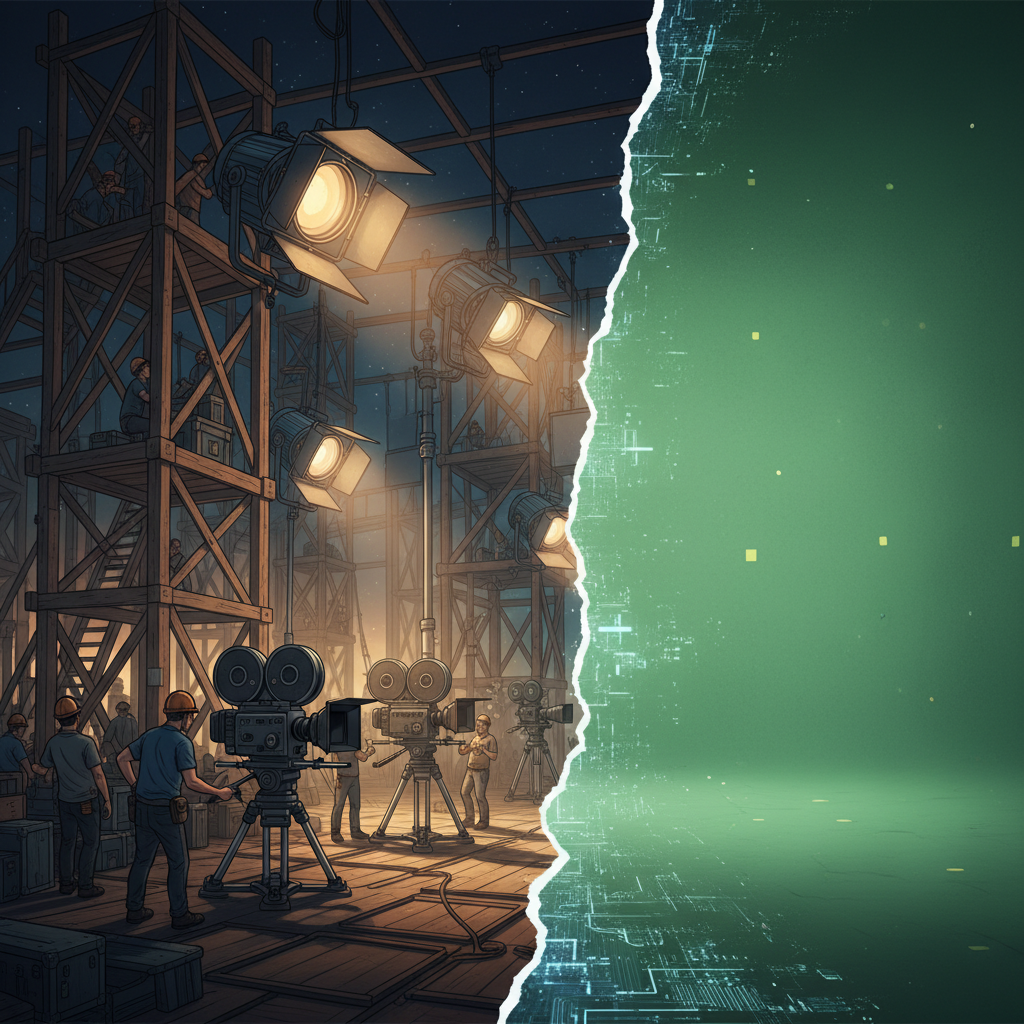
As generative AI pushes the cost of digital imagery to zero, premium studios and luxury brands are weaponizing physical scarcity to justify their pricing power.
Walk onto a major studio lot in Burbank or Pinewood this summer, and the atmosphere feels distinctly industrial. The soundstages are deafening. Carpenters are erecting four-story wooden facades. Pyrotechnicians are wiring thousands of gallons of combustible material. Cinematographers are loading heavy, mechanical 70mm film magazines into cameras that weigh as much as an engine block.
Five years ago, this scene would have been relegated to a handful of eccentric auteur projects. The industry standard was the volume—massive LED screens projecting unreal engines, flanked by rows of green screens waiting for post-production digital artists to fill in the blanks. Today, the physical set is making a violent return.
This resurgence is entirely misunderstood by cultural critics as a wave of analog nostalgia. It is an act of financial self-preservation. As generative artificial intelligence drives the marginal cost of digital imagery toward zero, the entertainment and advertising industries face an existential pricing crisis. If a viewer implicitly understands that a sweeping galactic vista or a meticulously rendered historical battle can be generated via a text prompt in seconds, their willingness to pay a premium for that visual experience collapses.
To maintain their pricing power—whether that is a twenty-dollar theatrical ticket, a major streaming subscription, or the perceived brand equity of a luxury commercial—studios and agencies are weaponizing physical scarcity. They are treating verifiable human effort and practical engineering not as production techniques, but as luxury assets.
The Deflationary Threat
The creative economy is currently experiencing the most severe deflationary shock in its history. Advanced diffusion models and video generation architectures have commoditized the baseline rendering of reality. A mid-tier visual effects house used to charge hundreds of thousands of dollars and require months of labor to simulate realistic water dynamics, crowds, or architectural destruction. Those same visual outputs can now be achieved at a fraction of the cost, often by a single operator.
In any market where the primary product becomes infinitely abundant and virtually free to produce, the premium tier must differentiate itself through artificial scarcity or verifiable difficulty.
Consider the mechanical watch industry in the 1970s. The introduction of quartz movements made accurate timekeeping cheap and ubiquitous. Swiss watchmakers faced complete annihilation until they pivoted. They stopped selling accuracy and started selling craftsmanship, heritage, and the sheer, unnecessary difficulty of assembling hundreds of microscopic gears by hand. The mechanical watch survived by becoming a "proof of work" luxury good.
Hollywood is adopting the exact same mechanism. The physical, practical effect is the cinematic equivalent of a tourbillon. It is deliberately inefficient, highly expensive, and completely resistant to digital automation.
The Economics of Effort
The shift is visible in how films and major advertising campaigns are being marketed. Historically, marketing budgets were spent highlighting the cast, the director, or the narrative premise. Now, a significant portion of the promotional cycle is dedicated to behind-the-scenes footage proving that what the audience is about to see was actually built, crashed, or detonated in real life.
Studios are explicitly marketing the absence of computer-generated imagery. When a recent blockbuster action sequel emphasized that it dropped a real locomotive off a real bridge, the studio was not merely appealing to action purists. They were communicating a financial signal to the consumer: We spent eighty million dollars solving complex physical engineering problems for your entertainment. This product possesses inherent value.
This dynamic extends directly to the balance sheet. Financiers are increasingly willing to underwrite massive physical production budgets because the resulting assets command a durable premium in the distribution market. A film shot entirely on practical sets with real stunts secures wider IMAX distribution, longer theatrical windows, and higher licensing fees precisely because it offers a sensory weight that audiences subconsciously recognize as scarce.
Conversely, the mid-budget, heavily digital feature film is suffering a severe contraction. If a movie relies entirely on digital environments, it competes directly with the infinite scroll of AI-generated content flooding social platforms. The visual language of CGI, once a draw, has become a marker of cheapness.
The Artisan Squeeze
This structural shift is radically reordering the labor market within the creative industries. For the past two decades, the power center of production shifted steadily toward post-production. Digital compositors, 3D modelers, and rendering engineers commanded high day rates and immense leverage.
That leverage has evaporated. As the software absorbs the technical execution of digital art, wages in the mid-tier visual effects sector have stagnated or declined.
Simultaneously, the demand for highly specialized physical artisans has violently outstripped supply. Master carpenters, physical special effects supervisors, stunt coordinators, and practical lighting technicians are experiencing an unprecedented wage boom. The industry spent twenty years discouraging these trades in favor of digital pipelines, resulting in a severe shortage of qualified personnel just as the demand for their services has spiked.
Production companies are now putting prominent physical effects supervisors on retainer, locking them into multi-year contracts simply to deny their services to competitors. The ability to safely execute a complex physical stunt or build a watertight, functioning submarine set has become a critical chokepoint in the modern studio system.
The Luxury Parallel
The advertising sector is reacting with identical logic, particularly at the highest end of the market. Luxury fashion houses, automotive brands, and high-end cosmetics have realized that using AI-generated imagery for their campaigns degrades their brand equity. If a brand’s entire value proposition is based on exclusivity, craftsmanship, and physical quality, projecting that image through synthetic, cost-optimized digital media creates cognitive dissonance for the consumer.
As a result, blue-chip brands are demanding completely analog production pipelines. They are mandating that commercial spots be shot on 35mm or 16mm film, ensuring chemical grain and optical imperfections that signal authenticity. They are flying crews to remote physical locations rather than utilizing LED volume stages.
Advertising agencies are now legally guaranteeing the "synthetic absence" of their deliverables. Production contracts increasingly feature clauses mandating that no generative AI tools be used at any point in the image pipeline, from storyboarding to final color grade. The raw, unmanipulated image has transitioned from a baseline standard to a premium tier offering.
The Future of Proof
The trajectory of the creative economy over the next decade will not be defined by which studio possesses the most advanced rendering algorithms. Those algorithms will eventually become commoditized utilities, available to everyone for a nominal subscription fee.
Instead, value will concentrate entirely in the physical layer. The studios that survive and maintain high profit margins will function less like technology companies and more like heavy construction firms. They will specialize in the logistics of moving hundreds of people to remote locations, the engineering of massive practical structures, and the management of complex physical risks.
Digital abundance forces a return to physical reality. As long as a consumer knows that a computer can dream up a universe for free, the only way to charge them for a ticket is to prove that you built it with your bare hands.